
Before Gas-Analysis Data Enters Plant Software, Give Every Reading a Decision Status
Plant software can display a gas-analysis value long before a team has agreed on what that value is allowed to influence. An apparently ordinary tag may arrive in a historian, dashboard, or maintenance screen with a unit and timestamp but no decision status. Is it a value for routine observation, a prompt to inspect an instrument, an input to an approved control routine, or a record that requires technical review before anyone acts? When that distinction is missing, a clean data connection can create an unclear operational handoff.
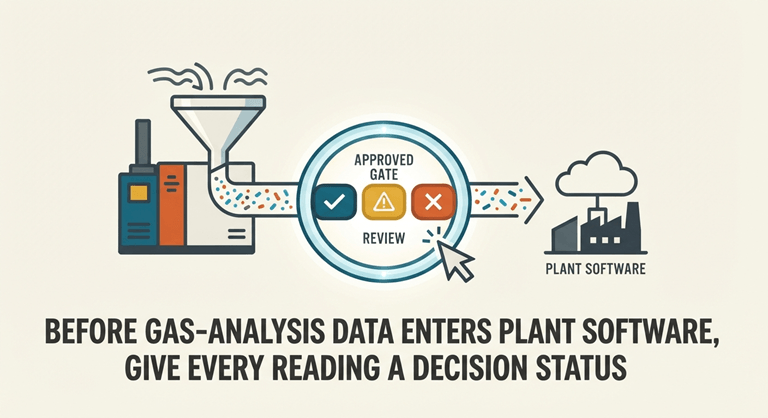
Viewed by a technology team, integration is a technology problem as much as an instrumentation problem. Teams integrating TDLAS gas analyzers, UV-DOAS gas analyzers, or NDIR infrared analyzers need more than a communication path. They need a small, visible agreement about the meaning that travels with the reading. Such an agreement does not have to be a complicated software project. Still, it must be explicit enough that an operator, controls engineer, and environmental specialist do not infer different permissions from the same value.
A tag name is not a decision.
Most integration projects begin with a practical request: make the analyzer data available where people already work. Yet the request can conceal a harder question. In troubleshooting, a value may be useful without being ready to trigger a control action. Within a reporting context, another value may need a different review path from one used by a maintenance team to plan an inspection.
Give each transferred value a decision status before the first mapping sheet is approved. Plain labels work well: observe, investigate, use under an approved procedure, or hold for review. Do not invent a universal vocabulary. Instead, make a default visible so that a software integration does not turn an unlabeled measurement into an implied instruction.
Use an undefined status as a reason to preserve the data without automating a response—no blank status. Doing so prevents an integration deadline from silently deciding an operational boundary. Existing site procedures are the exception: where one governs the duty, it should define the status rather than a dashboard designer.
Keep the process identity attached to the value.
It is very easy to separate the data obtained from the gas analysis from the condition under which it was obtained. After a value enters the plant software, the measurement point, target gas, installation mode, and process question may not be displayed on the receiving screen. Later, when a user looks at a trend, it is not necessary for them to know whether this trend is a combustion discussion, a purity check, a maintenance clue, or another responsibility. TDLAS gas analyzers, UV-DOAS gas analyzers, and NDIR infrared analyzers therefore require that process identity to come with the tag.
Air-emissions monitoring information is organized into groups within an Environmental Protection Agency air-emissions monitoring knowledge base, along with associated methods, quality assurance, reporting, and program material. That broader context: Monitoring information isn’t just a nstream of numbers it’s a software team. Context stays. It’s part of a method, a purpose, and a set of responsibilities: software shouldn’t take them away.
For each gas-analysis tag, keep a short process identityalongsidef the technical mapping. Document where measured, what gas, how installed, the question to be answered by the measurement, and who is responsible for the next review. If a historian, a dashboard, a maintenance tool, and a reporting workflow all share the same tag, then each user who has access is provided with a route back to the measurement duty rather than having one value which evolves multiple unofficial meanings. Those fields can be stored in controls databases and referenced in handover documents, and only exposed in dashboards by their users. It is important to note that this individual has the ability to recreate the context without having to request the members of the original project team to remember it.
Technology context changes the integration conversation.
GESHINE says the TDLAS gas analyzers are in-situ cross-stack and extractive laser-based gas-analysis technology. In the data handoff process, it counts. Assumptions made about the context of a result from one installation arrangement should not imply that they are the same context for a result from another installation arrangement. Software logs must contain sufficient information to return questions to the correct measurement set.
All this serves as a welcome reminder: UV-DOAS gas analyzers can be used to choose a family of technology to perform a specific optical measurement task, but not all reported values will be equal. Use the family name of the analyzer and the purpose of the gas analysis instead of the generic term “analyzer” in the data contract. Integrators can identify a Technology context from a Software field type, in turn.
NDIR infrared analyzers are no exception. The TDLAS gas analyzers, the UV-DOAS gas analyzers, or the NDIR infrared analyzers may give the same concentration figure to the system. Still, the project should keep track of which analyzer and which duty resulted in which concentration. Just don’t add those records to a single generic bucket because their software tags share a similar unit. Before deciding on which valid comparisons can be drawn under the engineering rules, the source identity is preserved.
Build a small data contract before the interface is frozen
When a one-page data contract will suffice, meet the needs of a list of tags, and can be reviewed as a contract between the instrumentation, controls, operations, and data teams, it can be appropriate. Keep it small.
Fields for a gas-analysis data contract
| Field | Question it resolves | Default owner |
| Process identity | Which duty and measurement point does this value describe? | Process or instrumentation engineer |
| Technology context | Which analyzer family and arrangement produced the value? | Instrumentation engineer |
| Decision status | What response, if any, may this value support? | Operations owner |
| Exception route | Who reviews missing, suspect, or out-of-context data? | Named technical reviewer |
The most important row is the Decision status. It translates a general command, like “send it to the system”, into a decision boundary that can be tested on commissioning. Software, generally speaking, should maintain a reading if it can. Still, it should not implicitly advocate for a reading without any accompanying discussion being included in a software’s decision for a reading to be recommended to a reading control or compliance decision. Promotion is part of an allowed procedure and owner.
Route exceptions instead of hiding them
Interfaces don’t always work well technically or operationally. Any connections may recover, invalid fields may be replaced with default values, and dashboards may be updated and continue to display the previous values. This kind of behavior is acceptable only if users are able to determine what has occurred and be able to identify the owner of the review.
Specify an exception route for missing context, communications failure, changed configuration, and any value outside the range of values for which the decision status was determined. The route does not need to be an alarm! Never hide it. Inform the individual who is supposed to carry out the assessment of the limiting factor. An exception that ends up in an incorrect screen stays in an exception with no owner. Only when the exception context of the TDLAS gas analyzer, the UV-DOAS gas analyzer, or the NDIR infrared analyzer is not removed from the instrument can they share an interface.
An independent data layer belongs here. Don’t include all the engineering explanations in a visualization; save the explanations of the process and the history of exceptions for the next reviewer to retrieve. Dashboards can remain compact without compromising data handoffs and remain audit trail-able.
What the contract cannot decide
This data contract cannot perform a validation of any installation, verify a regulated process for a specific use, or substitute for a process-safety review, or authorize a process change. Nor can it resolve disputes on selecting the technology. Those decisions are still made based on onsite-specific engineering, operating procedures, and, if applicable, the applicable compliance framework.
The benefit is narrower and more practical. It makes the boundary between a measured value and a permitted decision visible before the interface becomes routine. Teams that want to compare technology families while building that boundary can consult GESHINE gas-analysis resources and bring the resulting questions back to their own process, software, and operating requirements.
Make integration reviewable before it becomes invisible.
After some time (usually after a few hours) gas-analysis data may be lost and it is hard to remember what the message meant. Successful integrations are subtle and inconspicuous, which means that assumptions are erased. Brief data contracts preserve those assumptions: what is being measured, how it’s produced, what it might inform, who is the exception handler.
Whereas to a technology crowd, that is the true integration result. The transfer of values from an analyzer to another application is not sufficient. Pass enough decision-making authority and measurement context, and let the next person use the information without first figuring out the operating instructions (because they thought it was data).
Popular on OTW Right Now!



About The Author

Gagan Bhangu
Founder of otechworld.com and managing editor. He is a tech geek, web-developer, and blogger. He holds a master's degree in computer applications and making money online since 2015.