
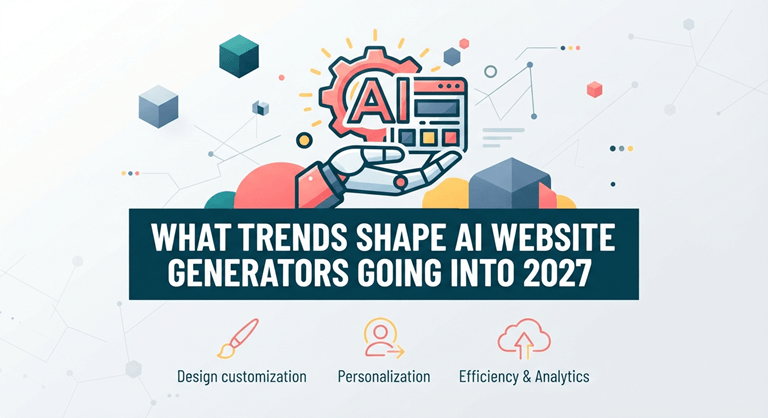
What Trends Shape AI Website Generators Going Into 2027
Website creation used to mean templates, drag-and-drop panels, and a lot of trial and error. In 2026, that’s changing fast with AI website generators.
An AI website generator now handles layout logic, copywriting suggestions, and even brand tone-matching in a single session. Some of it works brilliantly, with minimum human intervention to fix awkward spacing or a tone-deaf headline.
Today, businesses want speed without sacrificing quality, which is forcing rapid iteration across the entire category.
Personalization Is Becoming a Core Feature of AI Website Generators
Static websites are being out-competed. The pages visitors expect will adjust to them, based on their geographical location, past web browsing history, and even the type of device they’re using.
Today, website personalization technology is not an add-on; it’s the way that modern website builders work. The hero copy might differ for a player who has visited the site before compared to one who has never visited it. A cell phone user may receive a “dumbed down” form to scroll through with their thumb.
● Dynamic content blocks that swap based on user segment
● Behavior-triggered CTAs (exit intent, scroll depth, time-on-page)
● Localized pricing or messaging without manual duplication
This isn’t hypothetical. Mid-market tools are catching on to smart website customization, as well as enterprise suites. That’s a good move, and it will affect the ROI discussion with smaller teams.
Conversational Prompts Are Changing How AI Website Generators Create Websites
Type a sentence. Get a homepage. That’s the pitch, and it largely remains the case today.
Conversational website building turns the standard website-creation process on its head. Rather than picking a template and filling in the boxes, you write down what you want your business to be, the vibe you want to set, what you want to accomplish,h and the system starts to create something usable. Not perfect. Usable.
There’s a catch, however. Quality is important when it comes to prompt writing. The vagueness of the input results in the vagueness of the output; that is, the user is still required to have some strategy in mind before they begin typing. The technology removes friction; it does not remove judgment.
Don’t only anticipate this conversational layer to grow to include iterative editing, too, like “make the header bolder,” “shift the tone to more formal.
AI Website Generators Are Producing Smarter Website Designs
Early users of AI builders tended to use generic templates. That’s improving.
Industry context, competitor positioning, and even accessibility standards are now automatically taken into account in AI-based user experience decisions. There are some better automated solutions for spacing, visual hierarchy, and mobile responsiveness that don’t require a designer to validate each breakpoint.
AI-made products are closing the gap to professionally designed ones. It’s not shut down completely, and those who say it is are lying. The path is clear, though.
Continuous Optimization Is Expanding the Role of AI Website Generators
Once a website was a project with a definite end date. Launch it, move on. Not anymore.
What is becoming more common in AI design automation is built-in post-launch capabilities, such as tracking bounce rates, identifying low-performing pages, and pinpointing copy optimization suggestions based on conversion metrics. The generator is no longer considered a tool to be used once and then discarded, but one that will become a partner during the creative process.
This matters strategically. Weeks and months of development on a site mean better long-term return on investment than a site that doesn’t change. While teams can be risk-aware, it’s still best to check for changes before they go live, but it’s definitely asking for trouble if there is no oversight at all.
SEO and Marketing Features Are Becoming More Integrated
Building a page and optimizing it used to be two separate jobs, often two separate tools. That’s consolidating.
An AI site creation platform now frequently bundles:
● Meta title and description generation
● Internal linking suggestions
● Schema markup application
● Basic keyword gap analysis
Marketing functions are being brought directly into the website creation process through AI, reducing handoffs between the design and SEO teams. It’s not a substitute for a proper SEO approach, specifically if the niche you’re targeting is competitive. Consider it a powerful initial draft, not an approved plan.
The Future of AI Website Generators Points Toward Smarter Website Creation
Where does this go then? This is because the future of AI website generators might not just be about creating faster templates, but more about an AI that can evolve and learn a brand’s tone, target audience, and objectives over time.
AI website generation technology is now moving closer to becoming a digital co-founder, as it merges with data analytics, personalization engines, and conversational interfaces. AI web design trends in the coming years will likely focus on faster feedback loops: build, measure, adjust, repeat, without being dependent on a developer every time.
That doesn’t mean that human oversight goes away. These still require people to make brand judgments, ensure legal compliance, and craft the copy in a nuanced manner. But the ‘how do you build a website’ part that has to be done by hand, by hand, by hand? These are in decline and will continue to decrease.
Conclusion
AI website generator trends aren’t just about speed anymore. It’s about relevance and letting the right person get the right message at the right time, with design logic that used to require a lot of people. When considering these tools, keep in mind that flexibility and customizability are important features, and that they can integrate with SEO—but not necessarily be the shiniest demo.
The category is evolving rapidly, and the smart play is to choose a platform that is on the same trajectory as the category, not merely where it’s at in the moment.
Popular on OTW Right Now!


About The Author

Gagan Bhangu
Founder of otechworld.com and managing editor. He is a tech geek, web-developer, and blogger. He holds a master's degree in computer applications and making money online since 2015.