
Why Regulated Industries Still Rely on PC-Based Document Transmission
There is a quiet irony in how the most security-conscious industries tend to be the slowest to abandon older communication methods. Healthcare providers, legal firms, financial institutions, and government agencies continue transmitting sensitive documents through channels that most tech enthusiasts would consider outdated. Understanding why this is the case reveals something more interesting than simple resistance to change.
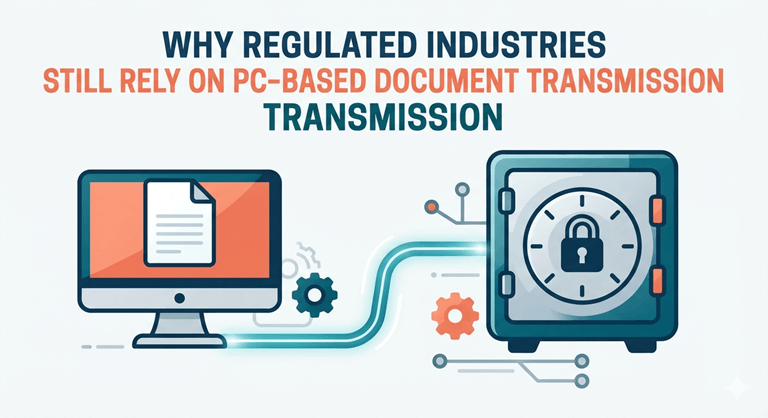
Compliance Shapes Communication Choices
Regulated industries operate under strict frameworks that dictate how data must be transmitted, stored, and accessed. In healthcare, for example, federal privacy regulations require that patient information be handled through channels that guarantee confidentiality, integrity, and auditability. Email, despite its ubiquity, does not inherently meet these standards without added layers of encryption and policy enforcement.
This is one reason why document transmission via structured, access-controlled software persists. The workflow is not about nostalgia; it is about accountability. Every transmission needs a verifiable sender, a confirmed recipient, a timestamp, and an archive trail. These requirements narrow the field of acceptable tools considerably.
The Document Chain of Custody Problem
In legal and financial environments, the chain of custody for a document can determine the outcome of a case or a transaction. A contract sent through an informal channel can be challenged. A disclosure sent without a delivery confirmation creates liability. Organizations in these sectors need tools that produce clear, auditable records by default, not as an afterthought.
Desktop-based transmission software addresses this directly. When a firm uses desktop fax software integrated with an admin portal, access controls, and archiving, they create a system here every document movement is logged and retrievable. This is not just a compliance checkbox; it is a risk management strategy.
Workflow Integration Over Feature Lists
One underappreciated factor is how deeply established communication tools are embedded n existing workflows. A billing department that has structured its processes around inbox and sent folder management for document handling is not going to abandon
that model because a newer tool promises more features. Familiarity reduces error rate nd training costs, both of which matter when dealing with sensitive documents at scale.
The inbox-and-sent-folder model, familiar from email but applied to structured document transmission, gives users a low learning curve while maintaining the compliance infrastructure that regulates industries’ demand. It is a design choice that prioritizes operational continuity over novelty.
Security Architecture Matters More Than Speed
Consumer-facing communication tools are optimized for speed and ease of use. Enterprise document transmission tools, by contrast, are optimized for security architecture. The difference is not just in the encryption layer; it is in how access is granted, how routing is managed, how cover pages are standardized, and how data is retained over time.
Secure transport protocols, two-factor authentication on admin portals, and multi-year encrypted archives are not features that make for exciting marketing. They are features that keep businesses out of legal trouble and keep sensitive data from being exposed. For organizations operating under regulatory scrutiny, that is the actual value proposition.
Why Smaller Organizations Should Pay Attention
Enterprise-grade security was historically accessible only to organizations with large IT budgets. That gap has narrowed significantly. Small and mid-sized firms in regulated industries now have access to the same security architecture that larger competitors use, without the overhead of maintaining physical infrastructure.
This shift matters because smaller organizations are increasingly targeted in data breaches, partly because attackers assume their security posture is weaker. Adopting structured, compliant document transmission is one concrete step that levels the playing field without requiring a dedicated security team to manage it.
A Tool That Ages Well
Technology that survives generational shifts in the broader software landscape usually does so because it solves a problem that does not go away. The need to transmit sensitive documents securely, with full auditability, is not a problem that cloud messaging apps or email threads have solved for regulators. Until they do, industries with
compliance obligations will continue to build their document workflows around tools designed with those obligations in mind.
The longevity of structured document transmission in professional settings is not a failure f imagination. It is a reflection of what the stakes actually are.
Popular on OTW Right Now!



About The Author

Gagan Bhangu
Founder of otechworld.com and managing editor. He is a tech geek, web-developer, and blogger. He holds a master's degree in computer applications and making money online since 2015.