
Why Every Business Needs an Online Queue Management System in 2026
Most businesses still consider customer queues like it’s 2015. A ticket dispenser, a bench, maybe a TV screen playing ads nobody watches. Meanwhile, the customer standing in that line has spent the rest of their week getting real-time delivery tracking, one-tap bank transfers, and flight check-ins from their couch.
It’s not an inconvenience anymore because of the mismatch. In fact, industry studies have demonstrated that after a certain point, customers who have to wait in line to join an industry simply stop bothering and leave without ever complaining. They simply don’t return.
This gap quietly widens every year. 2026 is the point where it stops being something businesses can ignore. But with the evolving technology, the solution is also easily accessible. Let’s discover how a queue management solution, is becoming a must-have asset for modern businesses of 2026 and beyond.
The Real Cost of Waiting in Your Business
A queue is not a customer service inconvenience anymore; it is a line item eating into your revenue and your team’s energy every single day without ever appearing on a spreadsheet.
The Walkouts Nobody Reports
Most businesses track complaints, not silence. Customers who leave without a word are the hardest loss to measure, and usually the largest one, because frustration rarely gets voiced before it gets acted on.
The Toll on Your Front Line Staff
Staff managing an unmanaged crowd are not doing their best work; they are doing damage control. Burnout, short tempers, and slower service all trace back to the same root cause: no structure to the wait.
When One Bad Line Becomes a Public Review
A single bad experience at a counter travels far faster today than it used to. One frustrated customer with a phone and a Google review can shape how the next fifty people perceive your brand before they even walk in.
What Actually Changed Between 2020 and 2026
The waiting room didn’t shorten itself; it was the customers who changed forever, and the majority of businesses continued to operate the same manual systems that they did 10 years ago.
Apps like delivery services have introduced the customer to live tracking. They were prepared for mobile check-in by the airlines. Customers are used to getting instant, mobile banking. That’s why it is easy to see the difference in service when they come into a bank branch where they see a paper ticket system.
Government expectations are catching up with the private sector, with government bodies throughout the UAE, Saudi Arabia, and India also being highly focused on digital citizen services. Those businesses that have been unable to modernize their queue experience are now becoming visibly lagging behind, rather than being inefficient within their businesses.
What an Online Queue Management System Actually Does
This is NOT a ticket machine with a screen on it. A system coordinates the whole customer experience from people making a decision to visit you to when they leave satisfied.
Beyond the Take a Number Machine
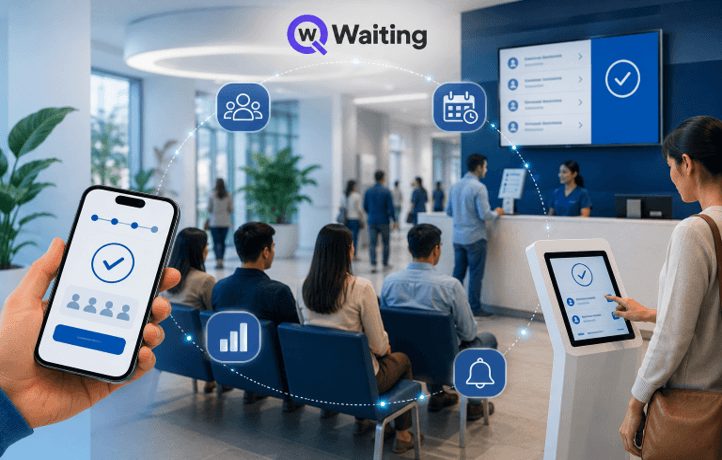
New platforms also handlepre-arrivall booking, virtual queuing (via mobile or via QR code), and real-time routing of customers to the appropriate counter or specialist, so customers never have to stand in the wrong line waiting for the wrong person.
Self-Service That Actually Reduces Pressure
Kiosks and WhatsApp-based check-ins allow your customers to sign up in seconds, allowing your staff to concentrate on service instead of crowd control, and without the customers feeling there’s been a loss of the human touch.
Data That Tells You What Actually Happened
Each check-in, wait time, and service time turns into a data point. Centralized analytics at locations – now you have a view of patterns rather than a guess as to why one branch is better than another.
If you want a real sense of what this looks like inside a live operation, see how a mid size hospital network reduced patient wait times using a virtual queue rollout across multiple departments.
Where This Matters Most Right Now
Every industry has a queue problem, but three make the case louder than the rest.
Healthcare
Patient flow not only impacts satisfaction scores but also impacts clinical outcomes. If everyone shows up on time to the appointment and waiting rooms are not overcrowded, employees can give attention to the care, rather than to a family that is angry because they are waiting in an overcrowded waiting room.
Banking and Financial Services
Whether it’s walk-ins, appointments, or VIPs, branches have to handle it all and provide routing that doesn’t lag behind or slow anyone down. Compliance around identity verification and service logging is also well supported with a well-run queue.
Retail and Government Services
In high foot traffic areas, the business could be up or down based on staff allocation. With a system that will tell you exactly when your peak hours occur, and what counters are underutilised, staffing is no longer an educated guess; it’s a decision that’s based on real numbers.
Proof This Is Already Happening at Scale
This is NOT a lab-tested theory, but a theory that is being lived. It is NOT a theory being tested in a lab in some place, but a theory lived. Already, service flows are being orchestrated across multiple service flows and across the networks of tens of thousands of businesses, in more than a hundred countries, every day, on queue orchestration platforms.
It is not the big brands that are moving the fastest – it’s the othat who began years ago to view waiting as an operational issue and resolved it accordingly – and that’s the ones whose retention statistics are cominto a light of their own.
The ROI Conversation Your Finance Team Actually Wants
Every operations leader eventually has to justify this to someone holding the budget, so here is the honest version of that conversation.
Staff Hours You Get Back
With self-service handling check-in and basic routing, your team won’t be spending time shuffling paperwork, but will have more time to devote to the interactions that require a human hand anyway. The change in that one thing alters the headcount planning for busy seasons.
Reporting: You Stop Doing Manually
Manual end-of-day reports are usually incomplete and take hours to complete. That’s all replaced by automated dashboards, and they update in real time instead of the next morning.
A Cost Reduction, Not Just a Nice Experience
This is the reframe that is approved by the budget. Fewer walkouts, fewer complaints to escalate, and fewer wasted employee hours are all readily apparent on the operating expense line – fewer waits are a customer experience improvement.
What to Actually Look For Before You Choose One
It isn’t always a permanent solution that is being built onto the platform; it is important to identify what differentiates the real solution from a quick fix.
Seek omnichannel support, not just for the kiosk device, but also for mobile, Web, and messaging. Be sure that the infrastructure iscloud-basedd and provides multi-location visibility, rather than branch-by-branch guesswork. Seek out a platform that can be scaled up from one place to enterprise deployment without having to be rebuilt. In regulated industries, search for biometric and secure check-in solutions that comply without slowing down the customer.
The workflows of Qwaiting have been developed based on this checklist and are used in over 35+ countries with over 3,500 clients, both in a single clinic and across a national banking network.
The Cost of Waiting Another Year
Keep in mind the customer who walked out without saying a word. She is not the only one; she is a pattern, a pattern that is repeated in businesses that haven’t made the transition.
2026 is not demanding businesses to call forth various futures. It’s asking them to cease taking the problem that they have a solution for. The companies that have been on the move will reap the rewards over the coming years. The ones that wait will be spending it to fill the gap.
See what a modern queue experience looks like for your business. Book a live demo with Qwaiting and walk through how it fits your specific locations, industry, and scale.
Popular on OTW Right Now!




About The Author

Gagan Bhangu
Founder of otechworld.com and managing editor. He is a tech geek, web-developer, and blogger. He holds a master's degree in computer applications and making money online since 2015.