
Best Practices for Secure Enterprise Data Operations Today
Mainframes continue to support some of the world’s most important business operations, from banking and insurance to healthcare, government, retail, and logistics. Even as cloud platforms and modern applications grow, mainframe systems remain trusted because they can process large volumes of data with speed, reliability, and stability. For teams learning how to manage these environments safely, resources such as Geekmainframe.com can help build stronger awareness of mainframe concepts, operations, and security needs. Today, secure mainframe data operations are not just a technical priority; they are a business responsibility.
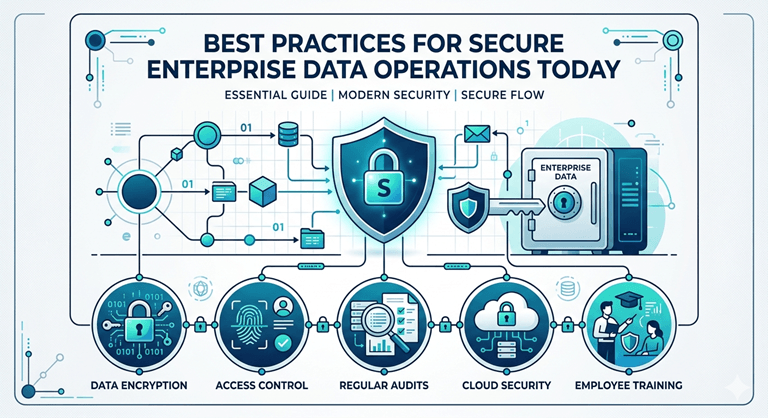
Understand the Value of Mainframe Data
The first step in protecting mainframe data is to understand its value. Customer records, financial transactions, employee data, business reports, and compliance data are some of the sensitive data stored on mainframe computers. There are potentially serious risks when there is a mistake in access control, data transfer, or monitoring.
The mainframe data should be assigned to different classifications according to sensitivity. Not every piece of data needs the same degree of protection; however, any information that is vital to the organization should be the most protected data. Data classification enables teams to determine who can access data, where it is stored, and the controls that need to be applied before it is passed from one system to another.
Strengthen Access Control Policies
One of the most crucial components of mainframe security is access control. Access to sensitive information must be restricted to authorized users only for viewing, modification, copying, and deletion. Businesses should adhere to the principle of least privilege (PoLP), which stipulates that users are granted access only to what they need to do their job.
Access reviews should also be done regularly. Staff turnover, team changes, and project closures can create gaps in access controls. Old permissions can become a security risk if they are still in effect. Security teams should monitor user accounts; they should reduce unnecessary access and deactivate inactive user accounts as soon as possible.
Multi-factor authentication should also be implemented, if possible. However, in today’s day and age, passwords are not sufficient, especially if the attacker is exploiting phishing and stolen credentials to target enterprise systems.
Monitor Data Activity Continuously
A huge amount of activity goes on in the mainframe environment every day. Suspicious behavior could go undetected if not monitored on an ongoing basis. User logins, access to files, changes to data, denied access, and unusual transaction patterns should be monitored.
Monitoring tools can be used to identify potential misuse, including someone accessing records outside normal working hours or downloading a significant amount of information. But monitoring shouldn’t be just about technology. The security team also needs to check alerts, monitor for unusual activity, and establish a clear response plan.
Effective monitoring can allow for more timely responses and minimize damage if there is an incident.
Encrypt Sensitive Data
Encryption secures data and prevents unauthorized users from accessing the data. All sensitive information should be encrypted when it is stored and when it is being moved. Data at rest is data that is stored in data stores such as databases, files, backups, or storage systems. Data in Transit: Information moving between systems, applications, users, or networks.
This is particularly crucial when mainframe data is shared with the cloud, APIs, third-party applications, or distributed systems. Future Processing’s approach to technology cost discipline in cloud environments often builds the same visibility that strengthens security controls, since tracking spend naturally surfaces every data flow and connection point. In today’s modern world, data is frequently going beyond the mainframe. With good encryption, once data is captured, it will be hard to access.
Care should also be taken in managing encryption keys. Even the best encryption plan can be undermined if there are issues with key management.
Keep Systems Updated and Properly Configured
Security is not just about tools; it’s about discipline. Ensure all mainframe systems, applications, utilities, and security software are up to date with approved patches. If you are not updating at the right time, your weaknesses may be exposed, and you may be susceptible to attackers.
Configuration management is just as crucial. Inactive services, default settings, inadequate permissions, and old scripts can all pose unseen dangers. Teams should maintain consistent configuration standards and regularly compare live systems with approved baselines.
Organizations should test updates in controlled environments before making changes and consider implementing a self-hosted password manager to manage credentials and strengthen access security. This helps mitigate the risk of downtime and ensure system security.
Protect Data During Transfers
In today’s day and age, data transfers are a normal event in any business transaction. Data on the mainframe can be exported to reporting systems and/or cloud-based systems, to partners, to analytics systems, or to internal applications. Each transfer can be a potential point of exposure.
It is always important to use secure transfer protocols. Sensitive data should not be transmitted to team members via unsecured methods (unsecured drives, unsecured data transfer, etc.) without controls. Before and after transfer, the data should be validated to confirm its accuracy and completeness.
It’s also a good idea to keep records of all significant data transfers. This facilitates auditing, troubleshooting, and compliance reporting.
Train Teams on Security Awareness
Secure data operations play an important role for people. Despite robust systems, data can still be exposed due to human error. Staff should be aware of the requirements for handling sensitive information, should be able to identify phishing attempts,s and understand password requirements and what should be reported if something is suspicious.
Training should not be limited to a single time. Security best practices, compliance requirements, threats, and threats on the Mainframe continue to change. Regular training helps Technical and Non-Technical teams remain alert and responsible.
The security culture fosters employee questioning, timely reporting of errors, and embedding data security into their daily routines.
Build a Clear Incident Response Plan
No organization can be complacent that security incidents will never occur. Having a clear incident response plan will help teams respond promptly if suspicious activity, unauthorized access, ess or data loss occurs.
The plan should include information about who needs to be notified, how systems need to be isolated, how evidence needs to be preserved, and how business operations can continue safely. Teams should also run through response drills in case of a real event.
Quick and efficient response actions can minimize financial, legal,c customer, merchant, and operational impact.
Conclusion
To ensure the security of mainframe data operations, a combination of access control, monitoring, encryption, system security updates, secure data transfer, employee training,ning and incident plan preparation should be used to strike a balance. Mainframes are still powerful and reliable, and are also a high priority for security. Organizations can ensure that their mainframe environments remain secure, compliant, and adaptable to today’s business demands by implementing best practices and recognizing the importance of data protection as a continuous endeavor.
Popular on OTW Right Now!




About The Author

Gagan Bhangu
Founder of otechworld.com and managing editor. He is a tech geek, web-developer, and blogger. He holds a master's degree in computer applications and making money online since 2015.