
When the Numbers Add Up but the System Doesn’t
Public institutions are held to a higher standard of financial accountability than private businesses. They answer auditors, elected officials, and the communities they serve. Yet any finance directors and administrators share a frustrating reality: their numbers lance, their reports get filed on time, audits come back clean — and something still feels broken.
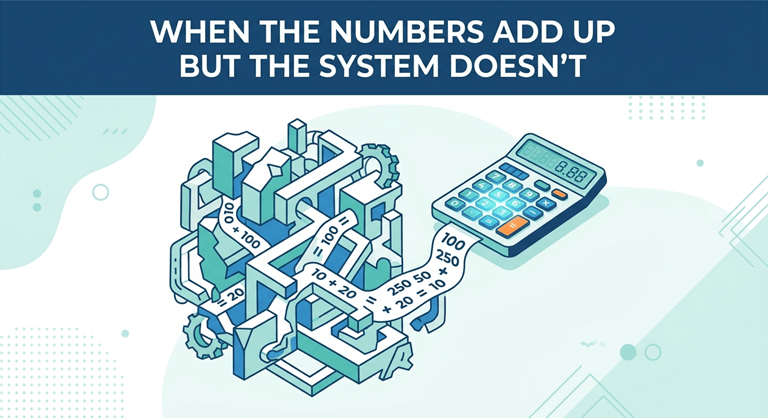
This is the paradox of operational dysfunction that looks perfectly functional on paper.
The Illusion of Financial Order
A balanced ledger does not equal an efficient process. Numerous public-sector finance teams have a ton of time allocated to reconciling data from siloed spreadsheets, double-keying data across systems, and monitoring approvals across the entire process. The outcome is right, but the road to obtain it is precarious.
If the operations rely on someone knowing where the data is located or are manually-driven, that has not been audited in 10 years, then an organization is 1 staff member’s department away from serious disruption. This type of fragility does not usually come to light in the audit processes. It is seen in burnouts, delayed reporting, and procurement delays; employees spend half the day doing repetitive tasks that could be automated.
Process Debt Compounds Quietly
A principle well known to software developers is that “technical debt” is something that is created when more things are done now than you would want done later. This is the same for financial institutions. Process debt includes automated processes that weren’t done, reports that were rebuilt from scratch because of a lack of integration, and so on.
The trouble escalates as it goes along. People are already doing so many things, and they have no time to solve their miseries, so they deal with them in the meantime. It has become a standard procedure to work out the workarounds. New staff members are trained on the workarounds. Sometime after that, no one seems to recall the rationale for doing things in a specific fashion.
This is particularly prevalent in government finance, where budget cycles, compliance needs,s and regular changes in government personnel put an ongoing strain on the system without the necessary resources always being available to modernise.
Why Technology Alone Won’t Fix It
Many organizations believe that the problems with their processes will be solved with the purchase of the latest software. It won’t. When you create a new system, on top of broken workflows, it will yield broken outcomes — but faster.
The first step to successful modernization is to draw out your existing workflows, rather than your “idealized” workflows. They recognize areas of data clog-up, bottlenecks, and the tendency to errors. Only after they’ve done this will they consider which tools are relevant to these areas.
This is why purpose-built tools matter. Accounting software for governments is designed with und accounting, compliance reporting, and multi-entity workflows built in — not bolted on afterward. That specificity matters because general-purpose tools force government teams to create workarounds for requirements that specialized systems handle natively.
The Accountability Gap Nobody Talks About
Another (less talked about) effect of inefficiency in public finance is its stealth anti-accountability role. If data aren’t stored in one location and must be compiled manually before reporting, there is no one source of data. There are more opportunities to miss discrepancies, and decisions are made on information that is outdated.
Not all risks are bad or a scandal. It’s more typically something that’s just a little bit off, a longer payroll report, a missed vendor payment in the approval process, and so on. None of these is attractive singly. In combination, they erode the foundation of good governance – how things work.
Operational Honesty Is the Starting Point
The most difficult part of making any financial operation better is realizing that what is currently successful isn’t as successful as it could be. A team that has conducted clean audits for a year may still be going through unwise and unsustainable practices.
It’s not a complete overhaul, but it will take care of that gap. It will take honest evaluation, the narrowing of improvements to only what is truly needed, and the willingness to change out workarounds for systems that can grow. In the case of public institutions, it is more than an upgrade of their operation; it is a requirement.
Popular on OTW Right Now!




About The Author

Gagan Bhangu
Founder of otechworld.com and managing editor. He is a tech geek, web-developer, and blogger. He holds a master's degree in computer applications and making money online since 2015.