
The AI Job Search Arms Race: Why Mass Applying Is Backfiring on Candidates
The job market has entered a strange and troubling phase. Job seekers, armed with increasingly sophisticated artificial intelligence tools, are now applying to hundreds or even thousands of positions in a single week. Recruiters, drowning under an avalanche of applications, have responded by deploying their own AI Job Search Platform to filter candidates out just as quickly. What has emerged is what industry experts call an AI arms race, a cycle where both sides deploy automation against each other, and the biggest casualty is the human connection that should define hiring. In this environment, the very strategies candidates believe give them an advantage are often the ones sabotaging their chances.
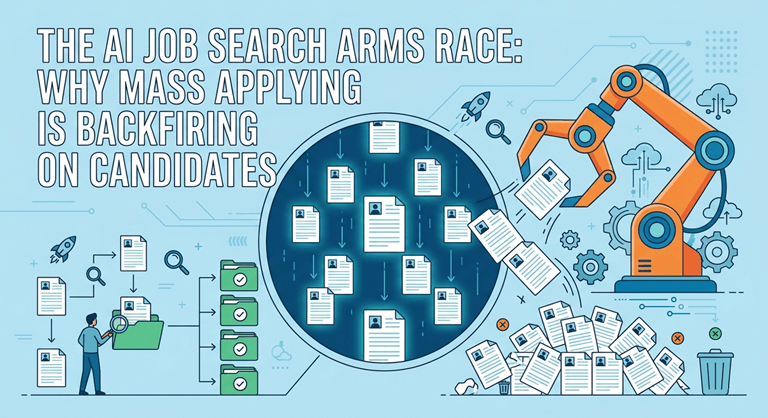
The scale of this problem is staggering. LinkedIn now processes more than eleven thousand job applications every single minute, a surge of nearly forty-five percent in just one year. Some candidates use AI agents that can find and complete applications autonomously, with one software engineer reportedly applying for five thousand jobs in a single week using such tools . But the success rate tells a different story, that candidate secured just twenty interviews, a hit rate of only 0.4 percent. Recruiters now speak of a tsunami of sameness in applications, where resumes look eerily similar, and genuine talent becomes nearly impossible to distinguish from polished but hollow AI-generated content.
The consequences of this arms race are far-reaching and damaging for everyone involved. Candidates are losing faith in the hiring process, with nearly half of job seekers saying their trust has decreased over the past year. Recruiters are spending up to half their week simply filtering spam and junk applications rather than actually evaluating talent . Even more troubling, research suggests that when job seekers use AI to generate applications, they are actually less likely to be hired. The automation that promised to streamline hiring has instead created a doom loop where AI-generated applications are met with AI-powered rejections, leaving both sides frustrated and the hiring process more broken than ever.
Understanding the AI Arms Race in Modern Hiring
The job market has entered an unprecedented phase where technology is being deployed on both sides of the hiring equation. Job seekers armed with generative AI tools are submitting applications at scale, while employers are using increasingly sophisticated AI systems to filter through the resulting deluge. Industry experts have dubbed this dynamic the AI standoff, where candidates and employers are both battling to maximize efficiency in what has become a race to the bottom. The promise that artificial intelligence would streamline hiring and connect the right people with the right opportunities has instead created a system where both sides are losing.
This arms race is huge. Over the past 12 months, LinkedIn has received over 11,000 job applications each minute. More than 400 percent as many candidates are applying to dozens of jobs in minutes thanks to AI, and that’s led to a surge in recruiter application volumes, according to a leading hiring platform, Greenhouse, which analyzed data from thousands of businesses to find that. It used to be a manageable stream of applications, but now it’s become an avalanche, and it’s drowning the hiring teams and qualified candidates.
The increasing automation has led to an AI doom loop, as per experts. Candidates mass apply for jobs using AI, employers filter through the dizzying amount of applications, and good signals are missed on both sides. Recruiters will now take anywhere from 30 seconds to two minutes to scan a resume,e and half of their time is used to weed out spam and junk resumes and applications to find the talent. Where one technology used to promise efficiency in hiring, it has instead created a frenzy of hiring and has left job seekers and hiring professionals exhausted and frustrated.
How Mass Applying with AI Is Hurting Your Chances
The rationale for mass application seems to be logical at first. The more jobs you apply for, the more opportunities you’ll have for interviews, so applying to hundreds or thousands of jobs using AI should have a significant impact. The facts tell a far different story, however. According to the findings of research conducted by SAP subsidiary SmartRecruiters, serial job seekers who apply for 10 or more jobs a day are twice as likely as typical job seekers to not make it to the interview phase. The quality of applications is not being maintained in this pure quantity-based approach, especially as it leads to poor quality applications.
These figures aren’t very bright for candidates who use volume strategies. In one week, one software engineer used AI automation tools to apply for 5,000 jobs and only got 20 interviews, which is 0.4% success! Likewise, one recently fired talent acquisition expert sent out more than seven hundred applications through LinkedIn’s “Easy Apply,” and very little feedback was ever received, which he termed as “one whiff in the wind. The stories are not exceptional and just one-off failures, but rather represent a general trend with mass application strategies failing to produce results.
The core issue is that it’s very easy for recruiters to detect when someone is not putting in their best effort. If candidates spend little time reflecting on fit for a job or adapting their application to the role, they can end up doing more than getting less out of it. 67% of hiring managers say they can detect if a candidate has generated their resume or cover letter using AI, primarily because of the generic language and overly slick formatting. If there is a market for you as an employer, and you’re dealing with hundreds or thousands of other applicants, AI mass applying won’t help your application get noticed.
The Real Impact of Automation on Job Applications
The impact of broad AI automation is not just about the application resresultst’s about the impact. The whole hiring process is transforming, and it’s not a good thing for either candidates or employers. Frequently, the extremely fast uptake of generative AI tools by job seekers to simplify the process of applying for jobs is a major driver of this trend, with the average number of applications per open position in the early-career segment rising by 100% since 2021. Although some of that is attributable to the macro-economic environment, the trend tracks right alongside the rapid adoption of generative AI tools by candidates to streamline their application process, with the average number of applications per early-career job opening doubling since 2021. This increase has slowed down their recruitment activities to a trickle,e as 70% of hiring managers say that less than half of the applications they receive are suitable for a job opportunity.
The quality issue is also worrisome. More than a third (34%) of people looking for work are applying for more than 20 jobs each week, and a lot of people are not customizing their applications and don’t even read the job descriptions closely. Therefore, this mass outreach leads to candidates not being aware of particulars in the job postings and a higher rate of job applications missing key experience or skills. We have a new wave of sameness in the job application process, as resumes are eerily alike and real talent is hard to tell from a mass of AI-generated, but well-presented, resumes.
What’s most disappointing is the trust that has been lost because of automation. Employers and candidates are less than pleased with the hiring process for the first time in Greenhouse’s fourteen-year history, according to the research. Almost half of those looking for work are feeling less confident in the hiring process in the past 12 months, with forty-two percent saying they believe AI is to blame. Sixty-two percent of entry-level workers say they lost trust in the hiring system, especially among Gen Z workers, who are the most affected by this trust crisis. The thought of automating hiring to make it transparent and efficient has instead led to a situation where neither side feels that they’re being treated fairly.
Why Recruiters Are Struggling with the Application Surge
The application backlog continues to grow for recruiters, and it’s getting worse! Greenhouse also discovered that the volume of applications submitted to recruiters has grown by over 400% from the prior year. This inflow leads to recruiters with 15-20 jobs on the table spending 3-5 hours daily going through the stacks of applications. It’s an enormous amount that impacts the hiring process by forcing recruiters to take 30 seconds to two minutes to consider each resume. This results in very little time for substantive assessment of candidates’ quality.
Many applications are not really qualified, further complicating the matter. According to LinkedIn data, only 70% of the applications hiring managers receive have all the qualifications required for a position. The reality is that usually, of the hundreds of applications that people receive, only 2 to 5 will be suitable for the role. According to talent acquisition experts, only 2 to 5 of the hundreds of applications will be appropriate for the position. This mismatch is sucking up the time of recruiters that would otherwise be better spent on candidates that will make them a good fit, but you’re finding yourself exhausted and frustrated while the truly qualified are left to the wayside.
Technological “solutions” to help are the culprit, and making things worse. As per Gartner studies, AI has yet to provide tangible gains in recruiter productivity. Instead, organisations have integrated AI tools without re-designing processes,s which means they are increasing process steps, not reducing them. Even though job descriptions are still being copied manually between HR systems and generative AI platforms, it is still a clunky and inefficient process. The end outcome is a chaotic situation in which recruiters are drowning and being told that they need to only turn to AI, and that’s more work for them.
The Hidden Dangers of Using AI for Mass Submissions
While the obvious problems with mass AI submissions are apparent, there are a number of hidden dangers that candidates may not be aware of. If applicants apply the same AI tools to create their resumes and cover letters, they begin to write content that is strikingly similar and is easily identified by recruiters. Thirty-four percent of recruiters spend up to half of their week sifting through spam and junk applications, with 65 percent of hiring managers having spotted applicants using AI tools to deceive them. There is a high and growing likelihood of spotting someone as a ‘spam applicant,’ and/or it is likely that their application will be rejected by the algorithm automatically, without them even knowing.
Damage to a company’s reputation can go beyond individual applications. Employers are beginning to suspect that AI-generated applications instead of them being efficient as they are. When it comes to spotting deception, over 90% of recruiters have reported it and worry about fake credentials, deepfakes, and fake experience growing. Three-quarters of hiring managers cite fraudulent applications as a concern they have had for more than a year. Over-dependence on AI could lead to a reputation of being untrustworthy, which can affect their performance in other applications.
Perhaps the most insidious danger is the skills gap that mass AI use creates. Candidates who depend on AI to writing cover letter their applications never develop the critical thinking and self-reflection skills necessary to present their experience persuasively. These candidates tend to become really weak when it comes to describing their accomplishments in an authentic way when they get to the interview phase, because they’ve not actually gotten engaged in the process of articulating their accomplishments. It’s the AI that feels like a quick fix, but is a crutch that hinders real-world professional development and leaves candidates ill-prepared for the real-world conversation.
Strategies to Use AI Wisely Without Overwhelming Recruiters
The main factor of successful application of AI is to consider it as a strategic asset, not a shortcut for hard work. Job seekers should change their mindset from quantity to quality; fewer and more relevant applications. This involves questioning a role for a fit, such as location, work hours, salary, and whether the job is a long-term fit. Candidates who choose to concentrate on jobs that require 90-95% of the qualifications are more likely to succeed than those who try to submit hundreds of applications using AI.
AI is not limited to content creation; it can serve as a research and refinement tool as well. AI can be leveraged by job seekers to learn more about companies and their problems, and to see how they could help solve those issues. It is best to start with your own achievements on your resume and then use the AI to refine and polish your language. Recruiters can’t tell the difference between a great resume and a clear one, and they will unequivocally reject a perfect resume from an AI over a perfect resume that’s actually written by a human.
AI really excels as a valuable resource when it comes to interview preparation. Candidates can even use Artificial Intelligence to create practice questions according to job descriptions and also conduct live mock interviews via voice mode. Such preparation enables candidates to be more natural and confident without going over the top in terms of dishonesty. But the line that should not be crossed is when using AI in real-time interviews. The purpose of an interview is to be clear, honest, and connect with the reader, not read from an AI-made script. Candidates can strategically leverage AI for preparation, without being part of the problem, while maintaining the human voice as a central part of the communication process.
Building a Smarter Job Search Approach for Better Results
The very first step in a smart job search is to realize that good is always better than bad. AI isn’t a panacea for applying to candidates; candidates should work on developing real relationships and showing real interest. Experts are growingly convinced that this is the future of recruitment—referrals, and that an application created by AI will be outperformed by a thoughtful, well-formulated resume at all times. This will take more time and effort, but the results are much better. The one candidate who did well moved away from mass applications and made a point of communicating with recruiters and establishing a personal brand.
In an automated world, networking and human connection are growing in significance more and more. In a highly foggy job market, real people connections are even more important. It takes time and effort to build trust and demonstrate to your potential employers that you are not an interchangeable commodity. The building of trust and letting the potential employers know that you are not an interchangeable commodity takes time and effort, but it makes a difference that can’t be achieved by mass applications. Employers and recruiters are interested in your thought process and what you’ve actually accomplished. With its proper utilization, AI can demonstrate that more clearly. When misused, it hinders and weakens the characteristics of the quality you are hoping to portray as a desirable candidate.
The future of job search is a combination of AI tools for researching, preparing, and structuring the content, with a focus on retaining the human voice and judgment. A halt to the AI arms race doesn’t imply the rejection of AI in recruiting, but rather a more conscious and strategic incorporation of the tool. While AI can help job seekers identify the right positions, optimize their resumes, and simulate interviews, don’t leave the final creative thought and self-reflection for a compelling application to chance. Instead of relying on volume, candidates can work through the automated hiring process without adding to the issue they are solving; instead, they can rely on the value and authenticity as the differentiator.
Popular on OTW Right Now!


About The Author

Gagan Bhangu
Founder of otechworld.com and managing editor. He is a tech geek, web-developer, and blogger. He holds a master's degree in computer applications and making money online since 2015.