
Why Gaming Platforms Need Faster Checkout for Microtransactions
The common assumption is that players abandon a purchase because the item costs too much. The data points elsewhere. On a $4 in-game purchase, price is rarely the obstacle. The obstacle is the checkout itself, the extra taps, the re-entered card number, and the redirect that breaks the moment a player wants to spend. Gaming platforms lose most of their microtransaction revenue at the payment screen, after the player has already decided to buy. The faster that screen resolves, the more of those small impulses turn into completed sales.
The Distinct Rules of Small Payments
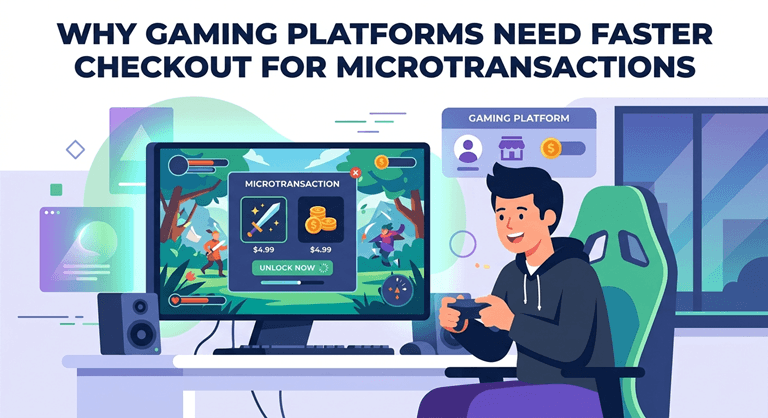
Unlike a miniaturized retail purchase, a microtransaction is not considered to be a retail transaction. The sums are negligible (one dollar to twenty), and the decision is quick, during the game, when you’re about the game,n ot your wallet. This is the value in the speed; this is the risk, at once. If someone wants to get a skin or a battle pass, they will be willing to spend the money if it’s just a one-tap purchase. The player is told to remove himself from the game, pick up a card, type in a billing address to cancel the purchase, and then go back to play. The effect is compounded when there is more volume. The base of a platform that processes millions of dollars in charges depends on the conversion rate and per-transaction cost – a percentage point in either direction is a big deal of money. The insignificant purchase from the player is the whole business model for the operator. The payment step is the point of sale design that is focused on, as all the time loops are configured to encourage the next small purchase.
Built for the Microtransaction Moment
Capturing that impulse needs payment plumbing built for it. A platform that runs high volumes of small charges needs igaming payment processing that authorizes in milliseconds, stores credentials securely for one-tap repeat buys, and keeps per-transaction fees low enough that a $2 sale still makes sense.
A small-ticket economy reverses the priorities. The processing layer has to be as large and fast as the purchase layer it serves because, if it gets a little bit bigger, the player has to stop.
The Mobile-First Reality
This expenditure occurs with most of it on a mobile device, typically using one thumb, seconds after a game is finished. Mobile gets most of the microtransaction revenues, but is also the area where most checkouts fail. Extra fields are more difficult because they’re not displayed on a screen; students can drop the session when they’re redirected to a browser or an app store, and abandonment is higher on the phone than on desktop. The winners on the platforms store the card after the first purchase, verify it with a face or fingerprint, and retain the full amount of the trading within the game. Each time a player is pushed out of the app, there’s a chance for the sale to die.
The Free-to-Play Engine
The whole model depends on payment speed. Free-to-play games drop the entry price to zero and earn everything after install, from optional purchases made by players already inside the game. The barrier to entering is eliminated; the only barrier remaining is at checkout. In-app purchases generated some $81 billion in 2024, an amount nearly equal to $24 billion by the US, and accounting for the bulk of online gaming revenue generated with this model. If a title leaks at the checkout stage when it’s sold, it can go to the top of download charts and fail to generate any sales.
In-app purchases and other microtransactions make up close to 76% of online gaming revenue, and the average annual spend per player rose to about $147 in 2024. The numbers only exist because it’s easy to buy them. Increase friction, and the spend decreases – the momentum of a $3 purchase is not going to last for 90 seconds waiting for checkout.
Friction at the Point of Purchase
There is a cost associated with friction that can be measured. The general average rate of cart abandonment for online retailers is around 70,% and for mobile retailers, it’s higher than 85%. There are consistent reasons. If the checkout is too lengthy, the customer must sign up while they’re still in the checkout, or if the card field in the checkout does not accept a valid card, then the customer is pushed away. Gaming inherits these too, and adds a few more, because the player is pulled away during gameplay, and each minute that it takes the player to leave the game increases the chance that it will never end.
It’s worse if the false declines occur. If a player’s payment is blocked by the fraud filter, he’s unlikely to try again. They assume that the card is broken and proceed to the next one. A 3% false-decline rate — typical on poorly-tuned systems — takes a significant chunk of revenue out of the bottom of a business volume operation. A processor that’s optimized for gaming provides a tight fraud screen without hampering the actual buyer in the middle of the impulse.
Loot Boxes and the Impulse Window
There are TONS of purchases that can be made for the highest profit within the narrowest buying window. Loot boxes and gacha pulls, which are random rewards that can be purchased with real money or premium currency, are a source of many billions, with the urge to open that one last loot box or pull being instant. That sense of urgency is tenuous. If they don’t pay or it takes too long, that juicy moment when they were feeling that impulse to buy is lost. The same goes for battle passes, ranging from $10 to $1,5 and with cosmetic drops that are given for a limited time. Both require a payment that is made within the seconds that the player allows it to be made. The platforms that capitalise on these moments the best are the ones where the checkout button is engulfed within the tap. These mechanics have come under the microscope of regulators in multiple countries, which adds another layer of compliance that a processor is expected to be able to manage without impacting the buy.
Closing the Gap Between Tap and Purchase
The money drains out as soon as it’s not in your hands and not in your pocket. A small-and-frequent-buyer checkout recovery platform will make up for the sales it’s not capturing. The next time it is their turn, the player who tapped first is the player who will “tap again”. The cashier is a part of the game when it comes to a business based on millions of little acquisitions, and the operators who construct it in that manner make a complementary download a paying habit.
Popular on OTW Right Now!


About The Author

Gagan Bhangu
Founder of otechworld.com and managing editor. He is a tech geek, web-developer, and blogger. He holds a master's degree in computer applications and making money online since 2015.