
PBN Hosting Explained: The Quiet Decision That Makes or Breaks a Private Blog Network
A practical guide to how PBN hosting works, why it matters more than the links themselves, and what to look for
Ask most people what makes a private blog network succeed or fail, and they’ll point to the links, the content, or the anchor text. Those things matter. But there’s a quieter decision that sits underneath all of them and routinely decides the outcome before a single link is placed: where the network is hosted. PBN hosting is the part of the strategy that gets the least attention and causes the most failures — and understanding it is the difference between a network that compounds value for years and one that disappears from the index overnight.
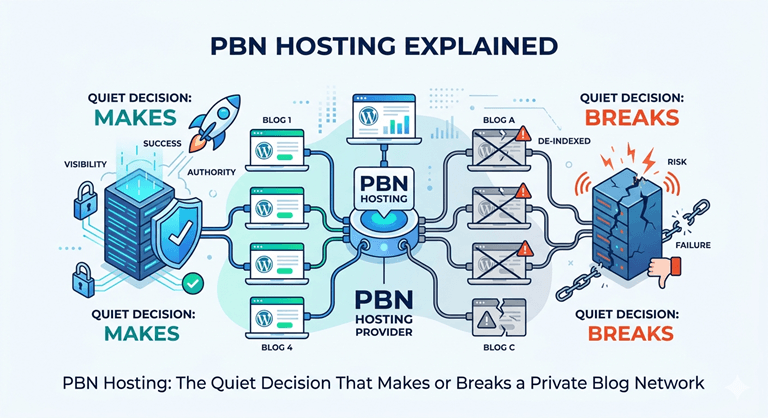
This guide explains what PBN hosting actually is, why it carries so much weight, the mechanics of how networks get detected, and what genuinely separates safe hosting from the kind that quietly sabotages your work. Whether you run a handful of sites or hundreds, the principles are the same — and most of them are widely misunderstood.
What Is PBN Hosting?
A private blog network is a group of websites you control, used to send backlinks to a main “money site” you want to rank. PBN hosting is web hosting set up specifically so those sites can’t be connected to one another — or to the site they link to — through their underlying hosting characteristics.
The reason this is a specialist concern, rather than something any web host handles, comes down to how search engines work. An algorithm doesn’t need to read your content to suspect a network. It only needs to notice that a cluster of supposedly unrelated sites all resolve through the same name servers, share neighbouring IP addresses, return identical server fingerprints, and were configured in the same way at the same time. None of that is visible to a human visitor. All of it is obvious to a machine. PBN hosting exists to erase those connections so each site looks exactly like what it claims to be — an ordinary, independent website.
Why PBN Hosting Matters More Than the Links
This is the part that catches experienced operators off guard. You can buy strong aged domains, commission excellent content,t and place perfectly natural links — and still lose the entire network to a hosting mistake that has nothing to do with any of those things. The links aren’t usually the fragile part. The hosting is.
That’s because deindexation tends to happen at the network level, not the page level. When a search engine identifies the shared pattern tying a set of sites together, it can devalue or remove all of them at once — regardless of how good the individual sites are. The hosting is the layer where that connecting pattern most often lives, which is why it deserves more scrutiny than it usually gets. Get it wrong and nothing else yodoid matters; get it right and everything else has a chance to work.
Networks rarely die because of bad links. They die because of where they were hosted.
How Networks Actually Get Detected: Footprints
A “footprint” is any repeated signal that connects the sites in a network. The common misconception is that there’s one decisive footprint — usually the IP address — and that varying it keeps you safe. In reality, detection is almost never about a single signal. It’s about correlation: a collection of small, individually harmlesss details that only become suspicious when they all line up across sites pretending to be strangers.
The footprints that matter most are usually hosting-level, which is precisely why hosting is so decisive:
| Footprint | Why does it connect your sites |
| IP & subnet | The oldest tell. Adjacent or shared IP ranges across “unrelated” sites. Varying the IP solves only this one layer. |
| Name servers / DNS | Repeated or custom name servers are a stronger correlation signal than the IP itself — and one most hosts overlook. |
| Server signatures | Identical software versions, response headers, and SOA records expose a shared configuration template. |
| Provider clustering | A whole network living inside one small SEO-hosting provider is itself a pattern — the neighbourhood gives it away. |
| Registration data | Shared registrars, privacy services, and renewal cycles tie domains together away from the sites themselves. |
| Software fingerprints | The same theme, plugins, and default settings repeated across sites form a CMS-level footprint. |
The lesson to be learned is that “unique IP” hosting – the most obvious feature that almost every provider boasts – covers only the most superficial layer. A host can assign different IPs to all the sites, and it keeps the network still completely vulnerable via DNS, server signature, and clustering. The ones that people don’t necessarily want to advertise against are the dangerous footprints.
Why Ordinary Hosting Is the Usual Culprit
When starting off a new project, it’s easy to put a PBN on shared hosting, or on a few cheap VPS boxes,s and then call it quits. It is the most typical and most expensive shortcut in the business, and it is because it is structural.
The basic hosting is designed for the opposite of a PBN. The purpose of this is to make it cheap: to fit a bunch of sites onto the same server, using a single name server and a single server signature. If you have a number of network sites, you have made a textbook set of correlated signals. The advantages of VPS hosting are more apparent, but operators tend to purchase them in bulk from the same host, and then set them up in the same way, thereby recreating the very footprint that they wanted to avoid. The older “C-class IP” system suffers from the same problem: “diverse” IPs all within a few known IP ranges, which are indicated by the neighbourhood itself, are not diverse.
What Good PBN Hosting Looks Like Today
The best contemporary strategy is the opposite of the old strategy. Instead of acquiring diversity from a small player, they spread sites over the same dominant infrastructure: CDNs, big cloud, and DNS providers all serve a great proportion of traffic on the Internet. The network becomes more of a network than anything else since it starts to exist among hundreds of millions of normal websites. It can provide all of the following if done properly:
- Distributed IPs via mainstream CDN,s so the origin is hidden and there’s no shared subnet to correlate.
- Varied name servers and DNS providers — the footprint that cheaper hosts ignore.
- Neutralised server signatures so sites don’t share one configuration fingerprint.
- Fast, reliable delivery because quick, always-on sites get crawled and indexed faster.
- Backups, monitoring, and indexation checks so problems surface while they’re still small.
- Frictionless management — one-click deployment and a single dashboard, so the safe way is also the easy way.
Specialist providers have emerged to do exactly this. Services such as PBN LTD, for example, distribute sites across multiple major CDNs and DNS providers and automate the footprint management that’s impractical to handle by hand — the kind of setup that’s difficult to replicate on standard hosting without considerable technical effort. The bigger picture is true for every provider: The infrastructure should be invisible in plain sight, rather than in a corner of the internet that’s reserved for PBNs.
How to Choose a PBN Host
A few honest questions cut through the marketing faster than any feature list:
Does it address more than IPs?
If the entire pitch is “unique IP,s be suspicious of this being a red flag. Request specific information on name servers, server signatures, and provider clustering — the things that really lure networks into trouble.
Is the infrastructure mainstream or niche?
A neighbourhood footprint is hosting that is completely housed in its own little SEO hosting. The safest networks are those that are embedded into infrastructure that is used throughout the entire internet.
Does the provider actually run networks?
Many hosts have never constructed or ranked a PBN — they provide you with servers with the correct jargon. One that has its own network learns where footprints actually occur, as it is necessary for its own rankings.
Can you verify the claims?
When you use the word “World’s safest,” you have to back it up with more. Seek out a free trial, money-back guarantee,e and a clear pricing policy to try before buying.
A Realistic Note on Risk
Honesty matters here. Private blog networks do not adhere to search engine rules, and no host guarantees that there is no way to get affected by them, and anyone who does is just overpromising. All it means to get a good PBN host is that the majority of unnecessary deindexations will not happen when you control the things that will: Content Quality, Anchor Distribution, Link Velocity, and simple moderation.
In simple terms: A good host won’t save a careless network, and a bad host will destroy a careful network. It’s the base, and as with any base, it may not show when it’s right, but it shows when it’s wrong. Think of the hosting choice seriously, and anything you create on top of that will stand the chance of being more durable.
Frequently Asked Questions
What is PBN hosting in simple terms?
Web hosting that is designed so that the sites of a private blog network don’t share the same IP, name servers, server signature ore configuration pattern that would allow a search engine to link the sites together or to the money site that they will be linked to. The aim is to make each site appear like any other, separate site.
Why can’t I just use normal hosting?
Because standard hosting is built to cluster sites together — shared servers, identical name servers, the same server signature — which is exactly the pattern that exposes a network. It’s the most common cause of deindexation. PBN hosting exists to remove those patterns automatically.
Are unique IPs enough to stay safe?
No. Unique IPs serve just the most apparent layer. Detection is based on the correlation of numerous signals, namely: name servers, SOA records, server header, clustering, registration data, and software fingerprints, and a host that changes only its IP still leaves the network vulnerable.
What’s wrong with C-class IP hosting?
It attempts to build some variety within a narrow-minded, dedicated SEO-hosting company, but the range of that company is one of the marked neighbourhoods. Transparency is achieved by spreading sites out over all the “mainstream” infrastructure that is utilized by the wider internet, rather than by concentrating within other PBNs.
Is PBN hosting expensive?
Not necessarily. The CDN-distributed method is often less expensive than the old-fashioned dedicated SEO hosting, and it’s safer, since it’s based on common mainstream infrastructure and automation. The price that really counts is not what you have paid for the monthly hosting, but what you’ve paid to rebuild a network that was deindexed due to a hosting error.
Popular on OTW Right Now!




About The Author

Gagan Bhangu
Founder of otechworld.com and managing editor. He is a tech geek, web-developer, and blogger. He holds a master's degree in computer applications and making money online since 2015.