
How Tiny Electronic Components Shape Your Smartphone’s Battery Life
Smartphone engineers will tell you a brutal truth: a handset’s battery life is ultimately limited by physics, not software tricks. Yet physics has a surprising number of negotiation points—most of them hidden under that shiny AMOLED screen.
From low-ESR capacitors to energy-harvesting glass, small components you’ve never heard of decide whether you’re scrambling for a wall socket by 3 p.m. or sailing past midnight.
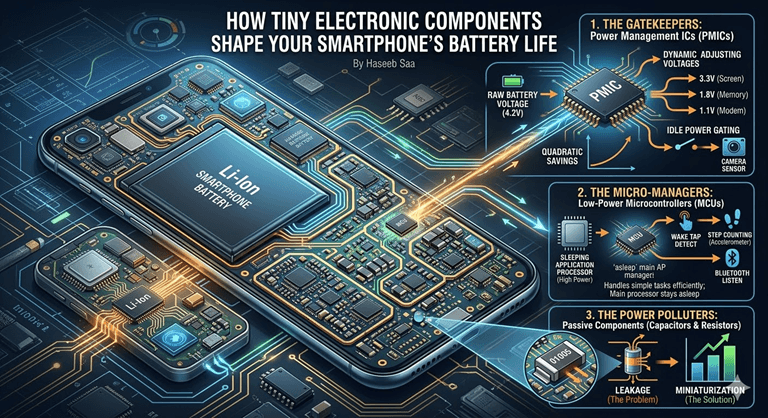
Below, we’ll crack open the power path, show how each passive part squeezes (or wastes) electrons, and offer practical tweaks hobbyists and power users can apply today.
Why Battery Life Is Still the #1 Pain Point
We have all been through it: You have 2 percent left on your phone when you are about to scan a digital boarding pass. You are not the only one. In mobile-use surveys, battery anxiety remains the most important consumer complaint. And as vendors vie to stuff more cells in, the demand increases at an even greater rate.
The average smartphone battery capacity in China was 5,418 mAh, 11 per cent higher than last year. Big cells are useful, but half the battle. The other half is the efficiency of all the resistors, capacitors, and inductors that the battery and your favorite apps are between.
Meet the Unsung Heroes in Your Power Path
Inside a modern logic board, current flows like traffic in a dense city. Three components keep order:
- Capacitors – are shock absorbers, irregularities of voltages caused by spikes of the app.
- Inductors & ferrite beads – filter and store energy in switching regulators.
- Resistors – detect, apportion, and burn unused voltage to heat.
Placed correctly, these parts trim micro-amps you’d otherwise lose 24 hours a day.
Capacitors: The Shock Absorbers
When used in the right part, these parts cut micro-amps otherwise spent away each day of the year.
- Capacitance (µF) – how much charge it can hold.
- ESR (Equivalent Series Resistance) – the internal loss that turns charge/discharge into heat.
Low-ESR components are higher priced and are a quick pay-off. Capacitors with low-ESR have the potential to double the wearable battery life by up to 15%.
The same applies to smartphones: The reduced ripple value ensures the converters consume less power to hold the voltage.
Inductors & Ferrite Beads: Smoothing DC-DC Conversions
Every time your CPU shifts from idle to 2.8 GHz, a buck converter swaps voltage for current in microseconds. The inductor is its energy bucket. Take one with the correct saturation current, and you do not get the effect of ringing, those sinusoidal spikes that burn an unconscious battery without effort to enhance performance.
Ferrite beads, on the other hand, block the high-frequency noise that could otherwise cause the radios to retransmit and preserve both battery and sanity during the video calls.
How Flagship Makers Fine-Tune Component Specs
Flagship teardowns over the past 18 months reveal a quiet spec war happening at the millimeter scale:
- Stacked MLCC arrays vs. single tantalum caps – Apple ditched four 10 µF MLCCs for a single 47 µF polymer part in its PMU rail, freeing board space and cutting ESR by 30%.
- Thicker six-layer boards – Samsung introduced the S-series that relocated to 1.1 mm PCBs in the RF area to accommodate shielded inductors that diminish mutual coupling and are not a waste of RF power.
- Polymer capacitors in camera modules – Vivo has been replacing ceramic with polymer in camera modules to support large HDR burst currents without voltage drops, without throttling the image-processor.
- Tighter resistor tolerances – Google’s Tensor phones employ 0.1% shunt resistors for power-path monitoring, letting the OS predict loads and shut down unused cores milliseconds sooner.
Tiny choices, but they snowball into hours of extra screen-on time across a charging cycle.
Power Management ICs: The Traffic Cops
At the center of it all is the PMIC, coordinating buck/boost converters, battery charging, and thermal gates. Think of it as the city’s adaptive traffic-light system.
The PMIC for smartphones market is projected to top $10 billion by 2030. Modern PMICs even embed machine-learning curves that learn your usage pattern, pre-warming voltage rails a split-second before a known high-draw event (say, launching the camera app).
When done correctly, the phone will not suffer voltage sag or overprovisioning–milli-watts you will need to save until dinner.
Five DIY Tweaks to Squeeze Extra Hours Today
- Audit power-hungry apps
Long-press the battery graph on Android/iOS, uninstall or limit any application that is in the top five but is not a mission-critical one. - Dial down the refresh rate
Reducing the frequency to 60 Hz can reduce the power of displays by 15-20% on OLED displays. - Enable adaptive charging
Charge the phone overnight to 80 percent, and charge it to the full before you wake up – increase lithium-ion cycle life. - Monthly battery calibration
Run from 100% to 10% once a month so the BMS keeps its state-of-charge math honest. - Hardware-head route: upgrade the battery-side capacitor
Assuming that you are happy with a hot-air station, then it is possible to replace the stock 0805 ceramic with a low-ESR polymer cap to eliminate ripple and heat. (Yes, you’ll break warranties–decide well enough)
When Components Go Wrong: Case Files
- Bulging capacitor – Early batches of a 2023 budget phone used cheap 85 °C electrolytics that swelled, shorted, and caused random reboots.
- Inductor coil whine – A manufacturer of e-readers chose under-specified inductors; was audible as a faint buzz each time a page was turned, and resulted in a 7 percent reduction in battery life.
- Resistor drift – A flagship wearable logged phantom “100% battery” events; root cause was a 10 mΩ shunt drifting 25% high after sweat ingress, fooling the gauge into early shutdowns.
The lesson: reliability isn’t just about chips—it’s about passives rated for real-world abuse.
Where to Source Quality Passives Quickly
Component shortages wreak havoc on even the best-laid prototypes. If you need an independent component broker that can overnight a reel of low-ESR caps or a hard-to-find PMIC, ICRFQ is a solid first call.
They check vendors, issue validity certificates, and deliver to any part of the world–convenient when your local distributor has a lead time of 32 weeks.
The Road Ahead: Energy Harvesting & Solid-State Batteries
The next leap may remove the charger altogether. Researchers are experimenting with:
- Piezoelectric glass that converts screen taps into a trickle charge.
- OLED cells and ULPV cells are laminated on the back of a stack of OLED cells to harvest ambient light.
- Finger swipe Triboelectric films to produce some form of static energy.
- Solid-state lithium metal anodes with 800Wh/L and higher energy density.
The development is not even; however, the tendency is obvious: batteries will help to divide the work with intelligent methods of gathering the energy you produce.
Conclusion
Tiny components rarely earn keynote slides, yet they govern the energy math of every swipe, selfie, and stream. By understanding how capacitors buffer surges, inductors tame converters, and PMICs choreograph the dance, we can stretch runtime today—and glimpse a future where the “low battery” warning becomes a relic.
Popular on OTW Right Now!




About The Author

Gagan Bhangu
Founder of otechworld.com and managing editor. He is a tech geek, web-developer, and blogger. He holds a master's degree in computer applications and making money online since 2015.