
10 Ton Overhead Crane for Sale – Factory Direct Pricing & Reliable Delivery
Sourcing a 10 ton overhead crane is a straightforward procurement decision when you know what to specify and where to buy. This article is written for buyers who are past the research stage and need accurate pricing, honest lead times, and a clear path to placing an order with a verified manufacturer.
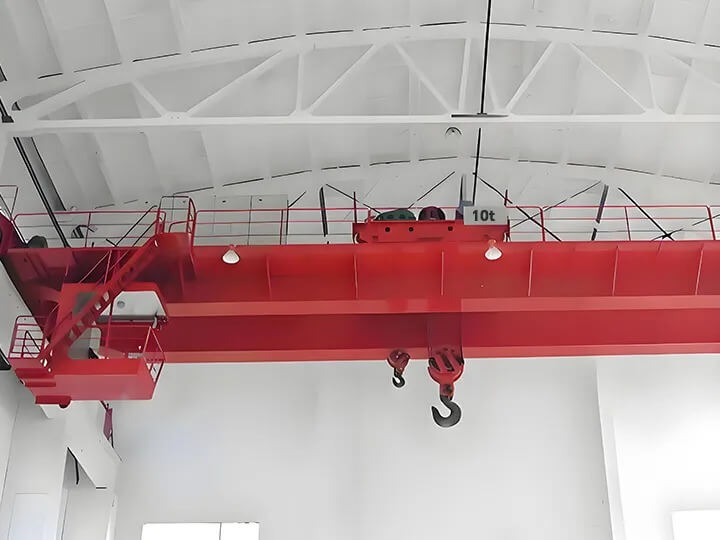
What Makes the 10 Ton Overhead Crane the Right Choice
The most frequently ordered overhead crane in industrial facilities around the world is in the 10 ton range. It encompasses most of the manufacturing and warehousing lift requirements, from heavy lifts that are capable of lifting large fabrications, tooling and machinery parts to light lifts where the runway structure and building columns can be managed without significant civil reinforcement.
Steel manufacturing facilities, automotive stamping and assembly production plants, general engineering workshops, precast concrete plants, chemical/petrochemical plants, and heavy equipment maintenance depots are typical customers that keep ordering 10 ton overhead cranes. For those whose heaviest normal lift is from 3 to 9 tons, a 10 ton overhead crane will provide the necessary rated capacity margin as set by safety requirements without excessive component cost.
Overhead Crane vs. Bridge Crane: Is There a Difference
In most markets overhead crane and bridge crane are synonymous terms for the same type of crane. These are both cranes of similar design in which a bridge structure runs up and down elevated runways and a hoist trolley runs across the bridge. Where it does exist, it is regional; in North America, overhead crane is preferred by buyers, whereas in Europe and Asia, bridge crane is preferred. Any good manufacturer will understand which is the correct term when you ask for a quotation.
Configuration Options for a 10 Ton Overhead Crane
Single girder overhead crane is the standard choice for spans up to 28 meters and duty classifications up to A4. The hoist runs on the bottom flange of the single bridge beam, which reduces the overall system height and building load compared to a double girder design. It is the lower-cost configuration and covers most light-to-medium production environments.
Double girder overhead crane places the hoist trolley on top of two parallel bridge beams, delivering significantly greater hook height for the same building clearance and higher structural rigidity across long spans. It is specified for A5 and A6 duty cycles, spans above 22 meters, and applications where the crane will run multiple shifts daily or carry special attachments such as grabs or magnets.
European-style low-headroom overhead crane is a compact design built to FEM standards with reduced end carriage height. It is the correct specification when hook height is critical and every available centimeter of building clearance matters. The compact profile also reduces deadweight, which is an advantage in older buildings with limited structural capacity.
Explosion-proof overhead crane is required in environments classified as Zone 1 or Zone 2 under ATEX or IECEx standards — petrochemical facilities, paint shops, flour mills, and similar locations. All electrical components are rated for the hazardous area classification. Price premiums over standard configuration run 35 to 55 percent.
Technical Specifications Reference
These parameters are for the standard 10-ton overhead crane range. Other values are available upon request.
Rated capacity: 10,000 kilograms. Span width: 7.5 to 35m according to the type of girder. Lifting height: 6-30 m. Lifting speed: 0.8m/min, 4m/min, 8m/min and variable speed with VFD. Trolley travel speed: 20-45 m.pm. Travel speed on bridge: 30-80 meters per minute. Duty class: A3 to A6 per ISO 4301 and FEM 1.001. Power supply: 380V, 415V or 460V, 3-phase, frequency as per local grid. Control options: pendant push-button station, wireless remote, or operator cabin.
The distances from the hook centerline to the back of the runway (called hook approach in the industry) are different for various models. This is an important dimension to take into consideration when lifting close to building walls or columns, and should be verified at quotation time.
Price Ranges for a 10 Ton Overhead Crane
The following are factory-direct FOB prices for standard production configurations. Freight, duties, runway structure, and installation are not included.
Single girder, 10 ton, span 7.5 to 10.5 meters: $7,500 to $12,000. Span 13.5 to 16.5 meters: $9,500 to $16,500. Span 19.5 to 22.5 meters: $13,000 to $21,500.
Double girder, 10 ton, span 10.5 to 16.5 meters: $15,000 to $27,000. Span 22.5 to 28.5 meters: $25,000 to $43,000. Span 31.5 to 35 meters: $35,000 to $56,000.
European style low headroom design is approximately 15-25% on top of the base single or double girder. VFD on each of the 3 motions and wireless remote costs $2,000 to $5,000. Anti-sway control increases the system value by $3,000 to $7,000 depending on the system type.
These figures are reference ranges only. When you are interested in a price for binding, you must have a formal quotation from your specifications. Each specific crane, with the same rated capacity and span, can be $8,000 or more apart based on hook height, duty class, hoist brand and options chosen.
Lead Times: What to Plan For
The production time of 10 ton overhead crane is 15-20 working days from the order confirmation and deposit receipt. Double girder standard configurations are in 20 to 28 working days. This can be extended to 30 to 45 working days with a custom span, explosion proof, or very high hook height.
In addition to the manufacturing time, it takes 25-35 days for sea freight from Chinese manufacturing centres to major port destinations in North America and Europe, respectively 18-25 days for Southeast Asia and the Middle East, and 30-40 days for South America and Africa. For hoist units and control panels, air freight is suitable, but for structural steel sections it will only be possible by sea.
Standard configurations require 7-11 weeks to place and receive the crane ready for installation on site. For projects that require non-standard specifications or remote delivery locations or port congestion, expect 12 to 16 weeks.
The Procurement Advantage of Buying Direct from the Factory
Trading companies include margin on all trades and local dealers do as well. That margin is 20-40% of the factory price for industrial equipment in this price range. The middle part is eliminated when you buy direct.
In addition to price, direct factory procurement means that if there is a technical question, you’re not working with sales people, you are working with engineers. Span corrections, hook height adjustments and runway compatibility are corrected at source – NOT once the crane has arrived on site.
Another material benefit is documentation. A factory-direct order will include a complete technical file, which includes structural steel mill certificates, hoist and motor test records, dimensional inspection reports, CE Declaration of Conformity, and load test certificate following factory testing at 125 percent of rated capacity. This package meets the needs of insurers, regulators and third-party inspectors in nearly all markets.
What to Confirm Before Requesting a Quotation
The suppliers will require the following information to make an accurate quotation and delivery date.
The length from the centerlines of the two runway rails in meters. If your runway does not already exist, be sure to provide the width of your building bays and the width of your column flanges to allow the supplier to determine what the maximum distance between rails will be.
Minimum height to be lifted from the finished floor to the maximum height of the hook. Provide a clearance of the underside of the building (lowest obstructions above the crane path) if the crane is to be located in a building with an existing roof structure.
Intended duty cycle: Duty cycle expressed in a description of use, including the number of hours per day, estimated number of lifts per hour, and the percentage of time loads are at or near the rated capacity or well below. This enables the supplier to designate the right duty class.
Local power supply: voltage, frequency and whether three phase power is available at the installation location.
The special requirements may be outside installation, high ambient temperature, corrosive environment, low ceiling height, hazardous area classification, existing runway integration or a special brand preference for the hoist.
Compliance and Certification
An overhead crane weighing 10 tons in a controlled commercial/industrial environment should be certified to the appropriate market standard. Most markets require or accept CE marking, and the EU requires it. The CE certification of overhead cranes is based on the Machinery Directive 2006/42/EC, verification of structural design according to EN 13001 and a factory load test.
ASME B30.2 has been promulgated for the installation and operation of top-running bridge cranes in the United States. Canadian installations use the CSA B167. AS 1418 is normally used in Australian projects. Check with your supplier at the quotation stage to ensure that the right documentation is prepared when manufacturing.
SGS, Bureau Veritas, TÜV Rheinland and Lloyd’s Register are third party inspection agencies that can be arranged to inspect the factory before the shipment. This is suggested for orders from a new supplier, and sometimes mandated by project owners or end-client contracts.
Evaluating a Supplier Before You Order
Manufacturers operating in the overhead crane market vary from ISO factories with decades of export experience to an assembly operation with limited engineering capabilities. The structural and mechanical engineering is well known at this 10 ton level — what sets the suppliers apart is documentation quality, engineering responsiveness and after-sales support.
Request any prospective supplier for references from projects in your country or region, sample GA drawings from similar past orders and proof of CE certification or equivalent. If a supplier can’t supply these within a couple of business days of your inquiry they are not ready to be a reliable long-term supplier.
Any lead time commitments should be documented in a purchase agreement with penalties for non-performance. The usual terms of payment are 30 percent against the bill of lading with the balance due when the bill of lading is sent to the insurer. Suppliers asking for full payment before shipment on a first order warrant that they have taken full care of the merchandise.
Long-Term Cost of Ownership
One part of the total operating cost of an overhead crane over its service life is the purchase price. The cost of maintenance, spare parts and downtime over 20-30 years of operation can be many times the cost of purchase.
Give a duty class that is similar to or just higher than your usage. An undersized duty class results in faster deterioration of structural joints, hoist mechanisms, and end trucks. It is more expensive to replace the hoist, when the crane is underspecified, than the premium paid for the correct duty class at purchase time.
Ensure that spare parts are available prior to ordering. Standard industrial supply sources in your market or the manufacturer should be able to supply key wear components, such as hoist rope, end truck wheels, brake pads, contactor sets, and hoist limit switch assemblies. Proprietary parts used by cranes from companies that are not widely available in the country lead to maintenance challenges.
Summary
The 10 ton overhead crane you buy direct from the factory, properly sized for your building and duty requirements, with all CE documentation and a factory load test is a long-term asset that will serve your facility well for 20 – 30 years. Standard configurations take 7 to 11 weeks for the procurement process from initial enquiry to crane on site.
The most common and costly errors are ordering a span that is too low, too short, too light, or not having compliance papers; getting it right before ordering won’t cost you a cent. Any good supplier will discuss these factors with you before quoting you.
If you have any questions about specifications, pricing, or lead times, feel free to contact us — we are happy to help.
Popular on OTW Right Now!




About The Author

Gagan Bhangu
Founder of otechworld.com and managing editor. He is a tech geek, web-developer, and blogger. He holds a master's degree in computer applications and making money online since 2015.