
Your Smart Garage Door Opener Is Probably the Least-Watched Device on Your Wi-Fi
Most home owners arrange the more dangerous devices on their home network in a fairly clear order: the laptop having the banking app, the phone, and possibly the camera aimed at the front door. The garage door opener is usually not included on the list, and if it is, it appears towards the bottom of it. This ordering is actually wrong.
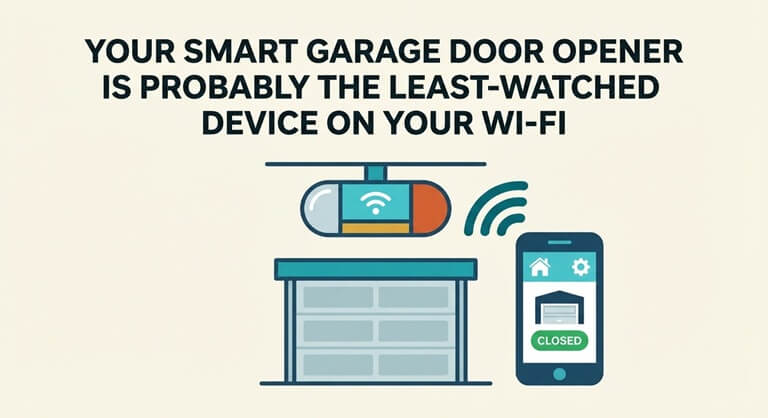
A smart opener is a small computer which is connected to the internet and fitted with a motor so that it can physically unlock part of your house; it communicates with a cloud service, takes instructions from an app, and in an increasing number of cases is on the same flat Wi-Fi network as all the other devices you have. A fault in that opener is not something you can simply ignore since it provides a means of gaining access to your house and your network.
The Threat Model Has Quietly Shifted
Security for garage doors used to depend on radio technology. If an attacker were within a few dozen feet they could try to intercept or retransmit the signal from a remote control, and rolling codes have in newer equipment largely eliminated that kind of attack. The older method of attack still applies to outdated equipment, but that is not what you should be concerned about at the moment.
The interesting attack today is remote and doesn’t require anyone standing near your house. In 2023, independent researcher Sam Sabetan published a detailed disclosure showing that a widely sold smart garage door controller shipped with hardcoded credentials baked into the firmware. Once someone had obtained those credentials, they could communicate with the vendor’s cloud message broker and send commands to any customer’s device from anywhere. The vulnerabilities had been classified as high or critical, covered several categories, and remained unpatched for a long time.
The case should be kept in mind since it wasn’t just a random occurrence involving one product; it illustrated the kind of failure that smart openers are susceptible to—specifically, cheap cloud infrastructure, shared secrets, and the vendor’s incentive to release features before they have been thoroughly tested.
Why the Obvious Fixes Miss the Real Problem
The natural thing to do when hearing a story like that is to change the Wi-Fi password, enable two-factor authentication in the opener’s app, and then be done with it. Those are reasonable hygiene measures, but they don’t address the part of the system that was exploited.
The difficult aspect is this: if the vulnerability is in the vendor’s cloud or in the credentials that have been embedded into the firmware at the factory, then anything you do using your account won’t have any effect on it. Your password isn’t the lock.
The lock refers to the vendor’s server, and you are not responsible for administering that server. Having a stronger password on a compromised platform still means that you have a compromised platform.
The second habit—purchasing a product from a well-known brand and relying on the label—is only a little better. The fact that it’s a big brand doesn’t mean that it has been audited; it only means that it has been marketed. Many consumer IoT devices come with hastily prepared firmware, unclear update policies, and no obvious method by which a researcher can report a bug.
Voluntary security labels for connected devices do represent a real advance, but their adoption is still in its early stages and the label does not currently act as a guarantee for products on the shelf.
Treat the Opener Like the Untrusted Device It Is
The approach that actually helps starts from an uncomfortable assumption: the opener will, at some point, have a flaw its vendor hasn’t fixed. Design your home network so that assumption doesn’t hurt you.
The Wiring Side Matters Too
Although software receives the most attention, the opening door is also a physical system consisting of a motor, a control board, and safety sensors. If the door is not well maintained it can fail in ways that a securely protected network cannot assist with, and odd behaviour caused by smart modules being fitted as retrofits to old hardware is a common source of problems that is misinterpreted as a hack.
If your setup is aging, or you’re adding smart features to an opener that predates them, have the mechanical and electrical side looked at by a qualified garage door technician before you layer more software on top. A clean install on current hardware is far easier to secure than a stack of adapters bridging generations of equipment.
What to Ask Before You Buy the Next One
When you’re ready to replace an opener, the security questions should be brief and it’s a good idea to ask them out loud. Does the vendor make available a security contact or a disclosure policy? How long will the device continue to get firmware updates, and should this be stated in writing? Will the device be able to function locally if the cloud connection is lost? Is it possible for you to completely turn off remote access?
A vendor who is able to answer those questions clearly is showing that they have given the matter some thought, while one who can’t is conveying the same thing in the opposite way. Since your garage door is just a door, you should buy it from someone who regards it as such!
Popular on OTW Right Now!


About The Author

Gagan Bhangu
Founder of otechworld.com and managing editor. He is a tech geek, web-developer, and blogger. He holds a master's degree in computer applications and making money online since 2015.