
Next-Gen Storefront Engineering: How Adobe Commerce and Hyvä Scale Enterprise Conversions
E-commerce is no longer merely about offering a wider variety of products, attracting more traffic, or processing more transactions. The true challenge now is to provide a consistent shopping experience even though the business behind it is becoming more and more complex.
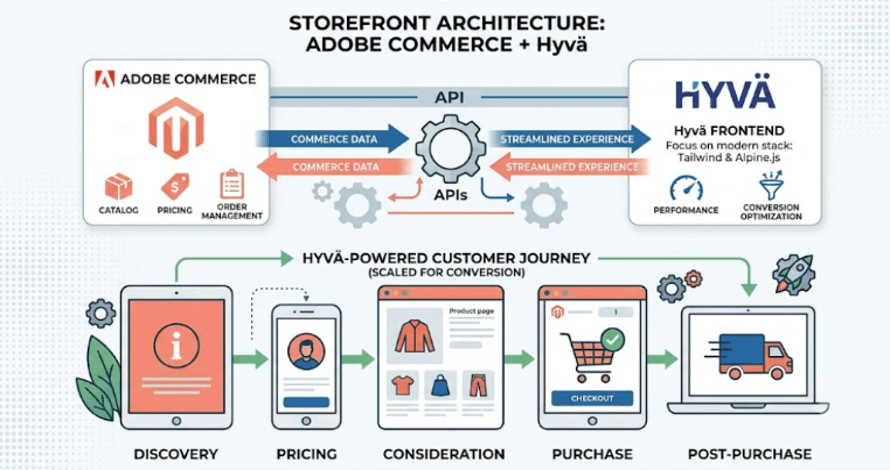
Adobe Commerce together with Hyvä can offer a practical basis for modern storefront engineering, with Adobe Commerce looking after the complex commerce needs and Hyvä providing a simplified frontend solution that stresses performance, usability, and maintainability. For companies that are planning such a modernization, an experienced development partner can assist in linking the storefront strategy with the existing commerce features, integrations, and business requirements.
Enterprise Commerce Needs More Than a Powerful Backend
Adobe Commerce is designed to support sophisticated ecommerce requirements, including B2B functionality, complex catalogs, customer management, pricing, promotions, integrations, and personalized commerce experiences. But the backend’s capabilities only become valuable when customers can interact with them through an effective storefront. Working with an experienced adobe commerce development partner can help businesses connect their commerce infrastructure with a storefront strategy that supports performance, usability, and scalability.
Even if an enterprise website has complex business logic and a number of integrations, customers will still encounter the problem at the front end if the category pages are hard to navigate or if the product pages load slowly. Therefore, storefront engineering is a key part of an enterprise e-commerce strategy.
What Hyvä Brings to Adobe Commerce
Hyvä approaches the Magento frontend differently, using a lightweight architecture built on modern frontend technologies, including Tailwind CSS and Alpine.js.
The aim is to cut down on unnecessary complexity on the frontend and to establish a simpler basis for developing ecommerce interfaces.
Instead of switching from Adobe Commerce, companies can keep their current commerce system and redevelop the parts customers interact with using a more performance-oriented architecture.
Building Faster Customer Journeys
Speed has an impact on every stage of the ecommerce journey.
Customers go from the landing pages to the category pages, then to the search results, followed by the product details, the cart, and finally the checkout process. If there is a delay at any of these stages it can break up that process.
The streamlined frontend offered by Hyvä can be used to cut down on unnecessary code and frontend dependencies. If image optimization, caching, hosting, API performance, and technical SEO are properly implemented, the result is a more responsive storefront.
Theme technology is only one part of performance engineering, since enterprise optimization involves the entire technology stack.
Designing for Conversion, Not Just Speed
While a fast website is important, having speed by itself doesn’t lead to conversions.
Enterprise storefronts also require good navigation, clear information about the products, intuitive filtering options, strong search capabilities, responsive layouts, and a smooth checkout process.
Hyvä gives development teams a flexible base for building these experiences while keeping the frontend architecture fairly light.
Businesses can therefore approach storefront development in two ways: improving technical performance while refining the customer journey.
Supporting Complex Catalogs
Large companies usually handle thousands of products, multiple categories, different customer groups, varied pricing structures, and a range of regional stores.
The frontend has to ensure that that complexity is understandable to customers.
This can include:
- Intelligent category navigation
- Advanced product filtering
- Search and autocomplete
- Product comparison
- Variant selection
- Personalized recommendations
- Mobile-first product discovery
- Optimized product detail pages
These experiences need to remain responsive as catalog size and traffic increase.
Working With the Existing Commerce Ecosystem
A storefront modernization project must not function by itself.
Enterprise stores using Adobe Commerce often link with various systems including ERP, CRM, PIM, payment systems, shipping services, analytics tools, and marketing platforms. Through these integrations, commerce teams are able to connect product information, customer data, inventory records, transactions, and marketing activities throughout the organization.
It therefore means that when doing frontend development, one must take into account the entire customer journey and the data that flows associated with it.
For example, the product page could rely on data that comes from a PIM, on pricing from Adobe Commerce, on inventory from an ERP, on recommendations from a personalization platform, and on analytics data from another system.
The storefront must combine these elements without causing unnecessary performance overhead.
Making Modernization More Manageable
A major challenge in the case of enterprise ecommerce is technical debt.
As time goes on, companies end up with a build-up of custom templates, third-party extensions, frontend overrides, and old code. Later on, even minor changes end up needing a lot of development work.
A good migration provides businesses with the opportunity to take a fresh look at that frontend layer.
Rather than copying all of the existing customizations directly over into the new storefront, development teams can decide which features are truly necessary, which ones can be redesigned, and which ones can be discarded.
It gives us the chance to simplify the architecture without losing the business functionality that is important.
What a Strong Hyvä Migration Process Looks Like
A successful implementation generally starts with discovery rather than development.
The process can include:
Technical audit: Review the existing Magento theme, extensions, customizations, integrations, and performance issues.
Business requirement mapping: Identify critical customer journeys and functionality that cannot be disrupted.
Compatibility assessment: Determine whether existing extensions require Hyvä-compatible implementations or custom development.
Frontend reconstruction: Rebuild templates and components using the Hyvä architecture.
Performance optimization: Test page speed, frontend resources, responsive behavior, and Core Web Vitals.
Quality assurance: Validate browsing, search, product selection, cart, checkout, account functionality, and integrations.
Launch monitoring: Monitor performance and user behavior after deployment and address emerging issues.
Scaling Conversion Optimization
Optimization of conversion should carry on after the launch.
Analytics can show us the points at which users abandon the process. Search data can indicate gaps in product discovery. Data from the device level can point to problems with the mobile version. Customer behaviour can highlight difficulties with navigation or at the checkout stage.
These insights can thus be used to make ongoing improvements to the storefront.
For organizations that want to make this transition systematically, choosing a Hyvä theme development company with experience in Adobe Commerce can help with frontend architecture, migration planning, custom development, and ongoing optimization.
Final Thoughts
Running an enterprise ecommerce business demands a balance between functionality and the customer experience. Adobe Commerce supplies the infrastructure required for managing complex commerce operations, whereas Hyvä provides a contemporary method of creating the customer-facing storefront.
When engineered together, they help businesses manage frontend complexity, improve performance, simplify maintenance, and deliver better shopping experiences. The genuine opportunity does not lie merely in adopting a new theme; it consists in rethinking the storefront as an essential component of the overall commerce architecture, one that is designed to stay fast, flexible, and scalable as the business grows.
Because of its experience with Adobe Commerce and modern e-commerce technologies, Magneto IT Solutions assists businesses in creating storefront experiences that ensure good performance and long-term scalability.
Popular on OTW Right Now!
-
 Online Therapy Services for Depression and Anxiety in Canada: How Virtual Counseling Can Help You Feel Better
-
 Get an ESA Letter Online: Trusted & Legitimate Provider (RealESALetter.com)
-
 Sleeper Earrings: The Complete Guide to Comfort & Style
-
 My Website Looked Fine Until I Checked Semrush: What I Found Behind the Scenes




About The Author

Gagan Bhangu
Founder of otechworld.com and managing editor. He is a tech geek, web-developer, and blogger. He holds a master's degree in computer applications and making money online since 2015.