
Your Recordings Are Invisible to AI: Why Transcription Is the Missing Layer in Every AI Workflow
AI has become remarkably good at working with information—provided that information is available in a format the system can process. It’s simple to use an AI assistant to summarize a document, analyze a spreadsheet, rewrite an email, or derive insights from notes. However, a significant portion of the information created by people does not get to that point.
It lives inside meetings, podcasts, interviews, webinars, lectures, screen recordings, and voice memos.
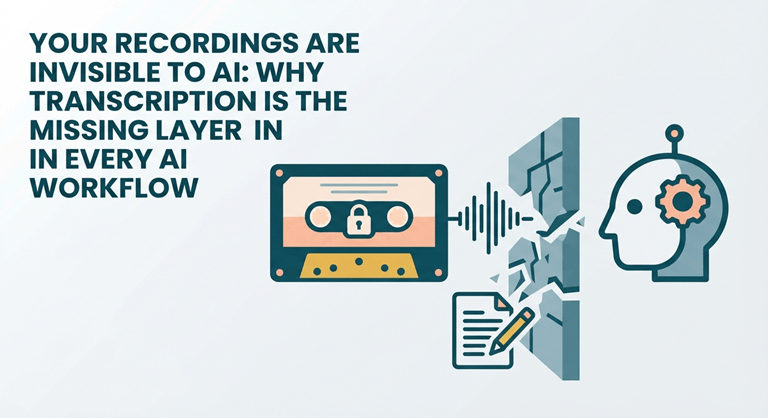
That means we’re missing a piece in today’s AI workflows. It is not always the case that the information is not available to humans. It’s that the information is stored within audio and video. Most AI systems struggle to search, compare, extract information from, or reuse as structured data until spoken content is converted to text.
The convenience of transcription is therefore more than warranted. It’s the information base that links human-made communication to AI-generated work.
AI Workflows Run on Text, but Most Real Information Is Spoken
Most of the AI workflows are driven by text. Prompts are text. Documents are text. Most Knowledge bases are written documents. Search queries are made of text. While some of the AI tools that accept other formats can reason over information, this is sometimes only when they can extract usable language from the other formats.
But human communication doesn’t work that way.
A product team can meet for an hour, but never have a detailed written record. An important insight from a customer can be recorded in a two-minute voice note by a sales rep. A researcher can have a dozen or more interviews, with useful observations recorded, but not organized. A researcher can have a dozen or more interviews where valuable observations are recorded, but not organized. An author can be equipped with hours of podcast material which can be utilized for articles, newsletters, video snippets or social posts.
The information exists, but it is difficult to operationalize.
That’s why transcription can be considered more than an accessibility feature; a tool for infrastructure. When speech turns to text, it can be integrated into the same AI processes that already work with text.
It can be summarized by an AI assistant, decisions extracted, themes identified, questions answered, it can be classified, or it can be linked with information from other sources. The recording is kept almost entirely out of the workflow without that text layer.
Unsearchable Recordings Are Data You Don’t Really Have
Not having a recording doesn’t mean that the information is not available.
Think of an enterprise that has hundreds of meetings in its history. The files can be safely stored, easily identified by date, and retrieved whenever needed. However, when an employee wants to find out when a specific pricing question was raised, they will need to browse through one of the recordings at a time and manually look for hours of speech to find the answer.
That is data that is actually stored but actually can’t be accessed.
Text alters the economics of retrieval. A transcript can be used for indexing, searching, quoting, summarizing, and feeding into another AI system. An organization will not need to ask if a decision was made in a particular meeting, but can search through the written record and find the desired part.
This is even more important with the increase in AI-generated information. The amount of documents, summaries, reports, and automated outputs that are being generated is higher than ever before. Their AI knowledge base could be only part of what their own people know if the original material they used is not recorded.
Transcription closes that gap by turning ephemeral conversations into persistent, machine-readable information.
What Transcribing Video Unlocks
Video has a lot more useful information than what’s visible. All meetings, interviews, webinars, training, product demos, lectures, and recorded presentations have some spoken explanation content that can be useful long after the fact.
When teams convert video to text, they create a searchable, reusable written representation rather than treating the recording as a single, fixed piece of media. AI support for captions, internal documentation, research and summaries, and repurposing content can all be helped by a transcript.
An interview for content teams can yield an article, posts for social media, quotes, video descriptions, and topic ideas. Recorded meetings can become searchable minutes of the decisions and customer feedback for businesses. Specific statements can be found within a recording without having to relisten to the entire recording.
It’s a conceptual change that’s crucial: the video is no longer the end product; it is a source of structured information.
With that information, AI can interact with the video in ways that are hard or impossible to achieve when the data is locked within a video file.
What Audio and Voice Notes Unlock
The same applies to audio, but it is sometimes even more difficult to miss as voice notes sound casual.
People dictate notes while they are driving, put down interviews, leave notes at work, remind themselves of things, or save notes from spur-of-the-moment thoughts. The advantage of these recordings is that they can be helpful just because they permit them to capture ideas before they are refined.
The trouble is, getting it back. If there are hundreds of voice recordings in a folder, it is hard to query. It won’t be much help to remember that “somewhere in a voice memo last month was an important idea.
Once users transcribe recordings, those informal thoughts can become searchable notes and reusable source material. These can then be summarized, grouped into themes, and extracted to identify action items, or they can assist in structuring a rough draft of a text from spoken ideas.
For light usage, there are free options available. YouTube’s AI-powered text-to-speech can generate a transcript for eligible videos, and phone dictation can convert spoken words into text. However, these options are not always applicable in longer recordings, to current media libraries, to multi-speaker conversations, and to workflows that demand uniform export and organization.
The general lesson is that it is much more useful to have the language of the audio available as text.
Transcription Is Powerful, but It Is Not Perfect
We can’t confuse the transcription process with an AI process: automated transcripts are not perfect.
Noise, poor sound quality, multiple speakers, odd names, jargon, industry jargon, and accents all affect the accuracy. Sometimes a model will also misinterpret words that sound alike, especially with limited context.
This is significant for transcripts that are being utilized for legal, financial, medical, research, or other important reasons. Quotes and factual statements are significant and must be verified from the source recording and not taken on faith.
Context also matters. A transcript can record that which was said, but not necessarily that which was meant. Sometimes tone, facial expressions, pauses, gestures, and visual information can convey meaning that can’t be captured in plain text.
These restrictions should not detract from the transcription’s importance in AI processes. They specify its usage. The transcript is really best viewed as a machine-searchable, machine-readable version of a recording, rather than an unquestionable substitute for the source itself.
The Missing Layer Between Human Conversation and AI
When considering AI adoption, one must speak of better models, better prompts, and better applications. Those things matter, but they don’t consider the essential question of whether or not the information that people want the AI to use is actually available to it.
The answer for many organizations and individuals is only partway.
They know their knowledge in meetings, interviews, podcasts, webinars, lectures, phone recordings and voice notes. While they are still just audio/visual, much of the information contained in these files is not easy to search or reuse.
It is through transcription that a bridge is created.
After speech-to-text, the same information ecosystem as documents, notes, emails, and other structured information can be used. It can summarize, retrieve, analyze, compare, and generate new outputs from it using AI.
The future of workflows with AI isn’t just about increasing information. It will rely on the availability of existing information as well. Transcription can be one of the most straightforward gaps for those already utilizing AI to bridge between what people are saying and what their AI systems can actually comprehend.
Popular on OTW Right Now!

About The Author

Gagan Bhangu
Founder of otechworld.com and managing editor. He is a tech geek, web-developer, and blogger. He holds a master's degree in computer applications and making money online since 2015.