
Why Relevance Matters When Using a Backlink Building Service
Backlinks can boost a website’s visibility, but not all links are equally useful. A site can earn many backlinks and still struggle to build meaningful authority if those links come from unrelated pages. Relevance gives a backlink context by connecting it to a publication, audience, and topic that make sense for the business.
For instance, an effective backlink building service should consider the placement, usefulness, and topical fit of every link.
This approach keeps link acquisition focused on connections instead of treating backlinks as isolated SEO signals or simple numbers.
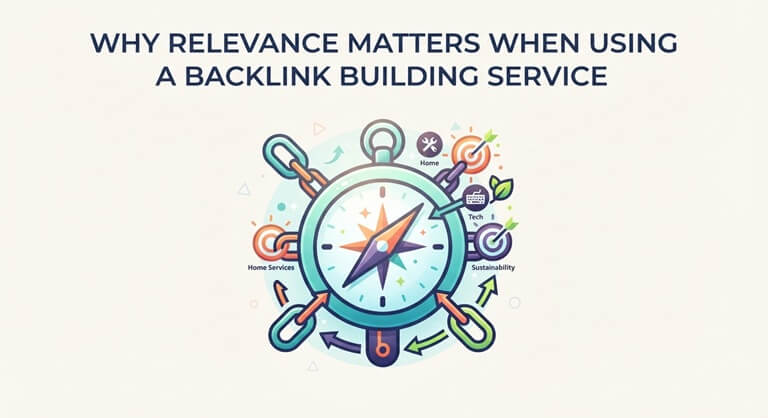
What Does Backlink Relevance Mean?
Backlink relevance refers to how closely the linking website, page, and content relate to the target page where the backlink appears. For instance, it makes more sense to have a placement on a cybersecurity company’s website in a tech or security magazine rather than on a random gardening website.
Relevance can vary: it may match the website’s industry, the article’s topic, or even the section where the link appears, answering a specific question the target page addresses.
Moreover, link quality also matters due to the manipulation prevention policies that search engines operate on, which is discussed in Semrush’s guide to unnatural links.
Why Relevance Matters More Than Raw Link Counts
There must be an inherent purpose for a link. When an article on content marketing refers to an article that builds authority, the link helps the reader take the next step. A link in an article that has nothing to do with the other article, just because it has good metrics, feels quite different.
Here are some ways relevant links help achieve the strategy:
- It makes your brand appear to a more appropriate audience.
- It creates more powerful topical associations around your website.
- It makes referral traffic more likely to be relevant.
- It provides the readers with relevant resources within an article.
- It makes outreach and guest posting feel more editorial.
There is still a place for links in the link-building process, but not for irrelevant links.
Domain Relevance vs. Page Relevance
Not all relevance is created equal. When assessing a backlinking opportunity, consider both the website and the specific page.
Website-level relevance indicates that the link has some industry-level relevance. Page-level relevance indicates more precise relevance. In other words, although a marketing website is relevant to a SaaS startup, an article about SaaS content strategy is more relevant than an article about offline marketing.
How a Backlink Building Service Can Evaluate Relevance
Professional campaigns take into account more than domain authority and traffic. Prior to placing an ad, check out what the website publishes and pose yourself the following questions:
- Is it common for the website to discuss the industry?
- Is the placement relevant to the destination page?
- Will the readers find the resource helpful?
- Is the website a source of valuable original content?
- Is the placement organic to the article?
- Does the website maintain its editorial direction?
A simple comparison makes the difference clearer:
| Factor | Relevant Link | Unrelated Link |
| Topic match | Strong connection | Little or no connection |
| Audience | Likely interested | Random or broad |
| Editorial fit | Natural | Forced |
| Referral potential | Higher | Usually lower |
| Content value | Supports the reader | Adds limited context |
| Long-term usefulness | More sustainable | Often limited |
The Role of Anchor Text
Anchor texts give users an indication of what they will find when they click on the hyperlink. It is supposed to be descriptive and appropriate for the surrounding sentence. Excessively optimized anchor texts can make a guest blog look promotional, especially if the same business-oriented phrase keeps repeating.
In Yoast’s article on the best practices for using anchor text, it is stated that good link texts are supposed to describe the destination and offer additional information about it.
Relevance and Referral Traffic
Backlinks and SEO metrics are often intertwined, but you should also consider referral traffic. When you link from a relevant website, there will be people who have interest in your topic already. They will be motivated to follow the link if it helps solve their problem via the article.
This is how a backlink from a site with a lower third-party metric than another site can be worthwhile because the topical audience is worth more for the business than any SEO metric.
How to Build a More Relevant Link Profile
Begin by outlining what subjects the website will deal with. Then identify sources that consistently cover these subjects in their articles. Narrow down the list based on relevance, quality of audience, editorial standards, and fresh content.
Finally, create some content that would give the publishers valid reasons to mention your resources.
Quality and Relevance Should Work Together
Relevance doesn’t mean ignoring authority, traffic, or website quality. All these factors have to go hand in hand. For example, a very relevant website that has poor content and dubious activities could probably not be worth the opportunity.
Backlinks should combine both relevancy and website quality. Companies should consider the full picture and not use a single metric to decide whether a link is worth having.
A Smarter Approach to Backlink Building
A backlink strategy succeeds when every link placement has a clear goal. Rather than considering how many links a particular service could provide, think about how these links would be able to increase topical authority, target the right audience, and bring actual value to your visitors.
The relevance will ensure it. It will connect your website to the ongoing discussions of your field and provide a place for backlinks in them.
When assessing link-building opportunities, pay them the same attention you give partnerships with content providers. Relevance is key to successful discovery, referral traffic, credibility, and a healthier content environment.
FAQs
1. Does every backlink need to come from the same industry?
False. The website doesn’t have to be exactly related to your business. The site should still have an important association in terms of the domain name, the page, the subject matter, or the target audience. Sometimes, even a general publication can do fine.
2. Is a high-authority website always a good backlink opportunity?
But not always. Authority metrics can help evaluate websites; however, they shouldn’t replace relevance and editorial quality. Sometimes a website may have all the metrics but lack relevance to the topic, making it less useful than a reputable, relevant publication.
3. How can I check whether a backlink opportunity is relevant?
Consider the site’s latest entries, classifications, audience, and editorial direction. Next, consider the page upon which the link would be found. Is the link helpful in providing information on the subject? If the link seems contrived, then find another place for it.
4. Should anchor text always contain my target keyword?
Not at all. Anchor text must describe the target link and fit naturally into the sentence. Using varied descriptions can improve readability and reduce the risk of creating links that appear over-optimized.
Sources
- Semrush — Unnatural Links: What They Are and How to Fix Your Link Profile
- Yoast — What Is Anchor Text, and How Can You Improve Your Link Texts?
Popular on OTW Right Now!


About The Author

Gagan Bhangu
Founder of otechworld.com and managing editor. He is a tech geek, web-developer, and blogger. He holds a master's degree in computer applications and making money online since 2015.