
Why Do Businesses Lose Customers Because of Slow or Outdated Digital Experiences?
In the current digital economy, speed and experience are not optional; it is a non-negotiable requirement. A customer does not complain before leaving; they quietly click away and never come back in most cases. Any minute of delay, any confusing interface, and outdated design element chips away at trust, loyalty, and eventually, revenue.
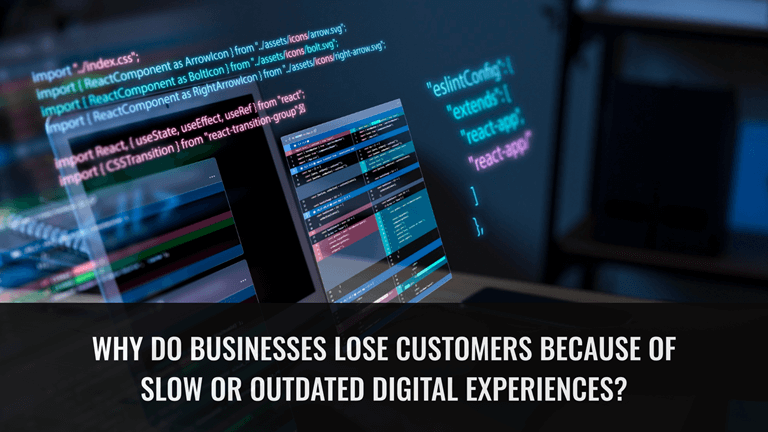
The digital consumer has become more unforgiving than ever, with a study conducted by Google finding that 53% of mobile users abandon websites that do not load in three seconds. Slow, or old-fashioned experiences, not only frustrate the user but actually hasten them into the arms of the competitors who provide faster, cleaner, and smarter experiences.
However, it is not only about the speed of the websites. It influences all the touchpoints (positions) of mobile applications and emails, landing pages, and social media campaigns. As a matter of fact, the brand perception is currently influenced by digital experiences to the extent that no single product feature is necessarily influential.
How Slow or Outdated Digital Experiences Drive Customers Away
Slowness or obsolete digital experiences are frustrating to the customer and put an invisible barrier that pushes the customer to the competitors. The customers simply want to have a smooth process on any platform, and even the slightest delay or an indefinite interface may lead to abandonment. To keep the users and make them loyal in the long-term, it is necessary to know how the problems influence the behavior of the user.
1. Customers Expect Instant Gratification
The contemporary consumer is pitting each touch with your brand against the highest online experiences that the consumers are exposed to in their everyday life, be it ride-cabbies, online stores, or streaming platforms. Consumers do not give a site or an application a chance when it is slow. Slow loading pages, slow response time, and slow user interfaces not only raise the bounce rate and cart abandonment, but also reduce user interactions and brand trust as well.
Not only does digital friction slow down the sales process, but it also has a detrimental effect on the vision of reliability and professionalism, and the customers are able to equate a bad experience to bad service, even in case the product remains great.
2. Friction and Complexity Increase Abandonment
The slightest hindrances can create a lot of anger. Long checkout forms, non-intuitive navigation menus, and different experiences on different devices, among other factors, also create friction to an extent that users are unable to carry out their intended actions. Customers do not leave a brand based on a lack of a product; they leave it because they find it too hard to access.
The unintuitive and complex processes make the user feel that it is more work than it is worth to deal with your business, and eventually, they will turn to competitors that do not offer that complication.
3. Outdated Design Signals Low Credibility
Design is more than just visual appeal; it’s a reflection of trust, professionalism, and attention to detail. Outdated interfaces, inconsistent branding, or poor mobile optimization issues often stemming from legacy approaches can be completely transformed through modern website development, which ensures responsive layouts, fast performance, and cohesive design.
Conversely, contemporary, hygienic, and unified design will give the users the assurance that the company is a professional, capable, and considerate enterprise that will meet their needs. A well-designed interface can make customers confident and can make them stick with the business, whereas an ossuaria interface will send the customer away in no time.
4. Fragmented Experiences Undermine Loyalty
In non-integrated digital platforms, tools, and data systems, the information about customers is dispersed across departments. The incomplete or inconsistent data is then worked with by the marketing, sales, and support teams in the form of misaligned messaging, lack of personalization, and fragmented campaigns.
Customers can see that their experience is fragmented, and when the same inconsistencies happen regularly, trust and loyalty decrease. The continuous, integrated, online experience is necessary in terms of fostering long-term relationships, and fragmented experiences lead users to competitors that offer smoother and more unified experiences.
How Businesses Can Retain Customers: Solutions That Work
Companies also do not need to lose their clients. They can design customer delight experiences by making them fast, usable, designed, integrated with marketing, and customized. This is where experienced digital partners play a critical role by helping businesses modernize platforms, optimize performance, and deliver seamless, user-centric digital experiences.
1. Optimize Performance
It is essential to have a quick, high-response platform.
- Minimize page load times and improve server speed.
- Compress images and optimize scripts.
- Implement Content Delivery Networks (CDNs) for global reach.
- Test performance regularly across devices.
Quicker experiences lessen the bouncing rate, augment the duration of the session, and enhance conversion.
2. Simplify User Journeys
The number one cause of abandonment is friction in the process of navigation or a complicated checkout process.
- Streamline forms and reduce steps.
- Provide clear calls-to-action.
- Use intuitive navigation and menus.
- Include in-app guidance or tooltips.
The ease of travel enhances interaction, boosts the level of sales, and simplifies interactions.
3. Modernize Design
A contemporary design enhances credibility.
- Modify UI as per the existing design trends.
- Ensure consistency across desktop, tablet, and mobile.
- Focus on readability, hierarchy, and accessibility.
The interface should be neat and professional, as it builds trust and strengthens brand recognition.
4. Adopt a Mobile-First Strategy
The mobile experience should be smooth since most of the traffic is via mobile devices.
- Optimize for smaller screens.
- Ensure touch-friendly elements.
- Enhance quick, frictionless mobile checkout.
Mobile optimization enhances conversions, engagement, and customer satisfaction.
5. Leverage Unified Platforms
The combination of marketing, selling, and support systems will guarantee that there is a single source of truth when dealing with all customers.
- Consolidate CRM, analytics, and marketing automation.
- Use shared data to personalize campaigns.
- Eliminate discrepancies and enhance cross-channel communication.
The single platform will promote uniformity in messaging, fewer errors, and trust.
6. Integrate Marketing Strategies
Digital experience is tightly linked to marketing effectiveness. Businesses should:
- Individualize marketing initiatives with behavior and purchase information.
- Retargeting and automated emails should be used to re-engage those who have left actions.
- Make content marketing and website experience unite to direct users through discovery to conversion.
- Make AI-based suggestions to provide a product or service that customers have acted upon.
Complementary marketing stimulates interaction, conversions, and brand loyalty.
7. Continuous Testing and Feedback
The digital landscape evolves quickly. Businesses must:
- Use analytics to monitor drop-offs and friction points.
- Conduct A/B testing to refine UX and design.
- Gather customer feedback in order to predict and resolve pain points.
Constant upgrading keeps your platform relevant, quick, and easy to use.
How Can Businesses Future-Proof Their Digital Experiences?
The digital environment changes fast. Companies that do not innovate face the risk of losing clients to their competitors who are embracing modern technologies. In order to be relevant and competitive, firms should embrace the use of tools and strategies that drive user experience, improve interactions, and create personalized value.
Voice Search and AI Assistants
Voice technology allows one to find, browse, and communicate with brands through natural language. By incorporating AI-based assistants into the digital platform, businesses can provide more convenient, quicker, and more user-friendly experiences without the necessity to navigate and type manually.
Why it matters: Voice search and AI assistants make interactions smoother and help customers to deal with less friction and build much more natural experiences. The brands that embrace the use of these technologies enhance accessibility, engagement, and customer satisfaction.
AR/VR Experiences for Product Visualization
Virtual Reality (VR) and Augmented Reality (AR) technologies enable customers to interact with and view products digitally. AR superimposes virtual contents on the physical world, and VR offers virtual worlds. These technologies change the interaction between the users and the products, and the interactions between the users and the products become more vivid and interactive.
Why it matters: AR and VR can boost the level of customer confidence and engagement as the interaction becomes more immersive. Companies adopting such technologies are able to be distinguished and create memorable and innovative experiences.
Progressive Web Apps (PWAs) for Fast Mobile Access
Progressive Web Apps are a combination of websites and native applications. They are quick, reactive, and they can operate with low bandwidth or offline. PWAs provide app-like experiences without downloads and thus guarantee users cross-platform access to seamless and reliable access.
Why it matters: PWAs increase the speed, reliability, and convenience, primarily with mobile tools. Brands implementing PWAs decrease friction, retain users, and generally engage users and convert more.
Hyper-Personalization Using AI and Predictive Analytics
AI-based personalization uses behavioral insights, tastes, and previous engagements to produce content, recommendations, and services that are uniquely personalized to the individual user. Predictive analytics can help businesses to foresee consumers and provide them with the most relevant experience that changes over time with consumer behavior.
Why it matters: Hyper-personalization will make customers feel that they are understood and appreciated. The more businesses apply AI-driven personalization, the more they engage and become loyal, and the higher the chance of a repeat purchase as they create an experience that resonates with an individual.
This investment in such technologies will keep businesses ahead of the times, provide new and olbunt village in the experiences and fulfill the increasing demands of the digitally-sensitive customers. The adoption of these innovations helps the brands to intensify engagement, thereby enhancing loyalty as well as ensuring long-term growth in a competitive digital landscape.
Conclusion
The customers in the modern day are not only brand loyal, but also loyal to convenience, pace, and simplicity. Delays or aged digital experiences push them unknowingly to the competition, which, in many cases, a business does not even detect. Due to the emphasis on fast, intuitive, and modern experience, combining marketing orientations and constant optimization of user satisfaction, companies will be able to gain trust, engagement, and repeat sales. All the interactions between the first and last customer conversion determine how the customers perceive and become loyal. Experience is the new loyalty in the digital-first world. Those firms investing in it keep their customers, become advocates, and grow sustainably.
Popular on OTW Right Now!


About The Author

Gagan Bhangu
Founder of otechworld.com and managing editor. He is a tech geek, web-developer, and blogger. He holds a master's degree in computer applications and making money online since 2015.