
What Multimodal AI Means for the Future of Consumer Technology
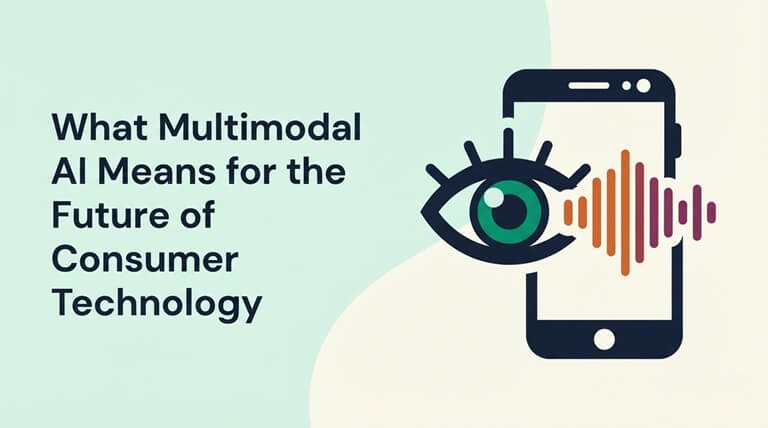
AI is moving in leaps and bounds, and one of the key areas of development is multimodal AI. Previous AI systems were essentially unimodal in that they could only deal with one type of input: text. Multimodal AI is able to deal with images, voice, video, and text all in one go.
With that capability, the technology can respond in a much more natural and helpful way. You don’t need to switch from tool to tool for different tasks anymore. You can have one AI system that can understand context from a variety of sources. As multimodal AI becomes more widespread, it will undoubtedly be the driver of the next wave of consumer tech.
What Is Multimodal AI?
Traditional AI models are generally focused on one type of information.
For instance, one system might be a text generator and another a text recognizer. Multimodal AI is the ability to bring those two together so that one system can deal with and integrate different types of data.
A user might ask a question out loud whilst showing the AI an object via the camera. The system will be able to look at both the image and the spoken question before it responds. It gives a much more natural experience, in the way we normally talk.
More Natural Human-Computer Interaction
People don’t tend to communicate via just one method.
In normal day-to-day conversation, we use speech, we use gesture, we use facial expressions, and we use what we see. Multimodal AI is the technology that enables it to do that.
Rather than having to type out a lengthy set of instructions, users can simply point a camera at something, ask a question and get help immediately. That’s much easier and makes AI accessible to people of all technical stripes.
Smarter Personal Assistants
Digital assistants are rapidly becoming much more capable as multimodal AI develops.
In the future, the assistant could do much more than just answer a spoken question. It could be looking at what you’re looking at, it could be aware of what’s going on around you and be able to make relevant suggestions based on that.
For instance, an assistant could spot a product as you’re shopping, give you a description of a landmark as you’re traveling, or assist with the repair of some piece of equipment by looking at a live camera feed and listening to your questions.
Wearable Devices Will Benefit Significantly
Multimodal AI is particularly useful for wearables.
Devices with cameras, mics, speakers, and AI can blend visual and audio information to provide assistance without the user having to constantly check their phone. That makes it much easier to get help whilst you’re walking, traveling, cooking or working.
As wearables get better, multimodal AI is going to be one of their key features.
Consumer Experiences Will Become More Personalized
AI already learns what you like, but multimodal systems are capable of a much better understanding of what you actually need.
AI can provide advice that is tailored to the individual situation by drawing on information from voice, visuals, schedules and habits. It could be suggesting travel routes, helping to organize your day or recommending what to buy based on your past behavior and what’s going on at the moment.
Personalization is likely to be a key feature of future consumer technology.
Shopping Will Become More Interactive
Retail is another area where multimodal AI could have a real impact.
Rather than just keyword searching, shoppers will be able to upload photos, ask questions out loud and get tailored recommendations. The AI will know what the customer is looking at and what they want to do.
This makes shopping easier and helps people to make better choices when they’re buying things.
Smart Glasses Highlight the Direction of AI
As multimodal AI develops, wearables are going to be a key way for consumers to experience it.
People who discover Ray-Ban Meta glasses are often introduced to more than just smart eyewear. They are also seeing how cameras, microphones, voice interaction, and artificial intelligence can work together in a single device. This combination demonstrates the practical value of multimodal AI by allowing users to interact with technology through both what they say and what the device can see, creating a more natural experience than traditional screen-based interactions.
This flexibility enables more people to use the technology and makes the digital services easier to use.
Accessibility Will Continue to Improve
Multimodal AI has the potential to make technology more inclusive.
People with different communication preferences or accessibility needs can choose the interaction method that works best for them. Voice commands, image recognition, text generation, and audio responses create multiple ways to access the same information.
This flexibility can improve usability for a wider range of users while making digital services easier to navigate.
Privacy Will Require Greater Attention
As multimodal AI starts to ingest more and more different types of personal information, privacy becomes even more of an issue.
Devices that use cameras, mics, location data, and AI require clear rules around how they collect, store, and use information. People now expect to know what happens to their data and to have real control over it.
Companies that are focused on responsible use of AI are more likely to build trust with people over time.
Developers Will Build New Types of Applications
Multimodal AI opens up opportunities for software developers and startups.
Apps can now combine visual recognition, conversation, translation, navigation and personal suggestions in one place rather than having a separate tool for each job. The idea is to build a solution that actually addresses a real-world problem rather than just a list of individual features.
This flexibility should help generate new ideas in areas such as education, healthcare, travel, retail, and productivity.
The Future Is Connected
Multimodal AI isn’t intended to replace the devices we have today. It’s about enabling them to work together in a more intelligent manner.
Smartphones, wearables, home assistants, cars and computers will all be sharing information more and more. The end result will be that users can seamlessly switch from one device to another without breaking their flow. AI will be providing the context so that the technology feels more connected and more responsive.
The end result is a system in which the information is ready when you need it rather than having to go in and enter it each time.
Final Thoughts
Multimodal AI is a massive leap forward for consumer tech. The idea is to bring text, voice, images, and all the other things together in order to create an experience that’s more natural and more useful, more in line with the way we actually communicate with each other.
As wearables, smart home devices and connected systems continue to improve, multimodal AI is going to play an ever bigger role in our lives. The companies that make use of these advances and get the privacy right will be the ones that shape the future of consumer technology.
Popular on OTW Right Now!


About The Author

Gagan Bhangu
Founder of otechworld.com and managing editor. He is a tech geek, web-developer, and blogger. He holds a master's degree in computer applications and making money online since 2015.