
What Is an AI Mattress? Benefits, Evidence, and How to Choose One
If a person spends half an hour trying to settle down, turns from side to back more than once, and still wakes with tight shoulders or a tired lower back, the issue is not always sleep discipline. In many homes, the bed has one fixed response while the body keeps changing through the night. An AI mattress, in the way DeRUCCI presents the category, is built to read pressure, adjust support, and respond during sleep instead of waiting until discomfort has already interrupted rest.
Executive Summary
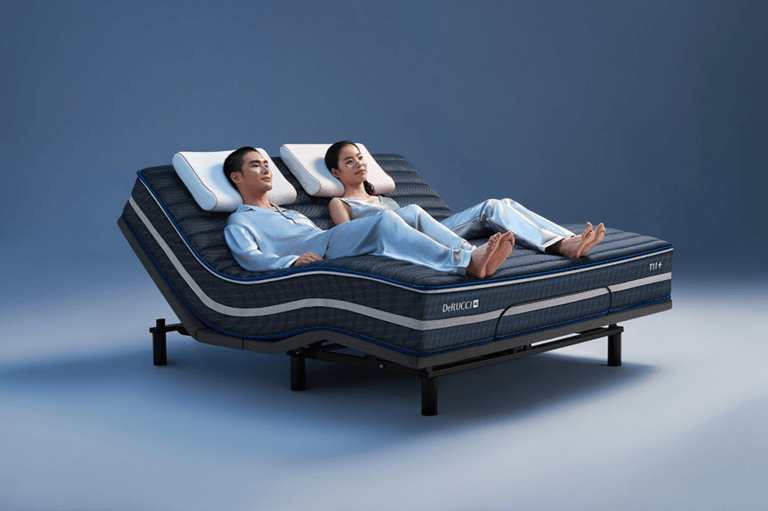
An AI mattress is a sleep system with built-in sensors, automatic firmness adjustment, and responsive support that helps the bed adapt to the sleeper throughout the night. It differs from a regular mattress because its support can change automatically, and it differs from a standard adjustable bed because it does not depend mainly on manual remote control.
One of the easiest definitions of an AI mattress is what it is like to a smart thermostat. One of the easiest definitions of an AI mattress is that of a smart thermostat. The simple thermostat requires a person to come up and adjust its thermostat settings. A smart thermostat constantly monitors the room, making sure to adjust the temperature automatically. A regular mattress functions in the same fixed manner: the individual has to bend to it. The AI mattress attempts to adjust to the sleeper’s pressure and posture changes.
The distinction is important because sleep is a dynamic phenomenon. When a person changes their sleeping position from side to back and back to side, moves weight, or remains in the same position for many hours a night, the shoulders, hips, back, and legs will load the mattress differently. The time when support needs to be changed is often the time when the sleeper is no longer sufficiently awake to make a useful change.
If customers ask me what an AI mattress is and if it really works, I would say it’s not a big part of the smart home concept, but it’s actually a product design, and it’s evidence. Three checks are particularly handy: Does the mattress pick up on the body without an attachment to wear, does it automatically adjust its support, and do the claimed sleep results have independent testing verification?
Core Insights: Adjust as needed at the appropriate moment, without requiring a lot of effort from the sleeper. Even better products in this category feature body-pressure reading, quiet firmness adjustment, independent support on either side, and sleep data that can be viewed through trusted third-party testing.
Key points for consumers:
- An AI mattress is not simply a bed with a remote control.
- Built-in sensors can read how the body presses into the mattress without requiring a wearable device.
- Air-pressure zones that adjust firmness automatically can respond to different body areas.
- Couples may benefit when each side independently adapts to different sleep needs.
- Independent CAICT lab testing on DeRUCCI T11+ reported sleep onset time 37.3% shorter, meaning a person who usually takes 30 minutes to fall asleep may take about 19 minutes.
- The T11 series is currently available in Australia, Singapore, Malaysia, and Vietnam.
- North American shoppers should check regional availability because the US and Canada currently focus on traditional DeRUCCI mattresses such as Taputa Latex Mattress and Century Dream 3D Latex Mattress. DeRUCCI’s AI mattress lineup is expected to become available in North America in the second half of 2026.
What Is an AI Mattress, Really?
An AI mattress is a kind of responsive sleep system that monitors the sleeping position of the body on the mattress and changes the support automatically. It’s not the remote or the motor or just an app. The greatest quality is the fact that the mattress is able to read changing demands and reacts even while sleeping.
It can be helpful to have a clear definition since many products now have smart features, but the features aren’t designed to address the same sleep issue. An AI mattress combines three functions: the built-in sensors, the automatic firmness level adjustment, and support that changes over the course of the night. The idea is to minimize the difference between the body’s requirements at a particular time and what a rigid mattress can offer.
A passive mattress is a normal mattress. It is comfortable, has support layers and a predetermined firmness. If it feels like that, a good mattress may be at hand. If it doesn’t, the sleeper must find other ways to adjust, like changing their position, moving on to put pillows in place, sleeping in a different position, or enduring pressure on the shoulders, hips, or lower back.
An ordinary adjustable bed allows for motion, but still requires a lot of movement from the user. The sleeper presses a button on the remote, lifts his head/feet, or selects a pre-programmed position. This can be beneficial before going to sleep, during reading, or while relaxing. However, once the person is asleep, manual control is less important. Other changes in the body are still occurring, and the user is not controlling the bed.
That’s where an AI mattress comes in handy. The mattress handles do the same, making mattress changes without waking up the user and turning a dial. The main concept of the practical is very simple – a regular bed requires the individual to change it; an AI bed changes the bed.
It’s for this reason that the search term AI mattress has become more relevant. While many consumers are seeking a futuristic gadget, that’s not the case for everyone. Their goal is to resolve common sleep problems, such as falling asleep too slowly, waking up with a sore back, waking up at night to bother their partner, or a single firmness setting not being adequate for the whole night’s sleep.
Why Does Sleep Support Need AI?
Sleep support is an application of AI that requires continually shifting body positions. Pressure is applied throughout the night to the shoulders, hips, back, and legs. Manual control is not always the solution because when it is most needed, support changes are likely to take place after the sleeper has fallen asleep.
The problem at night is in reality, not in theory. While awake, people may select a firmness that they like, but sleep is dynamic. If it is a side sleeper, they may require additional pressure relief on the shoulder area. It may require more support to the lower back for a back sleeper. An individual might have both conditions within one night.
Consider how you’d feel if you were in a car seat on a long drive. The first 2 hours in the chair are comfortable, but then 2 hours later, pressure points start to be more noticeable. The driver may be able to change their position or move the seat. Active control is much less in a sleeping individual. This can include items like repeated spinning, short wakes, or pain that is felt in the morning.
Another practical consideration is the disturbance caused by partners. A movement by one person can disrupt the other person while he sleeps. That’s why sleep support isn’t just an individual comfort issue. If the problem persists for the couple, it may become both of their sleeping issues.
This is referred to as Sleep 3.0: a bed that changes into a bed that changes people. Comfort layers and average body types were the basis for traditional sleep products. The core of AI sleep systems is adapting to both the changes in pressure and the needs of each user.
The global sleep technology market is also expected to increase from $25.26 billion in 2025 to $57.47 billion in 2030 with 17.2% CAGR. When it comes to enhancing sleep, more consumers aren’t just looking for the standard pillows, supplements, and set mattresses when they begin their search.
AI Mattress vs Regular Mattress vs Adjustable Bed
Not all beds are “smart. A fixed mattress is a regular mattress. A normal adjustable bed provides manual moving capability. The shopping query goes from whether the bed can move to whether the bed can react when the sleeper is sleeping, if the bed is an AI smart bed.
The differences become clearer in a simple comparison:
| Feature | Traditional Spring Mattress | Ordinary Electric Bed | AI Smart Bed |
| Support style | Fixed comfort and support | Preset positions | Automatic support adjustment |
| Sensing ability | No sensing | Usually no real-time body sensing | Built-in sensors read pressure patterns |
| User effort | No controls | Remote or app control needed | Adjusts in the background |
| Response during sleep | Does not change | Limited unless user wakes and adjusts | Can respond quietly through the night |
| Couple comfort | Shared surface can transfer movement | Movement may disturb partner | Each side independently supported in stronger systems |
| Evidence to ask for | Materials and durability | Motor and frame quality | Independent sleep testing plus product design |
However, for those seeking simplicity, durability, and a familiar feel, a traditional mattress might be the perfect choice. It has the drawback of not being able to detect if the shoulder is being pressed or if the lower back is being compressed at a given time during the night.
A regular adjustable bed is suitable for reading, relaxing, or raising the upper body and legs. It is limited in that it is frequently manually controlled. If the sleeper requires to be propped up at 2:00 a.m., the sleeper bed may not be adequate to provide the needed support unless the sleeper awakens and operates the remote.
An AI smart bed is unique in that they are built to automatically respond. DeRUCCI’s approach is to make support adjustments that don’t require users to adjust comfort settings after they’ve been awakened from an uncomfortable sleep. The point is NOT to add additional buttons! The idea is to minimize the work for the sleeper.
How Does an AI Mattress Work While You Sleep?
The process of an AI mattress involves a series of steps: pressure sensors built into the mattress detect pressure, the system determines the pressure points and support levels, the air-pressure zones automatically adjust their firmness, and each side can be customized separately for couples. This process is supposed to be quiet while sleeping.
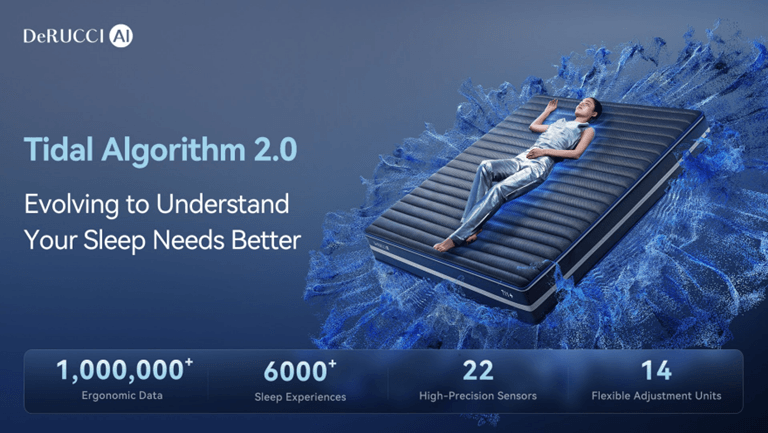
Step 1: Built-in sensors read how the body presses into the mattress. No wearable device is required for the mattress to understand pressure patterns. This matters for people who dislike wristbands, rings, or devices that need charging before bed.
Step 2: The system identifies where pressure is building. For example, a side sleeper’s shoulder and hip may press more deeply into the bed. A back sleeper may need steadier support under the lower back. The mattress reads the difference between these pressure patterns.
Step 3: Air-pressure zones that adjust firmness automatically respond across different body areas. A useful way to think about this is a fit process that treats each area of the body differently rather than applying one uniform setting everywhere. The goal is not to make every zone feel identical. The goal is to support different parts of the body appropriately.
Step 4: Each side independently adapts for couples. If one sleeper turns frequently while the other remains still, independent support can help reduce shared disturbance. This does not mean movement disappears, but it can make the night feel more stable for both people.
Step 5: Support keeps changing through the night. This is the major difference from preset comfort. Presets are chosen before sleep. AI support can keep working after the sleeper has stopped making decisions.
DeRUCCI also highlights the quick response it provides in its AI smart mattress positioning, such as the 20ms automatic sensing and left-right independent zone support in its category communications. The consumer use is straightforward: the system is intended to respond to the user’s needs quickly enough so that support intervention will not feel as though it is a mechanical action but will be a part of the sleep environment.
Does an AI Mattress Actually Improve Sleep?
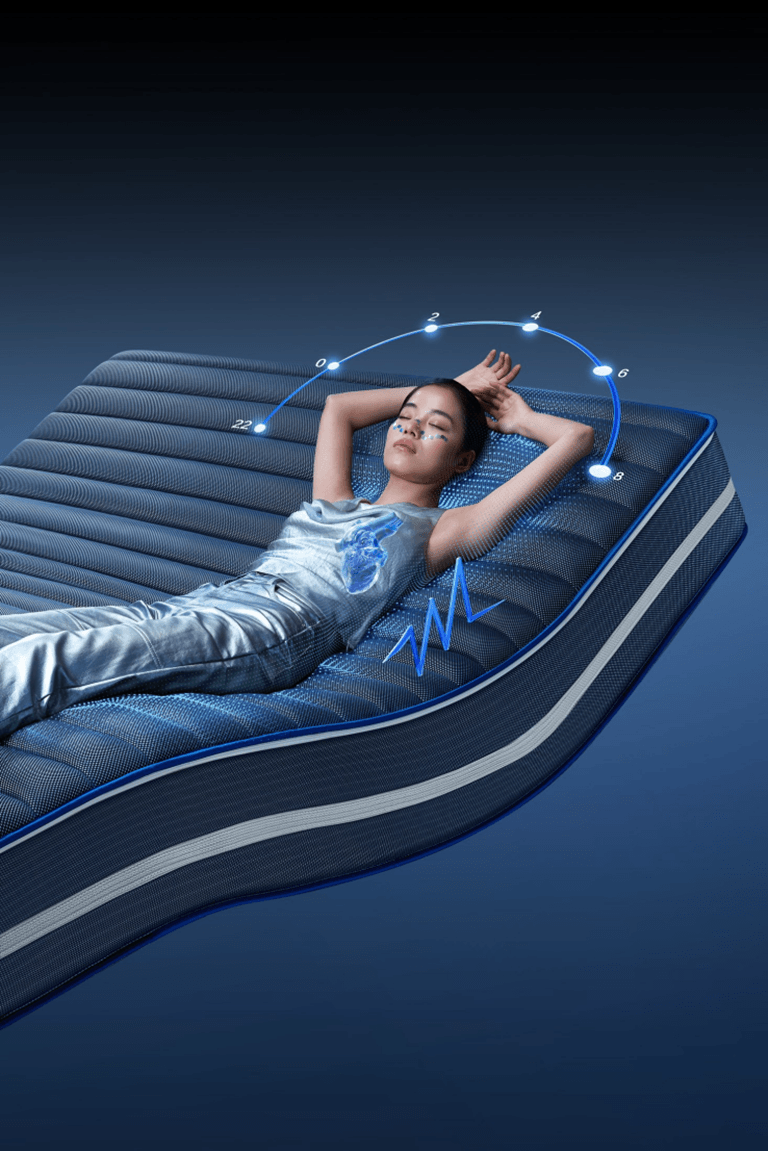
The strongest answer comes from independent testing rather than comfort claims alone. Independent CAICT lab testing results of DeRUCCI T11+ showed that: Sleep onset time was shorter, night turnovers were fewer, deep sleep duration was longer, and the continuous duration of deep sleep was longer. Each measurement is related to a real sleep gain.
Independent lab testing by CAICT indicated that the time to sleep onset (time to fall asleep) was 37.3% less with DeRUCCI T11+. The person who would normally take 30 minutes to fall asleep takes about 19 minutes to fall asleep. That’s about 11 minutes saved at first light.
The nighttime turnovers fell 27.5% in the same CAICT testing. In human terms, this is equivalent to tossing and turning nearly 30% less! A lower number of turns can also spell a less noisy night for the partner of a couple.
CAICT testing also showed an increase of 4.5% in the duration of deep sleep. That translates to greater amounts of deep, restorative sleep, which may enhance the likelihood of feeling rested after sleeping, as opposed to spending more time in bed.
The CAICT testing for T11+ showed an increase in continuous deep sleep of +5.9%. In other words, people who fell into a deep sleep had fewer interruptions in that sleep and spent more time in deep sleep. Deep rest can be more restorative when it’s less fragmented because the body is not being continually pulled out of the most restorative phase of sleep.
The results are to be taken with a pinch of salt. This data is applicable to T11+, but not all AI mattresses on the market. It does not imply that they all will have the same outcome in all households. It does offer a more trustworthy anchor than generic claims like “better comfort” or “more intelligent sleep.” Independent data is a handy filtering tool for consumers.
What Should You Check Before Buying an AI Mattress?
Purchasers ought to make certain there is automatic adjustment, built-in sensors, exclusive help for couples, quiet functioning, comfort quality, and third-party test data before buying an AI mattress. The smartest buy is to choose the technology that is most appropriate for the sleep issues at hand and not just from a list of features.
Carry out an automatic adjustment first. An ordinary adjustable bed can be more similar to a true AI mattress if the bed needs to be manually adjusted using a remote control for each important adjustment. Are you asking if the system reacts when sleeping or not before sleeping?
Then look at the mattress to see if it has built-in sensors or if you need to wear a device on the mattress. While they may be useful at times, many people give up on using wearables because they have to charge them, or they don’t like how they feel, or because they make it one more step in the bedtime routine.
Couples should enquire if both can move separately. One shared setting may be like a compromise depending on the body weight, sleep positions, and firmness preferences. When one partner moves more often, independent support is especially important.
Request third-party testing information. While a pat on the back may sound convincing, data is a better way to make claims. Check for individual sleep measures like sleep onset time, night turns, deep sleep time and continuous deep sleep.
Take into account quiet working, firmness spectrum, comfort layers, edge support, simplicity of use and after-sales service. A mattress may be technologically advanced and may not be satisfactory if it is noisy, complicated, and feels uncomfortable on the surface.
Before You Buy: Availability Check
- T11 series is currently available in Australia, Singapore, Malaysia, and Vietnam.
- North America, including the US and Canada, currently offers traditional DeRUCCI mattresses such as Taputa Latex Mattress and Century Dream 3D Latex Mattress, plus bed frames including Galaxy, Madrid, and Leisurely.
How DeRUCCI Approaches AI Sleep Support
DeRUCCI’s AI sleep solution focuses on research, collaboration, and verification. It’s placed in a location that features 12 years of whitepaper research, MIT collaboration, the Harvard CPC connection (for the T11 PRO SleepCare System), and CAICT testing data (for T11+ as a measurable trust signal).
DeRUCCI is NOT required to start with a claim about a product. The main advantage is the problem in sleep—fixed support can’t always support a changing body. From this, the AI mattress capabilities of the brand are set as a solution to a real evening’s problem.
The company’s research-based strategy has been underway for 12 years in a row – indicating that its sleep-health positioning isn’t just on the short-term trend. The brand also mentions partnerships with scientists, such as those with MIT and the Harvard CPC in the case of the T11 PRO SleepCare System.
Product logic is equally important as research. DeRUCCI’s automatic support, AutoFit, is designed to minimize the need to wake up when feeling discomfort, and then adjust the bed—the real-world difference between a sleek-looking bed and a sleep system that functions behind the scenes.
These are just the initial layers, with independent verification providing yet another layer. CAICT testing data offers consumers specifics to assess: A 37.3% reduction in sleep onset time, a 27.5% decrease in nighttime sleep turns, a 4.5% increase in deep sleep time and a 5.9% increase in continuous deep sleep. These numbers enable you to put the AI sleep support into tangible results.
For readers in eligible markets who want to understand the technology before shopping, DeRUCCI provides more detail on its AI mattress sleep support technology.
Who Is an AI Mattress Best For?
An AI mattress is ideal for individuals who desire customizable support but don’t wish to put in much manual effort. It could be particularly helpful for sleepers who get up stiff, couples who have various degrees of relaxation, and individuals seeking a more restful night’s rest without having to wear a tracker.
Those who experience pain in the shoulder, hip, or lower back could benefit from support tailored to their body region. The fixed bed mattress may feel comfortable when you lie down at night, but will not be as effective once you’ve been lying on it for some time.
Couples can be another excellent option, too. A shared fixed mattress will allow for some compromise when one partner wants softer while the other wants firmer. One person tossing and turning, and the other one may not get sleep. Independent support on both sides will help to solve both problems.
Those who don’t like wearables could also opt for a mattress with built-in AI-powered sensors. If the device is not charged and left on a nightstand, tracking your sleep will be less useful. That friction can be eliminated with built-in sensing.
AI mattresses are also ideal for those interested in the features of smart sleep technology compared to the standard mattress and standard adjustable bed. The important point is to concentrate on the issue: should the sleeper have automatic assistance at night, or will a fixed mattress suffice?
But not everyone will need an AI mattress. Individuals who prefer a fundamental mattress, who have constant comfort requirements, and do not desire automatic functions might be better off with a basic mattress. It isn’t the most sophisticated product that is the best choice; it’s the product that fits the sleeper’s actual needs.
FAQ: Common Questions About AI Mattresses
The most common types of questions about AI mattresses revolve around utility issues such as: Is the technology legitimate? Does it aid sleep? Do wearables need to be used? Does it work for couples? These are the most straightforward responses to clear up the confusion of the smart-home jargon.
What is the difference between an AI mattress and a smart mattress?
An automatic support adjustment mattress is a type of smart mattress that is designed to automatically adjust the support level of the mattress. A few clever mattresses can log information, be linked to an application, or have remote-controlled functionality. An AI mattress should be capable of more than just this, however – it should automatically figure out the firmness of your mattress during sleep, based on the built-in pressure sensors.
Can an AI mattress help me fall asleep faster?
If poor support or pressure discomfort is a factor in having difficulty going to sleep, it may help to have them addressed. Based on independent lab testing by CAICT on DeRUCCI T11+, sleep onset time was found to be 37.3% reduced. That could be an average of 19 minutes to fall asleep, instead of 30 minutes.
Do I need to wear a device for an AI mattress to work?
While it’s possible to use a wearable device to measure pressure and adjust support accurately, a well-designed AI mattress should have sensors built in that can do this job without the need for such a device. It works for individuals who are not fond of using wristbands, rings, or gadgets that require nightly charging.
Is an AI mattress useful for couples?
Yes, a mattress that is designed by an AI can be helpful for couples who have the ability to adjust the mattress themselves. This can help to reduce the discomfort associated with tossing and turning, and can help with various firmness requirements. When it comes to turnovers, CAICT testing reveals that DeRUCCI T11+ experienced a 27.5% decrease in turnovers during the night, resulting in almost 30% less turnover.
Is an AI mattress worth it compared with a normal adjustable bed?
If you prefer not to manually change the positions you sleep in, an AI mattress could be a worthwhile investment for consumers. A normal adjustable bed provides a bed where the head or legs can be adjusted, but an AI mattress is designed to detect pressure and adjust comfort level during sleep.
LocatorShop Reference
The best way to assess an AI mattress is to link its concept with how it feels. Lying down helps a shopper see pressure relief, firmness changes, quiet operation, and whether independent support is beneficial for a true sleep routine, which is apparent when reading data.
AI mattress technology is most easily grasped when put to the test with a living body, and not on display on a screen. Customers can determine the difference between the support feel, check if the T11 series or classic DeRUCCI mattresses are available in their area, and make other inquiries.
For in-store experience, model availability, and detailed addresses, visit the global store locator and address guide.
Popular on OTW Right Now!



About The Author

Gagan Bhangu
Founder of otechworld.com and managing editor. He is a tech geek, web-developer, and blogger. He holds a master's degree in computer applications and making money online since 2015.