
What Happens When a Parcel Can’t Be Read by the Scanner
Every modern parcel delivery system depends on a tiny strip of ink: the barcode or QR code printed on the shipping label. These codes help automated sorters route parcels quickly and allow customers to follow their package in real time. But what happens when the scanner can’t read the code? Damaged labels, smudged printing, and even glare from clear tape can push a package out of the automated flow and into the world of human hands.
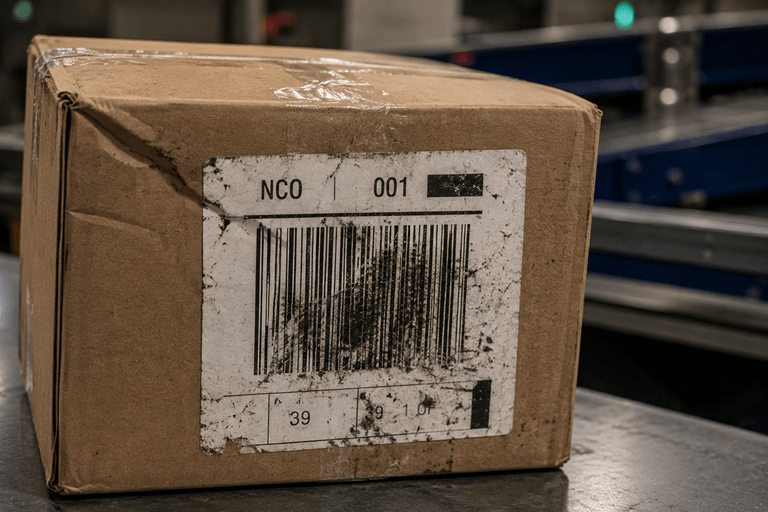
Why do labels become unreadable?
Shipping labels are machine-readable, but so much can go wrong en route to the shipping hub. The experts in the field point to a number of factors that can cause the barcode to be illegible, such as poor print quality, damaged or worn barcodes, errors in size or resolution of the printed label, or incorrect placement on the label.
Moisture, heat, or direct sunlight can also damage the ink on your label. Moreover, the human mistake is responsible for wrinkles, misaligned labels, ng or applying labels on curved surfaces,ces which contributes to the issue. These problems can be a problem in warehouses, which can delay order fulfillment and cause them to revert to manual data entry. This means that there is a high risk of errors and delays occurring.
From automation to manual intervention
If a sorting machine cannot read a bar code, it won’t just cease to attempt. If a sorting machine is not able to read the barcode, it does not stop trying. On the contrary, packages are diverted to exception lanes where human employees have to intervene. If an item has damaged or illegible labels, operational guidelines identify the practice of rescanning the item on handheld machines, staff manually keying in the necessary information, and, in some cases, using a different barcode to relabel it.
Replaces the package in the automated stream (manual action. It does need to be scanned two times, however, compared to a cleanly scanned parcel. Leaving undecipherable labels can cause bottlenecks, even if it is just a portion of them. In a high-volume facility, for instance, 5% of the volume may require manual work, which could result in thousands of items being handled by exception processing daily as they leave the main conveyor.
What it means for tracking and customers
In an online tracking feed (assuming you are tracking your order online), an unreadable barcode will appear as a label issue or shipment exception. If parcels can not be read in the exception lane, tracking may be delayed or interrupted until the parcel is reprinted and re-scanned.
This manual handling operation is, however, still considered the official chain of custody. Retagging and scanning of your package restarts once your package is relabelled and scanned, and you may continue to track your delivery. If the address is still clear, the parcel will typically move forward without difficulties. Carriers won’t accept the package or request instructions from the sender unless it is completely destroyed or there’s no address.
Innovations to minimise scanning failures
There is more investment in technology to decrease the rate of unreadable labels in the logistics industry . The logistics industry invests in technology to decrease unreadable labels. Thermal printers are more sophisticated, ed and everyone’s printing company now uses high-contrast ink, which results in crisper barcodes. Newer 2D codes, in a similar way, have more data in a smaller space.
A few operators are even testing radio frequency identification (RFID) tags, which can broadcast even in non-line-of-sight conditions and are capable of handling rough conditions. These tags can be read in tens/flowed through tunnels with antennas, and hundreds of parcels can be identified simultaneously. Moreover, the quality control, such as regular checks on labels and employee training, helps identify mistakes,s such as labels that might be miswritten or misplaced, ed before the parcels get out of the warehouse.
Tips for senders to avoid exceptions
There are things you can do as a shipper to help make your system better, but there are also things carriers can be working on to make their systems better. Use high-quality printing and use surfaces that are flat and free of obstructions. Also, protect them from moisture or abrasion.
Don’t put any shiny, reflective material over the barcode, as that may cause some glare to happen during scanning. If it’s a high-value or an international shipment, use multiple labels. Have one on top and place a second in a clear plastic bag. So, if the external label is damaged, then one can always replace it.
Keeping packages moving
Unreadable barcodes are an invisible but important part of the logistics story. They slow down operations, increase costs, and can briefly interrupt customers’ tracking updates. Yet the industry’s response—manual intervention, improved printing technology, and newer ID tags—helps keep parcels flowing smoothly. For shoppers, the best way to stay informed is still to follow the tracking information provided. A universal shipment tracking tool that gathers updates from different carriers into one dashboard can quickly alert you to exceptions and reassure you that your delivery is still on its way. You can explore one such platform, shipment tracking, which consolidates scans from various networks and helps you stay informed without having to contact every carrier individually.
The strangest causes of scanning failures
Not all unreadable barcodes are due to rain or damage. Shipping tape often covers labels already used for shipping, boxes are often folded at the corners, labels get scratched when being transported, and labels are often overlapped with other shipping labels that have been attached to the boxes on the journey.
Bright warehouse illuminations can also create glare that can mislead scanners, and reflective packaging can also mislead scanners. With many labels going to customers each day during high-volume periods, millions of labels can be printed daily. So, sometimes even a tiny mistake in your print statement will put your parcel into manual shipment.
What happens if nobody can identify the package?
The least common scenario is if both the barcode and an address are totally lost within the image. Rather than discarding the parcel at once, the carrier normally takes the package to a special facility where staff follow the instructions on the package to determine the recipient of the package.
Even things like warranty cards, product packaging, receipts, and even handwritten notes can help to tie an invoice to its remitter or recipient. This is key, as there are many parcels that appear to be lost and falling off the track of orchestration to be found again and then handed over to the appropriate parties. Don’t worry if tracking suddenly stops updating. That’s all.
Popular on OTW Right Now!
-
 Does Pump Selection Actually Move the Needle on Cooling System Energy Use?
-
 Austin Wood Fence Quotes Explained: Materials, Post Systems and 2026 Cost Checks
-
 The Role Of Inclusion Initiatives In Modern Healthcare Businesses
-
Best Pizza POS System: What Pizzerias Need for Delivery, Modifiers, and Fast Checkout



About The Author

Gagan Bhangu
Founder of otechworld.com and managing editor. He is a tech geek, web-developer, and blogger. He holds a master's degree in computer applications and making money online since 2015.