
What Businesses Should Know Before Signing a Contract Without Legal Review
Business owners deal with contracts all the time. Vendor agreements, lease renewals, service terms, and partnership deals often come with deadlines, making it tempting to sign quickly and move on.
The problem is that a contract can create obligations. A contract is a binding promise. Once you sign, the other party can hold you to every word, whether you understood it or not. That does not mean every contract requires the same level of review. But knowing what to check before signing can help businesses spot important risks.
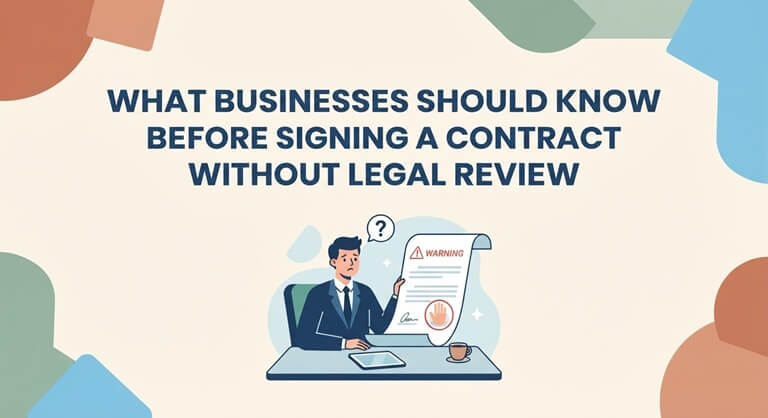
This article covers the value of legal review and how AI-assisted tools are changing the contract review process.
Skipping Review Doesn’t Remove the Risk, It Just Delays It
The risk sits inside the document until a dispute forces someone to read it closely. By then, no one can undo the terms.
Much of this harm is done by vague language. “Reasonable time” instead of a specific date in a payment term provides an opportunity to dispute later. When it comes to figuring out what something means, the more resources you have, the more likely you are to win the argument and get your way. If something is ambiguous, the one with the most resources is most likely to get what they want and argue their way to it.
As contracts get longer and longer, they also tend to include provisions stacked on one side, particularly if one party has their lawyer prepare the template. Typical vendor or SaaS agreements have provisions that are structured to benefit the vendor, not the customer that is signing the contract. Without review, those terms are as strong as any negotiated in good faith.
Certain Agreements Deserve a Closer Look Before You Sign
While every business contract needs review, the time available to review varies widely. Some of the most common ones can be the most detrimental when businesses rush through them; they are worth paying attention to when time is limited.
- The agreements between vendors and suppliers can also have conditions of liability, delivery terms, and renewal provisions which impact a business for years to come.
- A company may be locked into a lease or commercial rental agreement for a site and a rental schedule that may not make sense for that company, even after the initial agreement has expired.
- Independent contractor agreements and employment contracts also have inherent risks, including with respect to ownership of intellectual property and non-compete provisions.
- The same should apply to partnership and investment agreements, which set out the terms (profit, control, exit, etc.) between the parties who are invested.
- Most contract disputes are caused by what are known as a small number of Clauses. These clauses cause most contract disputes.
A Small Number of Clauses Cause Most Contract Disputes
A lot of contract issues can be boiled down to some overlooked clauses. Such terms can make a difference in what occurs if the business association doesn’t go the way it should.
- Indemnification clauses can decide who pays for certain losses or legal claims.
- Termination clauses explain how either party can end the agreement and what notice or costs may apply.
- Auto-renewal clauses can extend a contract if you miss the cancellation deadline.
- Liability caps also matter because they may limit how much one party can recover if a dispute occurs. Without a favorable limit, a business could face greater financial exposure than expected.
These clauses can be a component of a contract that is relatively brief, but can be quite significant.
A Lawyer’s Review Catches Problems Before They Become Expensive
This isn’t a time to rewrite the contract from beginning to end. It’s all about knowing which terms are potentially hazardous and which are ones to negotiate prior to signing.
A lawyer doesn’t read a contract to find words that will end up damaging the client; a lawyer reads a contract to see if those words are there.
That typically involves comparing the contract’s terms with those of similar contracts, flagging missing protections, and ensuring fair obligations on both sides.
Attorneys also look for conflicting provisions, as templates or previous agreements can create inconsistencies.
AI Tools Are Changing How Fast That Review Happens
Traditionally, reviewing a contract involved hours of manual reading, especially for longer contracts or high volumes of repetitive agreements. With the scrutiny that contracts require, law firms are now embracing the use of AI-driven platforms that accelerate that initial draft.
Spellbook AI for contract review and drafting is one example. Legal teams use it to redline contracts according to their criteria and highlight risky provisions before an attorney completes the review. Spellbook does not take the place of legal judgment. Rather, they provide the attorneys with a quicker “starter.
Knowing When to Involve a Lawyer Protects the Business Long-Term
All contracts do not require the same type of legal examination. If it is a simple agreement and is not going to be a high-risk agreement, then it may only require a careful internal check. However, if the contract involves a significant amount of money, a long term, a large liability, or an important business relationship, it’s important to explore the basis of the contract before it’s signed.
A 5 Year lease, investment agreement, or long-term vendor contract can impact the business for years. If the exit were to be more difficult and/or more expensive, legal advice might be more valuable.
The objective is not to send all documents to a lawyer. The point is to know when the consequences make the review worth it. Most of the time it is much more convenient (and cheaper) to have a brief consultation with a lawyer before signing than to deal with a problem that has turned into a conflict.
Popular on OTW Right Now!



About The Author

Gagan Bhangu
Founder of otechworld.com and managing editor. He is a tech geek, web-developer, and blogger. He holds a master's degree in computer applications and making money online since 2015.