
What a Dead QR Code Actually Costs Your Business: $5,000 to $40,000 Per Incident
A regional brewery prints 25,000 bottle labels with a QR code linking to a tasting notes page. The labels cost $0.12 each to print, $1,800 for design, and take three weeks to apply across a seasonal run. The QR code platform will end with the trial after 6 weeks of launch. All scans return an error. Glass is glued with the labels. These cannot be interchanged. The brewery will have to decide whether to keep the dead codes on 25,000 bottles for the remainder of the season or pay the brewery a $6,200 reprint and label charge in addition to their original investment. Both options didn’t recover the customer interactions that were lost over the weeks they were dead until they were noticed.
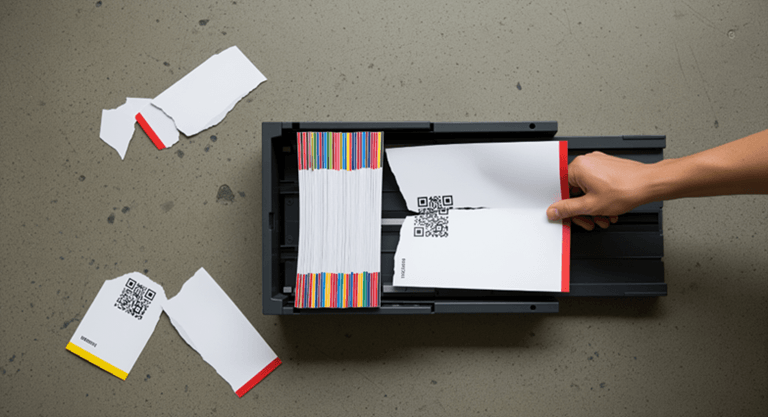
This is a reality for businesses, often,n and the amount of money in the bill is more than they anticipate.
The Hard Costs
Here is what a typical incident looks like when broken into line items.
Printing costs vary by format, but common ranges tell the story. Business cards run $0.10-$0.25 per unit. Product labels cost $0.08-$0.15 each. Brochures and flyers cost between $0.30 and $1.50. Event signage costs $15-$75 per piece. A run of 10,000 brochures at $0.80 each is $8,000 in printing alone. If those brochures carry a dead QR code, they need to be replaced or discarded.
Design costs compound the damage. The cost for reworking files, updating assets, and coordinating with the printer depends on the complexity of the revision cycle and is $500-$2,000 per cycle. If the original designer is not available, then the new designer must be able to reconstruct from the source files (if they are available).
Distribution and labor are often the largest hidden line items. Someone boxed and sent the brochures to 12 locations, gave them to people on the staff, and placed them on display racks. Repeat of this doubles the logistics expenses. Redistribution costs $1000 – $5000 for a multi-location operation.
| Cost category | Low estimate | High estimate |
| Reprinting (10K units) | $1,000 | $15,000 |
| Design revision | $500 | $2,000 |
| Redistribution/labor | $1,000 | $5,000 |
| Disposal of dead materials | $200 | $1,000 |
| Staff time investigating the issue | $300 | $1,500 |
| Total per incident | $3,000 | $24,500 |
The figures start to get into the thousands of dollars when the print runs are greater, such as product packaging, trade show,w or direct mail pieces over $40,000. This doesn’t even include baseline marketing print waste. But 25% of all print marketing pieces go to waste, according to a survey of marketers conducted by Staci Americas, and that’s before any QR code goes astray.
The Costs That Don’t Come With a Receipt
The invoice totals are painful. The damage that never gets invoiced is worse.
Lost customer interactions represent revenue that simply evaporates. Every QR code on product packaging that is not scanned and redirected to the customer registration page, loyalty program, or customer feedback form is sending a message to the customer that it’s not working. If there are 50,000 packages that are being scanned at 3% per second, that means there is a total of 1500 possible customer touch points lost every second. Just 10% of those of them that would have been converted to a sale or sign up were lost for the business, and they will never be seen again.
Brand perception damage is harder to measure but easy to feel. The customer reads a QR code and is presented with an error page. This customer’s instant verdict: This company doesn’t have its own materials. The scan may have been the only way for restaurants to get to the menu. In the case of a product, it could have been the only means of getting warranty information. The customer does not think “there’s a billing problem on their QR site. The customer believes that the business is broken and has some questions to ask.
Time-to-discovery gaps make everything worse. After printing, most businesses don’t monitor their QR codes. A customer complaint may take 14 days (or longer) to appear, after which the code may be back in business for two weeks before another customer complaint. In that time, all of the printed materials were creating negative impressions rather than positive ones.
At other times, it is impossible to repair the damage at any cost. A promotional campaign printed on ketchup bottles to use QR codes in 2015 resulted in a third party grabbing the domain name, and the QR codes now go to an adult website, said Heinz in the announcement. The bottles were already widely used in German homes. Re-printing was not possible. Heinz was very sorry and removed the codes from those bottles, but they did not go away.
Why This Keeps Happening
The problem is that a business model has been adopted by the majority of QR code companies: provide a trial for free, let users make and print dynamic QR codes during the trial, then disable the codes after the trial period, unless the user begins to pay.
A dynamic QR code that can route scans through a platform’s server to allow for changing the destination and tracking scans provides the platform with a kill switch. The code that is printed on your material remains the same. It’s as if the server that is behind it just doesn’t respond.
Typically, most of the platforms offer somewhere between 7 and 14 days of a trial period. This is explicitly mentioned in the support documentation of QR Code Generator by Egoditor—Dynamic codes generated while the trial is on are disabled at the end of the trial. Similar to this, companies like Beaconstac, Uniqode, a nd QR Tiger work on a monthly subscription basis, which ranges from $5 to $17 a month. It’s not the fees for these platforms that are the problem. The issue is codes that are developed during a trial period are hostages. You print them in good faith at a time when you think it’s a product evaluation, and they turn into leverage when it isn’t.
The same issue is seen across Trustpilot reviews made for the top QR platforms. Users introduce their types of printing materials as part of their trial and find that the codes were no longer working on the trial’s end, and then find out that they have only two choices: either they have to pay, or they have to re-print. One reviewer said it was a “ransom note for my own marketing materials.
How FreeQR Eliminates This Risk
FreeQR was built specifically so that this failure mode cannot occur. The way it works is a free-first model: QR codes generated with a free account will remain active forever. No trial period, no credit card needed, and no countdown to deactivation.
FreeQR combines a QR code generator and a micro landing page builder, providing you with a dynamic QR code building tool. Every QR code is for a personalised landing page featuring image, video, contact, social media, form, and file download blocks. Scan analytics is available in the free plan. Higher numbers of teams and higher volume do have paid tiers, but the free plan is actually a good working plan, not a 14-day pressure device.
For businesses doing the math, FreeQR replaces a redirect service ($8/mo), a link-in-bio tool ($15/mo), a basic form builder ($20/mo), and scan analytics ($29/mo). That is $72+ per month in tools consolidated into a single free platform. More importantly, it eliminates the reprint risk entirely. A code created on FreeQR’s free plan today will still scan a year from now, regardless of whether the account ever upgrades.
This Is a Risk Management Decision
The expense of selecting the incorrect QR code platform isn’t really the monthly subscription fee. It’s the $5,000 to $40,000 reprint costs after sending out materials, plus the interactions with customers that go away while dead codes languish on shelves, plus the hours of staff time wasted trying to figure out what went wrong.
One thing to test before you send your design to a printer: If you don’t pay the platform another dollar, will the QR codes on this material be usable 6 months from now? If it’s no, or a reading of fine print is required to find out, the platform has explained how it intends to profit from your print run. A free dynamic QR code generator that keeps codes active permanently is not a convenience — it is insurance against a reprint bill that dwarfs the cost of any subscription.
Popular on OTW Right Now!


About The Author

Gagan Bhangu
Founder of otechworld.com and managing editor. He is a tech geek, web-developer, and blogger. He holds a master's degree in computer applications and making money online since 2015.