
Vacuum Casting Service for Rapid Prototyping: A Cost-Effective Solution for Product Development
Introduction
Bringing a new product to market takes more than a good idea. Before investing in expensive production tooling, you need to know whether your design works as expected. That means testing the fit, checking the function, evaluating the appearance, and making improvements based on real-world feedback.
This is where a vacuum casting service becomes valuable. It offers a practical and affordable way to produce high-quality plastic prototypes without the high costs of injection molding. Whether you’re developing a consumer product, automotive part, medical device, or industrial component, vacuum casting helps you move from concept to prototype much faster.
In this guide, you’ll learn how vacuum casting works, why it plays an important role in rapid prototyping, and when it makes sense to use it during product development.
What Is a Vacuum Casting Service?
A vacuum casting service is a rapid manufacturing process used to produce small batches of plastic parts with high accuracy and excellent surface quality. Instead of using expensive steel molds, as in injection molding, it relies on flexible silicone molds that are much quicker and cheaper to produce.
The process starts with a master model. This model is usually created using CNC machining or 3D printing, depending on the required precision and design complexity. Once the master is ready, a silicone mold is built around it. After the silicone cures, the mold is carefully cut open, creating a cavity that perfectly matches the original part.
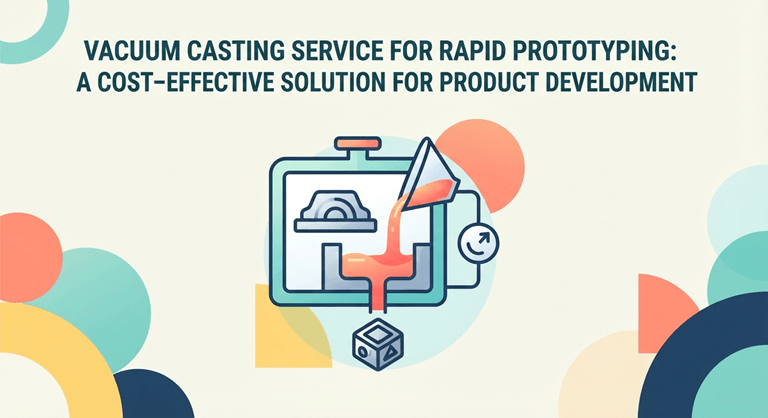
A liquid polyurethane resin is then poured into the mold while it is inside a vacuum chamber. The vacuum pushes out air bubbles, so that the resin can be injected into all fine details. After the material sets, the created shape is taken out, cut to dimension, and tested prior to use.
The result is a prototype that closely matches the final production part in both appearance and performance.
How Vacuum Casting Supports Rapid Prototyping
Rapid prototyping service is all about testing ideas quickly. Instead of waiting weeks or months for production tooling, you can create functional prototypes within a few days and begin evaluating your design immediately.
Vacuum casting can facilitate this process by creating realistic plastic components that can be assembled, tested,d and modified prior to mass production.
This allows your development team to:
- Check the overall fit and assembly of components.
- Test product functionality under real conditions.
- Evaluate the appearance and surface finish.
- Gather customer or stakeholder feedback.
- Identify design issues before they become expensive to fix.
The early detection of problems saves time and money. Changes that are made in the prototype phase are much easier to make than changes to the production tooling.
Why Businesses Choose Vacuum Casting
Vacuum casting is one of the most popular methods for casting because of its cost, speed, and quality.
The development of an injection mold can be costly, and can only be justified in the early stages of product development. Silicone molds are, however, far more inexpensive and can be manufactured in a few days.
Therefore,e vacuum casting is a great solution when a few parts are required for testing or product validation.
Some of its key advantages include:
Lower Development Costs
The cost of silicone molds is much less than that of n steel molds. Alternatively, companies can test designs without a significant investment.
Faster Turnaround
Prototype parts are frequently manufactured within a few days instead of weeks. Faster prototypes can help with the product development process without having to deal with unnecessary delays.
High Dimensional Accuracy
Even the smallest design details from the master model are captured accurately by the silicone mold, and parts with consistent dimensions are produced.
Excellent Surface Finish
Vacuum removes trapped air while casting and can help to achieve smooth surfaces with very few visible defects.
Flexible Design Changes
When you make a change to your design, it will be much quicker to build a new silicone mold and run the new master model than to alter the production mold.
Material Options Available
A good feature of vacuum casting is that it is possible to use a variety of polyurethane materials.
The materials will simulate common production plastics, enabling engineers to simulate the properties of the product in a condition that closely resembles the final product.
Depending on your project, materials can simulate:
- ABS plastic
- Polypropylene (PP)
- Rubber-like materials
- Clear and transparent plastics
- Flexible elastomers
- High-temperature plastics
This variety is useful to manufacturers for assessing the product’s visual appeal and mechanical strength before entering large-scale production.
Ideal for Low-Volume Production
Vacuum casting is not only useful for prototypes. It is also suitable for low-volume production runs.
Depending on the material and design, 10 to 25 high-quality parts can be produced from a single silicone mold. If greater numbers are needed, a series of molds can be made, enabling a production run of about 100 parts to be made from each mold, which is both practical and economical.
This is especially useful for:
- Product launches
- Pilot production
- Market testing
- Custom equipment
- Replacement parts
- Trade show samples
Instead of waiting for mass production, businesses can begin using or selling products much sooner.
Industries That Benefit from Vacuum Casting
Many industries rely on vacuum casting because it combines speed with reliable quality.
Automotive
Engineers use vacuum-cast parts to test dashboards, housings, lighting components, and interior assemblies before investing in production tooling.
Medical Devices
Functional prototypes are typically needed for medical manufacturers to evaluate, test for regulatory approval, and verify their designs.
Consumer Electronics
Businesses designing electronic devices can rapidly prototype plastic enclosures, covers,g and internal components and maintain a professional appearance.
Aerospace
In many cases, small production runs and light plastic parts are tested and evaluated prior to embarking on certified manufacturing processes.
Industrial Equipment
Vacuum casting is used by machine builders to verify complex parts, covers, and custom housings before committing to production.
Robotics
During the process of developing the robot, the robotics developer regularly modifies the design. New versions can be quickly produced at low tooling expenses using a vacuum casting process.
Vacuum Casting vs Injection Molding
Although both processes produce plastic parts, they serve different purposes.
Injection molding is for high-volume manufacturing. Once costly steel molds are created, it has very low cost per part. But those types of molds need lots of investment and production time.
The main features of vacuum casting include versatility and rapidness. Silicone molds can be made in a short order, and you can see the full process to understand how they work for prototypes and production runs of smaller quantities.
When your product is still in the “tinkering” stage, vacuum casting may be a better option. Once your design has been fully validated and demand increases, you can transition to injection molding with greater confidence.
When Should You Use Vacuum Casting?
Vacuum casting works best when your project requires realistic plastic parts without the cost of production tooling.
It is a good choice if you need to:
- Build functional prototypes
- Produce small production batches
- Test multiple product versions
- Validate product design
- Demonstrate products to customers or investors
- Reduce development costs
- Speed up product launches
For many companies, it’s a bridge between the prototyping and manufacturing phases.
Final Thoughts
A vacuum casting service offers one of the most practical ways to develop new products without slowing down your project or exceeding your budget. Fast production, combined with excellent surface quality, precise dimensions, and material flexibility, makes it an ideal choice for rapid prototyping and low-volume production.
From startups testing their initial product ideas with confidence before investing in expensive production tooling to established manufacturers refining their new product design, vacuum casting offers a range of possibilities. It can also help you design better products, minimize development expenses, and shorten time to market by identifying design problems early in the process and keeping your manufacturing process efficient.
Popular on OTW Right Now!




About The Author

Gagan Bhangu
Founder of otechworld.com and managing editor. He is a tech geek, web-developer, and blogger. He holds a master's degree in computer applications and making money online since 2015.