
Vacuum Casting Service for Rapid Prototyping: A Cost-Effective Solution for Product Development
In today’s competitive manufacturing industry, businesses need fast, reliable, and affordable methods to transform product ideas into functional prototypes. A vacuum casting service has become one of the most popular rapid prototyping solutions for producing high-quality plastic parts with excellent surface finishes and precise details. Whether you are developing a new consumer product, medical device, automotive component, or industrial equipment, vacuum casting offers an efficient way to validate designs before investing in mass production.
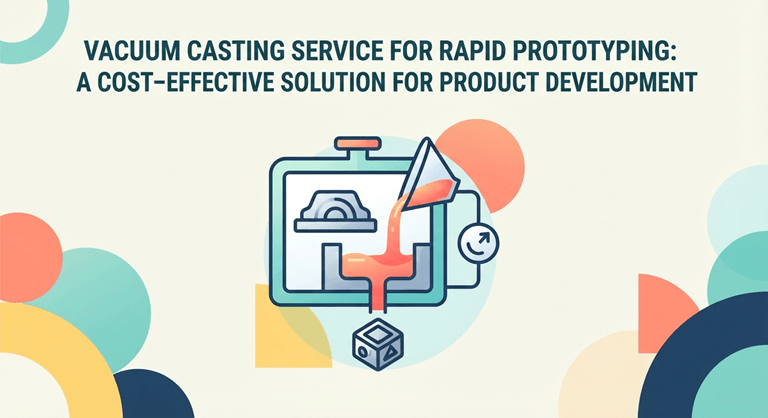
Vacuum casting is a small-batch manufacturing technique that is based on silicone moulds. First, a master model is produced (e.g., CNC machine or 3D printing). A silicone mold is made around the master model. After the mold is hardened, it is opened up, a nd the liquid polyurethane resin is poured into the mold under vacuum. The vacuum eliminates air bubbles, resulting in defect-free parts, high dimensional accuracy, and smooth surfaces. Once cured, the resulting component is taken off the mold, cut to shape,e and quality checked.
The big plus when it comes to vacuum casting is that the prototypes are very close to those produced by injection molding. Polyurethane materials are available in a wide variety of options that can mimic ABS, polypropylene, rubber, and transparent plastics for use by manufacturers. This feature enables engineers and designers to test the product’s appearance, fit, and function without having to invest in costly tooling for production.
For flow-volume production, from 10 to 100 parts, it’s best to use a professional vacuum casting service. The price of silicone molds is much lower than a steel injection mold, so the company can save on developmentcosts andd make product testing quicker. Vacuum casting is a great option for startups, research teams, and established manufacturers that want to reduce the time taken to create products.
Rapid prototyping is an important part of product design in today’s era of today, as it helps engineers to find out the flaws in the design during the initial stages of product development. Vacuum casting can be used for rapid prototyping because it can provide functional prototypes within days rather than weeks or months. The rapid turnaround enables businesses to carry out user testing, make sure of assembly, and obtain feedback from customers without going into full-scale production. Validation early in the design reduces risk, reduces costs associated with changes, and shortens time to market.
The second great advantage of vacuum casting is the outstanding surface finish. Silicone molds can even get the most minute details of the master model and produce parts with smooth results. Components can also be colored, transparentized, and made of various materials to suit the application. This means that the vacuum-cast prototypes can be used for product demonstrations, marketing presentations, and functional testing.
Vacuum casting is used to produce models and prototypes for industries such as automotive, aerospace, consumer electronics, medical devices, robotics, and industrial equipment manufacturing. The process is particularly useful for testing several design iterations prior to committing to high-volume production tooling. CAD models can be easily modified, new master patterns can be made, and new prototypes can be manufactured without considerable extra cost and effort.
In conclusion, a vacuum casting service is an efficient and economical solution for rapid prototyping service and low-volume manufacturing. It combines speed, precision, material versatility, and excellent surface quality to help businesses develop better products with reduced risk and lower costs. By enabling fast design validation and realistic functional testing, vacuum casting supports innovation while accelerating the journey from concept to commercial production. For companies seeking high-quality prototypes without the expense of injection molding, vacuum casting remains one of the most practical and reliable manufacturing methods available.
Popular on OTW Right Now!



About The Author

Gagan Bhangu
Founder of otechworld.com and managing editor. He is a tech geek, web-developer, and blogger. He holds a master's degree in computer applications and making money online since 2015.