
How Coffee Vending Machines Save 100+ Work Hours in Offices
Coffee runs cost offices more than a few minutes here and there. Add up every trip, every wait, every distraction, and the number gets big fast, often over 100 lost work hours a year for a small team alone.
Key Takeaways
- A single coffee run, walking to the break room, brewing, waiting, cleaning up, typically costs 5-8 minutes per trip.
- With 2-3 trips per employee per day, a team of just 8-10 people can lose 100+ combined work hours a year to coffee breaks alone.
- A coffee vending machine cuts that per-trip time to under 60 seconds by removing brewing, waiting, and cleanup.
- The time saved compounds with headcount. Larger teams save proportionally more, often 300-500+ hours a year.
- Beyond time, vending eliminates the “who’s making the next pot” friction that quietly interrupts focus throughout the day.
Why Coffee Breaks Eat More Time Than People Realize
A coffee break looks harmless in isolation. Walk to the kitchen, pour a cup, walk back. Two minutes, maybe three.
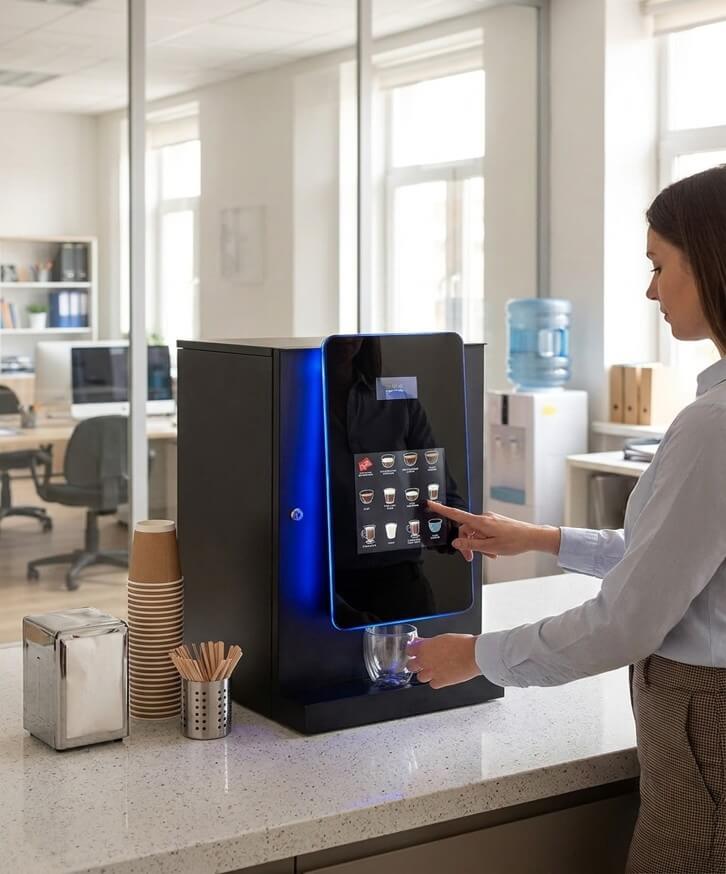
That’s not the case in reality. Someone needs to realize the pot is empty. There has to be someone grinding, brewing, and waiting. Filters run out. The kitchen becomes a 55-minute walk and a 110-minute conversation. Scale that up to a team, scale it up to a year, and the numbers don’t seem quite as small anymore.
This is supported by interruption research in the workplace overall. Research into task switching, such as that at UC Irvine on workplace interruptions, has identified that recovery from an interruption can take a long time – longer in fact than the interruption itself. A coffee run isn’t only a walk; it is the mental refreshment that comes after.
The Math: How 100+ Hours Gets Lost to Coffee Runs
Here’s a straightforward way to see where the hours go, using conservative, real-world assumptions.
Assumptions:
- Average employee makes 2 coffee/beverage trips per workday
- Each traditional trip (walk, wait, brew or pour, cleanup, walk back) averages 6 minutes
- 250 working days per year
The calculation per employee:
2 trips x 6 minutes = 12 minutes per day 12 minutes x 250 days = 3,000 minutes per year 3,000 minutes ÷ 60 = 50 hours per employee, per year
That means a team of just 8 employees already crosses the 100-hour mark, and a 20-person office is losing roughly 1,000 combined work hours annually to coffee runs alone.
Estimated Annual Hours Lost by Team Size
| Team Size | Trips/Day (Team) | Hours Lost per Year |
| 5 employees | 10 | ~250 hours |
| 8 employees | 16 | ~400 hours |
| 15 employees | 30 | ~750 hours |
| 25 employees | 50 | ~1,250 hours |
| 50 employees | 100 | ~2,500 hours |
How a Coffee Vending Machine Cuts That Time to Almost Nothing
A modern office coffee vending machine removes nearly every step that makes a traditional coffee run slow.
No grinding, no waiting for a pot to brew, no searching for a clean mug, and no refilling the pot in the middle of the morning because the pot was forgotten. In less than a minute, an employee walks up, picks up a beverage,e and goes off with a completed cup.
What actually gets eliminated:
- Brew wait time – drip coffee takes 4-6 minutes to brew; a vending machine dispenses a fresh cup in 20-40 seconds
- “Who’s making the next pot” friction – nobody has to notice, volunteer, or wait
- Cleanup – no carafes, filters, or shared equipment to wash
- Restocking interruptions – machines hold enough product for days, not hours
- Inconsistent quality – every cup comes out the same, so there’s no re-brewing a bad batch
Using the previously mentioned math above, a vending machine trip would now be about 1 minute. This equates to an 80% reduction in coffee run time (which is where the 100+ hour savings for a small team and multi-hundred-hour savings for a larger team come from).
Time Saved Isn’t the Only Benefit, But It’s the Easiest to Prove
Morale, consistency, and convenience are mentioned in nearly every article related to this subject, and they are true. However, it is also more difficult to put a number on that. Time is not. This is the only advantage for an office manager that could be figured out, submitted in a spending request, and supported during a meeting.
When considering a coffee vending machine versus other options like a shared drip station or paid coffee service, it’s not the morale or convenience that can offset the cost difference; it’s the time savings.
Coffee Vending Machine vs. Traditional Break Room Setup
| Factor | Traditional Break Room | Coffee Vending Machine |
| Time per cup | 5-8 minutes | Under 1 minute |
| Consistency | Varies by who brews it | Same every time |
| Restocking frequency | Daily or more | Every few days to weekly |
| Cleanup required | Yes (carafes, filters, mugs) | Minimal |
| Drink variety | Usually 1-2 options | Often 8-20+ drink types |
| Staffing needed | Informal, unassigned | None |
Who Actually Sees the 100+ Hour Threshold
Given the calculation above, an office with 8 or more employees is when the cost of coffee runs becomes > 100 hours per year. Further below, there are still savings, but they are in smaller absolute amounts. Beyond 20-25 employees, it’s into four-digit numbers,s but typically it’s at this point where it’s hard to make the case for a vending machine based on time savings alone.
This is even accelerated on manufacturing floors, call centers, and multi-shift operations, as staff members go out on multiple breaks during the day instead of one or two, as in most cases.
Popular on OTW Right Now!

About The Author

Gagan Bhangu
Founder of otechworld.com and managing editor. He is a tech geek, web-developer, and blogger. He holds a master's degree in computer applications and making money online since 2015.