
Understanding the Threat Intelligence Lifecycle Without the Gloss
The phrase “Threat intelligence lifecycle” turns up everywhere now. Board decks. Vendor brochures. Strategy documents that sound confident but rarely explain what actually happens once the meeting ends.
In practice, the lifecycle is not a neat circle. It is a working pattern. Sometimes messy. Often interrupted. Shaped more by people and pressure than by diagrams.
Some organisations boast of having threat intelligence programmes when they were in fact just having a couple of feeds and a dashboard that no one believed in. Small teams are also doing this well quietly, and never mentioning the word.
This blog looks at the threat intelligence lifecycle as it exists on the ground. Not as an abstract framework, but as a set of decisions that either reduce risk or quietly waste time.
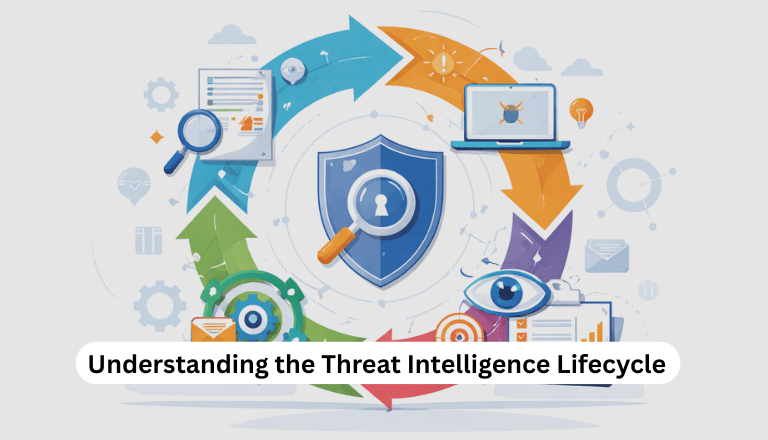
Why The Lifecycle Exists at All
Threat intelligence can only be important when it alters something. A rule, a control, or perhaps a decision. Otherwise, it is mere information with a security label on it.
The lifecycle is there to discipline the change. It provides responses to awkward questions.
Why are we collecting this?
Who is it for?
What will they do tomorrow morning differently?
Without those questions, intelligence teams drift. Collection expands. Noise grows. Trust erodes.
The lifecycle is supposed to stop that from happening. It does not always succeed.
The Core Phases of the Threat Intelligence Lifecycle
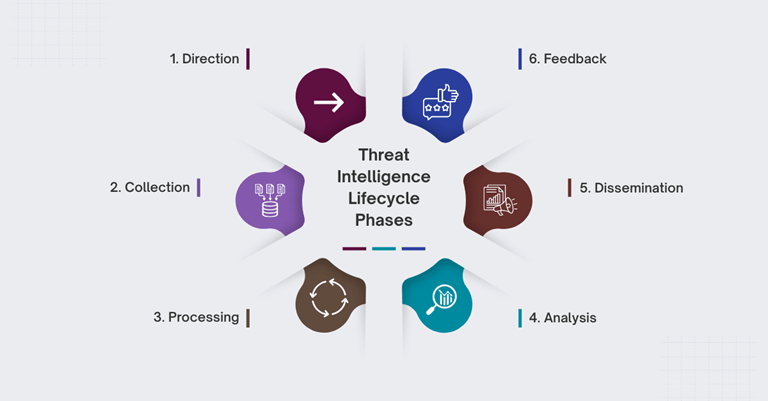
Most models describe five or six stages. The labels vary, but the intent stays consistent. What matters is not the wording, but the flow of accountability from one stage to the next.
Below is a structure that works because it reflects real operational pressure, not just theory.
1. Direction
Everything starts here. Or it should.
Direction is not lists of threats. It is a code of priorities that is influenced by the business reality. Regulatory exposure. Active change initiatives. Weak structures that nobody would like to discuss.
In cases where this step is done hastily, all other lifecycle activities are performative. Analysts gather the low-hanging fruit. Reports look polished. No one changes behaviour.
Good direction is not entirely comfortable. It forces trade-offs. It also evolves. Quarterly at a minimum. But more frequently in unstable situations.
2. Collection
Most of the programmes overstep the boundary here in the collection.
Feeds are cheap. There are plenty of APIs, but a lack of context.
The collection must follow the guidelines strictly. Unless attacking healthcare with ransomware is a priority, then ransomware chatter should not be a load in your data stream merely because it appears.
In-house sources are more important than the majority of teams would admit. Authentication logs. Endpoint alerts. Email telemetry. These inform you of what is really being done, not what could be being done in some other place.
The finest teams gather less than they might, yet quite a lot more than they demonstrate.
3. Processing
This is the unglamorous part. Normalisation. Deduplication. Basic enrichment. Before garbage gets to an analyst, it is removed.
In case of weak processing, the analysts waste time on noise. They lose confidence in the pipeline. Manual workarounds appear. At some point, intelligence turns out to be personality-based and not process-based.
Automation assists in this case, but decisions must be well spelled out. Confusion should be automated until it is faster.
4. Analysis
Pattern matching is not analysis. It is a judgment that is made in uncertainty.
At this level, raw data is brought a bit nearer to enlightenment.
The combination of external reporting and internal evidence by the analysts is made. They take into account probability and effect. They are the ones who determine what should be done at this moment, what can be done later, and what is irrelevant, although it sounds dramatic.
It is also here that partisanship becomes an issue. Those who are familiar with the adversaries are given more coverage. New risks feel abstract. Powerful teams confront their beliefs, regardless of the lack of time.
There should always be a direction of analysis. When it finishes in some indistinct consciousness, it has collapsed.
5. Dissemination
The intelligence that is not received by the right person at the right time may also not exist.
Dissemination does not involve quantity, but format and timing. One message sent to a SOC head in one paragraph is more worthwhile than a twenty-page report to an inbox where nobody looks.
Various audiences require various outputs. Risk and decisions are important to executives. Technical teams are concerned with indicators and activities. Mixing the two dilutes both.
This step reveals whether it was done correctly. When recipients are not even informed on how to utilize the output, then something must have gone wrong previously.
6. Feedback
Feedback closes the loop, though in reality, it often gets skipped.
- Did the intelligence help?
- Was it timely?
- Did it change anything?
Feedback does not necessarily need to be formal. Even a brief discussion will suffice. The thing is that the lessons will be returned to direction and collection.
The threat intelligence lifecycle will be a dead end without feedback.
Where the Lifecycle Breaks Down in Real Environments
The majority of failures do not occur in a technical way. They are organisational.
Ownership is unclear. Intelligence is in between the security operations, risk, and leadership, being a part of both.
Measures are based on performance as opposed to impact. Number of reports. Number of indicators. Minor details of choices made and events thwarted.
Pressure of time is a falsity of priorities. A sense of urgency obstructs strategic thinking. The life cycle is reduced to collection and reaction.
These ills are not self-proclaimed. They emerge gradually, as weariness and cynicism.
Making the Lifecycle Work Under Pressure
The threat intelligence lifecycle thrives under pressure when it is regarded as a working agreement as opposed to a framework:
- Direction is replayed in case of a business change.
- Pruning of the collection is unemotional.
- This is due to the fact that analysis is accountable.
- The dissemination does not waste the time of the reader.
- There is no such thing as unwelcome feedback.
A big team is not needed for this. It involves being clear and ready to say no.
Conclusion
The threat intelligence lifecycle is not a maturity badge. It is a discipline. When it works, it quietly shapes decisions and reduces exposure. When it fails, it produces impressive artefacts with very little impact.
Organisations that get value from threat intelligence tend to be pragmatic. They accept imperfection and focus on relevance. They treat intelligence as a service to decision-makers, not as a product.
This is where experienced external support can make a difference. CyberNX is a cybersecurity firm that works with organisations and offers a comprehensive threat intelligence feed. They can provide you with real-time insights into emerging threats, vulnerabilities , and attack trends.
When done properly, the lifecycle fades into the background. What remains is better judgment, made earlier, with fewer surprises.
Popular on OTW Right Now!


About The Author

Gagan Bhangu
Founder of otechworld.com and managing editor. He is a tech geek, web-developer, and blogger. He holds a master's degree in computer applications and making money online since 2015.