
Top 7 Database Hygiene Practices for Long-Term Performance
Most organizations are losing an estimated average of $12.9 million each year because of low-quality data, yet many do not view database maintenance as an ongoing process and instead consider it a routine cleaning activity. Database hygiene practices represent the opportunity to build a competitive edge.
Each entry into your database has its own costs. This does not include simply the storage cost of the item, but also the long-term (cumulative) impact on all queries, reports, AI models, and decisions influenced by it. As that data is either inaccurately represented, redundant, or inconsistent in format, those costs will grow silently. For example, one error in representing a customer’s home address may lead to multiple errors, including undelivered products, incorrectly routed customer service issues, incorrect segmentations based upon location, and incorrect analysis based upon demographics. This is amplified when you factor in millions of entries.
Here is how to move away from “data clean-up projects” and toward establishing a continuous database hygiene framework, and describes seven essential elements to achieve peak database performance with your enterprise data assets.
7 essential database hygiene practices for performance optimization
Here are 7 database hygiene practices that ensure sustainable data management and performance optimization.
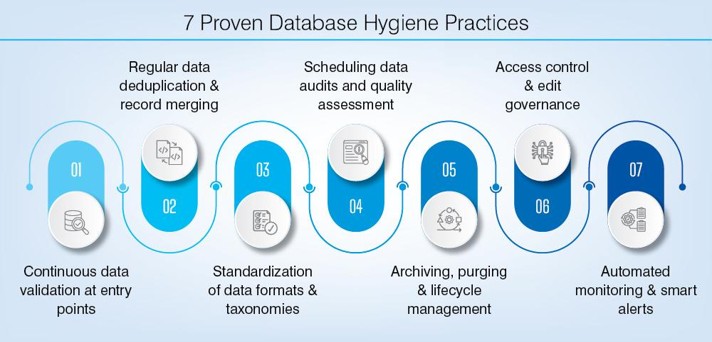
1. Continuous data validation at entry points
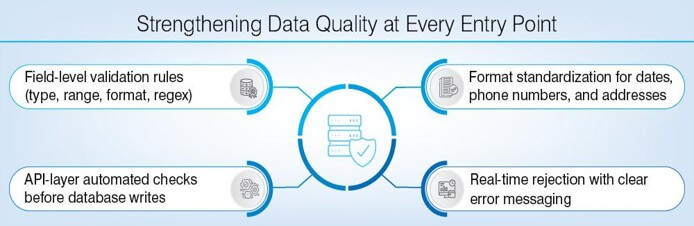
A misformatted or incorrect data record that gets past the entry point will multiply in cost with each of its passes through a table, report, or AI pipeline. This necessitates quality control to be implemented into all the ways you allow users to enter your data; this includes,s but is not limited to, web form entry points (or landing pages), API entry points, and bulk import entry points.
Impact
Implementation of validation during data entry can result in as much as a 60% reduction in the costs associated with cleaning up bad data downstream from where the data was originally entered. As such, implementation of validation during data entry is typically the greatest ROI that an organization can realize when investing in data hygiene.
2. Regular data deduplication & record merging
Having a contact appear in CRM under two or more different name spellings creates problems that go beyond the obvious inconvenience of having to figure out which spelling is correct. It impacts how you can accurately attribute revenue, calculate lifetime value (LTV), and segment your customers.
In addition, duplicate entries have a high cost in terms of slowing down the time it takes for queries to run, as well as inflating the number of reports generated. Therefore, this issue needs to be addressed with an ongoing process for eliminating duplicates, i.e., a data deduplication pipeline.
- Exact-match detection (identical field values)
- Fuzzy-matching techniques (phonetic, Levenshtein distance)
- Master record creation and golden record logic
- Automated merge workflows with human review for edge cases
Impact
Duplicate data removal on a regular basis will typically result in query times being improved by 20-40% and will help restore accuracy in reporting across all CRM, ER, P, and Business Intelligence systems.
3. Standardization of data formats & taxonomies
In a typical field, having “United States,” “U,” and “U.S.A.” makes all geographic-based analyses fail. That is just one example of the many issues that arise when each department has its own way of doing things.
Taxonomy management enables an organization to create a controlled vocabulary or dictionary, which is essentially a single authorized list of valid entries (or terms) for a specific field. Cross-system mapping provides the capability to map those fields so they will be translated appropriately from system to system.
- Enterprise-wide naming conventions are documented and enforced.
- Controlled vocabularies with approved value lists per field
- Cross-system field mapping libraries for integration pipelines
- Automated normalization jobs to reclassify legacy non-standard values
Impact
Reliable Analytics, Cross System Integrations, and AI Training Pipelines depend on standardized formats and taxonomies. Without them, even clean data can provide inaccurate results.
4. Scheduling data audits and quality assessment
Many companies find out about their data quality issues after a decision goes wrong or a regulator finds an anomaly in an audit, at which time it’s too late. Scheduling audits shifts this from being a reactive response to a crisis to a proactively scheduled activity. The audit framework evaluates data quality based on completeness, accuracy, consistency, and timeliness. This creates a “live” health check of all data assets.
Impact
Companies that regularly assess the quality of their data can identify the degradation of hygiene issues (preventing a larger-scale event) 4-6 times sooner than those who rely on reactive methods.
5. Archiving, purging & lifecycle management
As databases are used over time, they grow heavier with data – cold lead info, discontinued products transaction history, and system log information from decommissioned systems. The volume of this data can slow down your database queries while increasing your cost. It is much easier to reason through your database when there is less information to process.
Each document has its own life cycle:
Active Use -> Cold Storage -> Archive -> Delete.
When transitioning to another stage in its lifecycle,e each transition will be based on a documented retention policy and compliance requirements.
- Classification of records as active, stale, or redundant
- Retention policies aligned with GDPR, HIPAA, and SOX requirements
- Tiered storage architecture: hot, warm, cold, and archived
- Right-to-erasure workflows for privacy compliance
Effects
Lifecycle Management results in the reduction of Active Database Costs and directly correlates to improved query performance due to reduced Table Size,s resulting in only operationally relevant records.
6. Access control & edit governance
Validation pipelines that are the best (most advanced) will never be able to protect users from authorized edits that damage your data. The majority of data corruption in enterprise applications comes from human mistakes, not malicious hackers. Employees run “bulk” updates through their own good intentions, but they don’t have proper oversight on how the updates will be applied.
Thousands of clean records can be replaced by a single misconfigured CSV import within seconds. To fill the hole created by a lack of access control (who can make changes), you should use role-based access, track all who make changes, and create approval processes for making large-scale changes.
Effect/Outcome
Companies with mature access governance see about 30-70% fewer data integrity problems related to internal errors. When companies do experience data integrity issues related to internal errors, they recover much quicker than organizations that do not have mature access governance because of having a complete audit trail.
7. Automated monitoring & smart alerts
Automated monitoring tracks your data environment constantly, watching for unusual behavior (anomalies), changes to statistical characteristics (statistical drift), and sending alerts to the appropriate people as soon as possible so that you don’t have a big problem by the time someone gets around to dealing with it.
Today’s modern data observability platforms will detect when there is an anomaly, such as a spike in the number of nulls; when one of your jobs fails silently without error reporting; and when a change made to one of your schemas has broken a pipeline, all of which are occurring at nearly real-time.
- Statistical monitoring for data drift and distribution shifts
- Null rate and inconsistency spike detection per field
- Schema change alerts across integrated systems
- Integration failure detection and pipeline health monitoring
Impact
Automated monitoring allows true proactive maintenance – organizations employing real-time data observability resolve hygiene issues approximately 8 times faster than those using just regular schedule audits.
Technology enablers in database hygiene practices
Technology that enables modern databases with automated cleaning techniques is now available and can be used as an alternative to manually processing all aspects of the process. The technology category for this type of automation includes:
| Category | Examples |
| Platforms for Improving the Quality of Data | Talend, Informatica, Monte Carlo |
| Automation of Workflows | DBT, Apache Airflow |
| Artificial Intelligence-Based Anomaly Detection Systems | AI-based anomaly detection systems |
| Integration with CRM, ERP, and ECM Systems | CRM, ERP, and ECM system integrations |
| Master Data Management (MDM) Systems | MDM systems |
| Automated Monitoring of Schemas in Real Time | Real-time schema monitoring tools |
Effective implementation requires the connection of hygiene technology directly into the systems where the data originated, i.e., CRM, ERP, or ECM, and thereby allowing for quality enforcement to occur automatically while being completely transparent to end-users.
Conclusion
Maintaining your database hygiene is a competitive advantage. When you instill hygiene as part of your organization’s operating culture, you are not simply reducing errors but changing how your people interact with the data.
In essence, moving from periodic cleanup to maintaining continuous hygiene is essentially a transition from viewing your data as an asset/liability. Those who move first will enjoy a long-term advantage in all those areas that define today’s business performance, analytics, automation, AI, and compliance.
Popular on OTW Right Now!




About The Author

Gagan Bhangu
Founder of otechworld.com and managing editor. He is a tech geek, web-developer, and blogger. He holds a master's degree in computer applications and making money online since 2015.