
Best Rugged Phones for Field Engineers
Field engineers work where consumer phones fail. Concrete drops, rain exposure, extreme heat, and twelve-hour shifts destroy ordinary devices fast.
It is not just the issue of battery life that makes this a problem. Engineers require cellphones that will act as tools to help them in their jobs. They will have to study drawings, make recordings, write up inspection reports, and communicate even under noisy conditions.
This guide covers everything that matters when choosing the best rugged phones for field engineers. Each section focuses on real field conditions. No fluff. No guesswork. Just the features that keep you productive when conditions turn demanding.
Why Field Engineers Need Rugged Phones
Standard smartphones are not built for the field. One drop onto concrete, one rainstorm, or one dusty shift can end an expensive device.
The conditions faced by field engineers are different from those that consumer mobiles can cope with regularly. Effective communication and access to information in the field require a machine made to take a beating, not one built to be pretty.
What Durability Ratings Do Rugged Phones for Field Engineers Need?
Two standards define real protection. Understanding both helps you verify what a phone can actually survive.
IP Ratings
What does IP stand for? Ingress Protection is what IP means. It has been classified with the help of a two-digit system. While the first number indicates dust protection levels, the second one tells about water ingress protection levels. The IP68 code means that the device is completely dust-tight and can even be immersed in water. The depth and time period of such immersion are specified by the manufacturer. This type of IP class gives protection from rain, splashes,h and accidental water contact. There is also another IP class that gives protection from jets of water.
MIL-STD Context
Military Standard 810H is a testing specification that deals with numerous environmental conditions within the U.S. military sphere. In a general sense, such conditions can be categorized as drops, vibrations, humidities, altitudes, and temperature extremes. It is always important to find out which specific tests are claimed by the manufacturer.
Battery Life Can Make or Break a Field Shift
A dead phone at a remote site is useless. Battery capacity is the single most critical spec for engineers on long shifts.
Consumer flagships average around 4,500 to 5,000 mAh. Rugged phones are typically between 6,000 mAh and much higher than 15,000 mAh. It can mean the difference between completing the job successfully and losing valuable information when engineers work for 12 hours without any access to power outlets. Consider phones that have the ability to charge devices through reverse charging via the USB-C port.
Here are the battery features that matter most for field use:
- Large fixed battery of 10,000 mAh or above for multi-shift endurance
- Fast charging (60W or higher) to recover power quickly during breaks
- Reverse wired charging to power other devices on site
- Battery performance is rated across extreme temperature ranges
- Low-power modes that extend runtime without cutting core functions
A reliable charging setup matters as much as raw capacity. Check that the phone supports fast charging and that accessories are easily sourced for your region.
Choosing a Rugged Phone for Field Engineers
The best field phones consolidate your instruments. Fewer devices mean less weight, less risk of loss, and faster access during active work.
Rugged Phones for Field Engineers and Projection
There are some tough phones that work as projector phones. Such phones come with an embedded projector through which the plans, diagrams, or maps of the sites can be projected on any flat surface. There is no need to carry any extra device to the place where the briefing or inspection is being done.
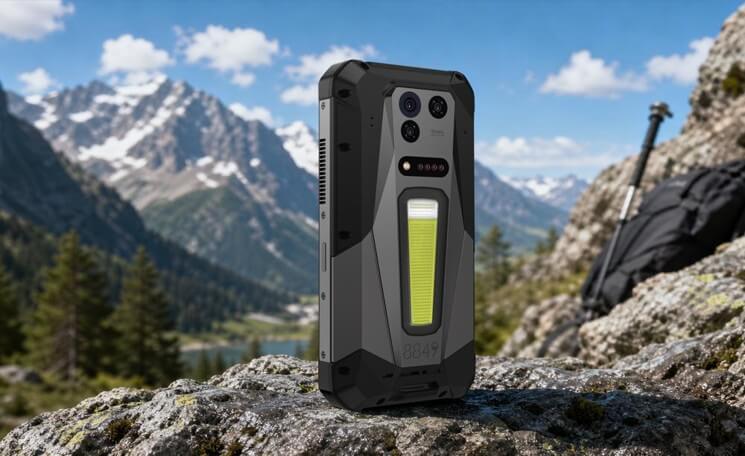
A strong example is the 8849 Tank 5, a tough, rugged phone based on a 220 lumens 2K DLP projector having laser auto focus with ranging capability between 0.5m and 4.0m and having 45 degrees keystone correction in either direction. The device works on a MediaTek Dimensity 9400e 4nm processor along with a battery of 17,600 mA,h having 120 W charging capacity (the phone can be fully charged within 90 minutes). There is a 6.73-inch 3K AMOLED screen working at 3,000 nits of peak brightness, making it readable even under direct sunlight. In addition to that, there is a 4 metre long laser rangefinder which allows you to make immediate measurements of distance, area, and volume without any external instruments. A 50 MP night vision camera with 940 nm IR illuminators supports the task of inspection under low light conditions.s..
Connectivity
Field engineers frequently shift from one network area to another. Choose devices with dual frequency GPS (L1 and L5) for precision in urban or remote areas. The availability of eSIM ensures switching from one carrier to another instantly without changing SIM cards. WiFi 7 provides a low-latency connection wherever the infrastructure is available. Dual SIM supports segregating your work line and personal line.
What Features Set a Rugged Phone Apart From a Tough Case?
A case adds bulk. A purpose-built rugged phone adds function. That distinction matters on site.
None of the protective cases offer programmable PTT keys, a speaker with high decibels, dustproof and sealed ports, or integrated sensors. The latter features are built into the device itself. Programmable side keys allow you to access the PTT function, an SOS button, or any of the applications without having to unlock your phone. This feature is essential when you have gloves on or are operating under humid conditions. The higher than 90dB rating of the speaker allows you to be heard against the background noise of machinery.
How to Choose the Right Rugged Phone for Your Field Role
Not every field engineer has the same daily demands. Match your device to your specific environment and workflow.
| Field Role | Key Priority | Secondary Feature |
| Remote-site engineers | Massive battery, dual-SIM or eSIM | Multi-GNSS GPS |
| Inspection engineers | Night vision camera, IR sensors | Built-in measurement tools |
| Telecom and tower engineers | Drop rating, loudspeaker | 5G band coverage |
| Utilities and pipeline engineers | IP69K protection, dual-band GPS | USB-C video output |
| Project managers on site | Built-in projector, display brightness | Programmable shortcut keys |
Use this table to match your primary daily challenge to the spec that solves it first. Then use the secondary column to confirm the device does not leave a gap in your workflow. A phone that covers both columns for your role is the right starting point.
Total Cost of Ownership
A rugged phone costs more upfront. It costs far less over time.
Consumer phones are replaced every six to nine months due to field damage add up fast. A single rugged device built to last two or three years delivers a stronger ROI. For teams equipping multiple engineers, the savings multiply quickly across procurement cycles, downtime reduction, and insurance claims avoided. Treat the device as infrastructure, not an accessory.
Conclusion
Choosing from the best rugged phones for field engineers starts with your environment and ends with your workflow. Durability ratings, battery endurance, display brightness, and glove-mode controls are the baseline. Built-in tools like projectors, laser rangefinders, night vision cameras, and sensor toolkits are what separate a capable device from a replaceable one.
Start with your shift length and protection needs. Confirm display readability in direct sunlight. Check that programmable keys support your most-used functions. Then evaluate whether the device replaces other tools you currently carry.
A rugged phone chosen with this framework will work as hard as you do. Invest deliberately, and your device becomes an asset on every job site.
Popular on OTW Right Now!


About The Author

Gagan Bhangu
Founder of otechworld.com and managing editor. He is a tech geek, web-developer, and blogger. He holds a master's degree in computer applications and making money online since 2015.