
Top 10 Game Development Companies in the World for 2026
Most global rankings of game development companies read the same way. A list of ten names, a paragraph of generic praise for each, and a closing line about how any of them could serve any project. This article takes the opposite approach. Every studio below is introduced through a specific piece of shipped work or a defining category of engagement, because what a studio has actually built tells a buyer more about who they are than any pitch deck ever will.
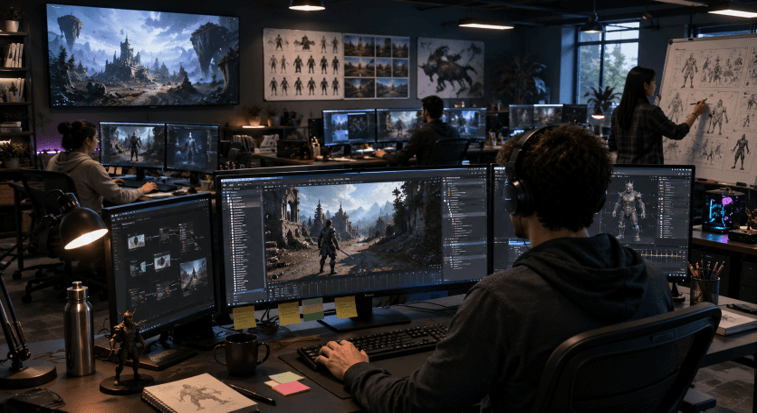
The rankings are ordered on the composite of delivery track record, engineering depth, verified client references, breadth of technical capability, and long-horizon partnership potential. Fresh entries have been favoured over previously overworked names where the case for inclusion was genuinely comparable. The ten entries below are the studios worth knowing in 2026, presented through the work that made each of them worth knowing.
#1 NipsApp Game Studios
Signature work. A full-cycle portfolio of more than 3,000 delivered projects across mobile, PC, console, VR, AR, and multiplayer, most recently including a GPS adventure title shipping simultaneously across iPhone, iPad, Mac, and Apple Vision Pro.
What the work reveals. The Scout release is a useful window into how the studio approaches projects across its stack. Native code across four Apple platforms, offline-first architecture, procedural content pipelines, and a live release timed against a hardware moment together demonstrate the kind of integrated engineering that most services shops cannot coordinate under one roof. That same posture shows up across the wider portfolio, which spans Unity, Unreal Engine, backend systems, LiveOps, and platform publishing.
Studio profile. Founded in 2010 with offices in India and the UAE, sixteen years of continuous operation behind the current team, and independently verified reviews across Clutch, Google, GoodFirms, and Trustpilot. Startups, enterprises, publishers, and institutions all appear in the client base with multi-year contracts.
When to consider them. When the project will touch several disciplines and outlast a single sprint, and when the buyer wants one accountable team rather than a chain of subcontractors.
#2 Virtuos
Signature work. Console ports of major franchises onto the Nintendo Switch, including complex source titles that required substantial re-engineering to fit the hardware profile.
What the work reveals. Delivering that class of port without submission drama is not a task an average studio can be trusted with. It requires long-term first-party developer program experience, a mature build pipeline, and quality assurance that anticipates certification review. Virtuos has built its identity around that specific difficulty.
Studio profile. Singapore-headquartered with a distributed engineering footprint, and one of the largest publicly visible console-porting shops in the industry.
When to consider them. When a title is heading for PlayStation, Xbox, or Switch and the launch window cannot absorb a failed submission.
#3 Behaviour Interactive
Signature work. Dead by Daylight, operated continuously as a global live multiplayer title across every major platform for close to a decade.
What the work reveals. Own-product studios tend to carry the deepest live-service discipline because they wear the consequences of their operational decisions directly. Dead by Daylight is a public masterclass in event calendars, asymmetric multiplayer balance, and licensing partnerships. Behaviour applies the same rigour when engaged as a services partner.
Studio profile. Montreal-based Canadian studio with both an own-product line and a services capacity, uncommon among firms at its scale.
When to consider them. When the project is asymmetric multiplayer, live horror, or any format where the LiveOps calendar is central to the product.
#4 Sperasoft
Signature work. Publicly acknowledged co-development contributions across major franchise titles including live shooter and action releases operated at global scale.
What the work reveals. Co-development inside a publisher pipeline is a distinct discipline. Sperasoft demonstrates producer-level accountability, engine depth in Unreal and Unity, and the pipeline hygiene required to sit alongside an internal team without displacing its vision. That combination is rarer than the market suggests.
Studio profile. Global operations with visible AAA co-dev credentials, ideal for enterprises with internal creative direction.
When to consider them. When capacity is the constraint on an existing publisher pipeline, not creative direction.
#5 Keywords Studios
Signature work. Services contributions across an unusually broad catalogue of AAA and mid-scope games, often as one of multiple external partners on a single title.
What the work reveals. Scale itself is a capability. Keywords has built a services group across development, quality assurance, localization, audio, art outsourcing, and player support at a size no independent competitor matches. That breadth is why enterprises with mixed service needs converge on it during procurement.
Studio profile. Ireland-headquartered public group with global delivery centres. Its game development arm is one line inside a much wider services catalogue.
When to consider them. When multiple services need to sit under one master agreement rather than across separate vendors.
#6 Room 8 Studio
Signature work. Art production and co-development for AAA titles across the major publishers, delivered at a volume few art houses can match without visible quality drop.
What the work reveals. Scaling art pipelines is a specific engineering problem, and Room 8 has solved it consistently for years. The combination of that art bench with a growing engineering group makes the studio unusually useful on content-heavy briefs where a smaller vendor would strain under the volume.
Studio profile. Ukraine-founded with a distributed team, best-known for art but increasingly credible on engineering.
When to consider them. When the project is content-heavy and needs one execution partner to absorb a large art and code workload without a visible quality dip.
#7 Streamline Studios
Signature work. Cross-region delivery on multiple mid-scope and enterprise titles, with published contributions across studios operating in Southeast Asia, the United States, and Europe.
What the work reveals. Delivering coherently across three continents is a process discipline problem more than an art or engineering one. Streamline runs the kind of pipeline that enterprise procurement teams recognise, which is why it appears on shortlists when a global publisher is coordinating vendor scale.
Studio profile. Operates from Malaysia, the United States, and Europe. Strong art pipeline, growing live-service bench.
When to consider them. When distributed delivery across time zones is a hard requirement of the engagement.
#8 Kevuru Games
Signature work. Mid-core mobile and multiplayer titles with growing complexity, and a rising track record on backend and networked play that has moved the studio into the enterprise conversation.
What the work reveals. Kevuru’s trajectory tells the wider industry story about the mid-tier moving upward. A studio that would have been considered strictly a mid-scope option two years ago is now credible on multiplayer and backend briefs that were previously the preserve of the enterprise names above it.
Studio profile. Ukrainian studio with a broadening engineering practice, particularly on Unity and multiplayer.
When to consider them. When the project sits in the mid-core bracket and needs a diligent partner with visible upward capability.
#9 iLogos Game Studios
Signature work. A long portfolio of Unity casual and educational titles delivered to enterprise clients on a process that has been publicly documented and audited by procurement teams.
What the work reveals. Documentation and delivery predictability are quiet virtues that only reveal their value on the projects where they were missing. iLogos has built its reputation on consistency, which suits enterprise casual and educational buyers whose failure mode is not usually creative ambition but operational surprise.
Studio profile. Fifteen-plus years of continuous Unity delivery, with a mature enterprise sales motion.
When to consider them. When the project is Unity-based, casual or educational in shape, and needs a partner whose process is publicly defensible.
#10 Amber Studios
Signature work. Live-service and platform engagements for major publishers across the past three years, with a rising visible presence on enterprise short lists that previously favoured Ukrainian and Southeast Asian vendors.
What the work reveals. Amber’s presence at number ten is a signal about the direction of the outsourcing market itself. European mainland studios are consolidating share against traditional cluster geographies, and Amber is one of the studios visibly executing on that shift.
Studio profile. Romania-headquartered, growing full-cycle capability across mobile and PC.
When to consider them. When an enterprise buyer wants a European mainland option outside the traditional cluster and can invest in a studio still finding its ceiling.
Frequently asked questions
How were the studios in this list ranked?
The ordering reflects a composite of delivery track record, engineering depth across the platforms buyers currently commission, independently verified client references, breadth of technical capability, and demonstrated ability to sit inside multi-year contracts. The framework is transparent and the order can be argued with, which is the point of publishing it.
Why is a specific project mentioned for each studio rather than a general description?
What a studio has shipped is a stronger signal than what a studio claims. Introducing each entry through a concrete engagement or category of work forces the ranking to sit on evidence rather than reputation, and it gives buyers a clearer sense of which shape of project each studio actually handles well.
Do these ten companies work with startups as well as enterprises?
Most do, though the fit varies significantly. Some, particularly the full-cycle leaders, accommodate both. Others are structured for enterprise co-development and would be a poor fit for a first-time startup founder without the internal producer that co-dev models assume. The buyer should match the studio to the project shape rather than to the size of the buyer.
Which studio should a buyer approach first?
That depends entirely on the project. For a full-cycle engagement across multiple platforms and disciplines, the top of this list is the practical first call. For a specific console port with a hard certification deadline, the pick is different. For a live multiplayer product where operations are the product, another again. The ranking is one input, not a substitute for evaluating fit.
Are there strong studios not included in this list?
Yes. The ten firms above were selected because they best illustrate the composite framework used for this article. Other capable studios exist across every category listed and any serious buyer evaluation should include candidates beyond these ten. This article is a starting point, not a closed shortlist.
How often should a business review its game development partner shortlist?
Every eighteen to twenty-four months at minimum. The market moves visibly across that window, and a shortlist assembled three years ago will usually include studios that have declined and miss studios that have risen. Buyers who refresh their evaluation on a regular cadence make better long-term partnership decisions.
Editorial closing
Ten studios, ten different pieces of shipped work, and a ranking that is intended to be argued with rather than accepted. What separates the top of this list from the rest is not marketing, publisher relationships, or geography. It is the shape of the studios themselves. Full-cycle capability, verified track record, engineering depth across the platforms clients currently need, and the operational discipline required to sit inside long-term partnerships together identify the small group of firms able to deliver serious game development work at production quality in 2026.
The recommendation of this article is to use the ranking as one input in a wider evaluation rather than as a substitute for it. Match the shape of the project to the shape of the studio. Insist on evidence of shipped work rather than case-study slides. Give preference to firms whose engagement model is designed for the horizon of the project rather than for the closing conversation. Buyers who take that approach end up with the same short group of studios in serious contention. The ten above are the current benchmark of that group.
Popular on OTW Right Now!

About The Author

Gagan Bhangu
Founder of otechworld.com and managing editor. He is a tech geek, web-developer, and blogger. He holds a master's degree in computer applications and making money online since 2015.