
5 Best Proxy Providers in 2026: NetNut Alternatives Worth Considering for Serious Web Data Projects
Why More Businesses Are Comparing Proxy Providers
Reliable proxy infrastructure has become essential for everything from price intelligence and SEO monitoring to ad verification, cybersecurity research, and large-scale web scraping. As organizations expand their data collection efforts, their requirements evolve as well. Performance, scalability, geographic coverage, and infrastructure quality often become more important than simply sticking with the first provider they used.
That’s why many developers, data analysts, and enterprise teams begin exploring NetNut alternatives to find a solution that better matches their workloads. Each provider has its own set of advantages, but by comparing multiple platforms, businesses can determine an appropriate level of reliability, functionality, and future growth potential.
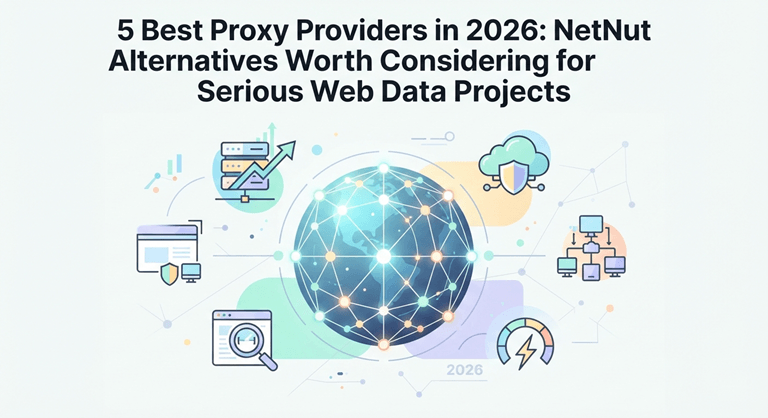
Here are five proxy providers that deserve attention in 2026.
1. Oxylabs
Oxylabs has become one of the top enterprise proxy providers with its comprehensive worldwide platform and wide-ranging products. When businesses have a challenging web data collection project, they tend to narrow down their choices to the one that can handle most of the major use cases.
The company has residential, datacenter, ISP, and mobile proxies that can be used by the organization as per their project requirement, instead of being forced to adapt one of the proxy types for their workflow.
Of all of Oxylabs’ attributes, one of the greatest is consistency. High volume operations are supported with a stable connection through large IP pools, intelligent session management,t and a global geographic coverage. This creates a great opportunity for various businesses, es including e-commerce intelligence, travel aggregation, financial research, cybersecurity, and digital marketing.
Other than proxy services, Oxylabs offers various other tools and APIs that simplify web scraping development, such as web scraping automation. Technical teams can create data collection pipelines within one ecosystem, rather than using a number of third-party systems.
The combination of the infrastructure, the scalability, and developer-friendly tools makes Oxylabs one of the best options available today for enterprises that are looking for long-term growth.
2. Bright Data
Bright Data is one of the most prominent proxy service providers out there. It has a wide range of infrastructure that enables residential, mobile, ISP, and datacenter proxies in various geographical areas.
Focusing on flexibility, the platform was designed. It is ideal for enterprises with precise targeting needs and advanced routing requirements, offering a high degree of customization. It’s highly customizable and can be used in complex environments for gathering data for detailed targeting.
For organizations creating more sophisticated automation solutions, Bright Data provides extra data collection solutions as well. But it has a lot of features, which may make it more complex in use, particularly for smaller tethat who only need to use it for a reliable proxy and do not want to deal with the complex configurations.
Having an experienced engineering department, groups tend to value the platform’s customization options and depth.
3. SOAX
Geographic precision and flexible targeting are a key part of SOAX’s activities. There are many times when users will be able to narrow down residential IP addresses to the country, city, region, and in some instances, even the internet service provider.
Providing such granularity makes SOAX attractive to businesses that are tracking local search engine results, testing ads in the region, and verifying website experiences in a country.
The platform also highlights the importance of having a fresh IP pool,s which helps to minimize the chances of repeated requests being made from the same IP addresses over a long duration of time.
SOAX is often used by companies doing international market research when assessing the providers of enterprise-class proxies.
4. Smartproxy
Smartproxy is known for its user-friendly design and robust performance, making it a popular choice among users. The service provides residential, datacenter, ISP, and mobile proxies and has a user-friendly interface that users who are not too familiar with proxy management can easily navigate.
This ease of access makes Smartproxy a great option for startups, scaling businesses, and agencies that require reliable infrastructure but don’t have to put a lot of engineering effort into deployment and management.
The platform also has several scraping-oriented tools, which will ease the use of regular data collection tasks and will make it a convenient solution for medium-sized projects that are planned to expand over time.
The solution’s usability and scalability have made it one of the most widely used in the industry.
5. IPRoyal
IPRoyal offers a wide range of proxy services to suit different technical needs and requirements of businesses. Residential proxies are a key feature of it, but it also offers datacenter and mobile proxy solutions.
IPRoyal is an excellent way for companies that are just starting to try out web scraping to test various proxy types, as well as to start using their services before rolling out enterprise use.
IPRoyal is a great choice for businesses that have moderate data volume needs, such as SEO monitoring, competitor analysis, website testing, and research projects, although it may be necessary to implement additional infrastructure in the future for businesses with massive systems.
It also has a simple pricing model that is attractive to businesses seeking to minimize their operating expenses.
6. CyberYozh
CyberYozh is a flexible proxy infrastructure provider designed for web scraping, SEO monitoring, automation, and data collection. The platform offers residential, mobile, ISP, and datacenter proxies, allowing businesses to choose different proxy types depending on their project requirements.
One of its main advantages is its broad infrastructure, with 100M+ IPs across 190+ countries. CyberYozh also provides real mobile LTE/5G proxies with unlimited bandwidth options, residential rotating proxies, and datacenter connections for different types of workloads.
The platform also supports integrations with automation tools, anti-detect browsers, and cloud phones. Additional features such as fingerprinting support, SMS activation, and fraud-risk checks can be useful for teams running more advanced automation and multi-account workflows.
CyberYozh is a practical option for businesses that need flexible proxy infrastructure across different use cases, from smaller SEO and research projects to larger scraping and automation operations.
What Actually Matters When Comparing Proxy Providers
When making a proxy provider selection, you have to go past the comparison of marketing pages or the better headline pricing. There are a number of factors that have a direct impact on the success of the project, which can be technical in nature.
The rate of success ought to be one of the initial measures assessed. Failing requests use more bandwidth, need more retries, and delay automations. The higher the completion rate, the more efficient the operations.
Another aspect that needs to be taken into account is the size of the proxy pool. The bigger the network, the less IP repetition there will be, which will naturally help spread out the traffic, and the less risk that you’ll be blocked for a long scraping session.
It’s also important to consider geographic coverage. International market intelligence is frequently collected simultaneously in dozens of countries, requiring simultaneous access to this information by businesses. Limited regional availability may limit research capabilities, or data may be less accurate.
The more you do,o the more it needs to be consistent. Millions of requests across multiple regions can behave differently from infrastructure that can handle thousands of requests reliably.
Looking Beyond Raw Performance
Technical specifications are not an adequate description. Often, integration features, documentation, API design, and customer support have more impact on productivity in the long run than network performance.
A well-designed API is able to shorten the time to implement, and full documentation for the API will help you to perform less troubleshooting when deploying. Support of existing scraping frameworks and analytics platforms can also be a big engineering time saver.
Another factor being taken into account is responsible infrastructure management. As enterprises become more savvy in reviewing how providers keep their networks up and running, meet compliance requirements, and record operational procedures, it is important to be mindful of these factors when deciding on a procurement.
The most suitable proxy provider is ultimately dependent on the size and intricacy of the project. Advanced geographic targeting, scalability, reliability, and ease of integration are some of the priorities that some organizations might have. When deciding on a provider, rather than the provider’s marketing hype, you are making decisions that benefit you and your business in the long run and will also support the growing demands of web data operations.
Popular on OTW Right Now!
-
 10 Top-Rated Caller ID Apps Based on Features, Privacy, and User Experience
-
 Best Software Project Turnaround Consulting Firms in Europe: List for 2026
-
Top 7 Remote Employee Monitoring Software Solutions for Modern Workplaces
-
 5 Free Online Resources That Actually Help Kids Understand Math (Not Just Memorize It)



About The Author

Gagan Bhangu
Founder of otechworld.com and managing editor. He is a tech geek, web-developer, and blogger. He holds a master's degree in computer applications and making money online since 2015.