
Top 10 Best Test Automation Tools for Modern Software Testing
Software testing is changing fast. Teams now release updates every week or even every day. Manual testing alone cannot keep up with this speed. Companies need automation to maintain quality and reduce risk. That is why many professionals are exploring the Best Test Automation Tools to stay relevant and grow in their careers. H2K Infosys supports learners by focusing on real-world testing practices and industry-relevant skills.
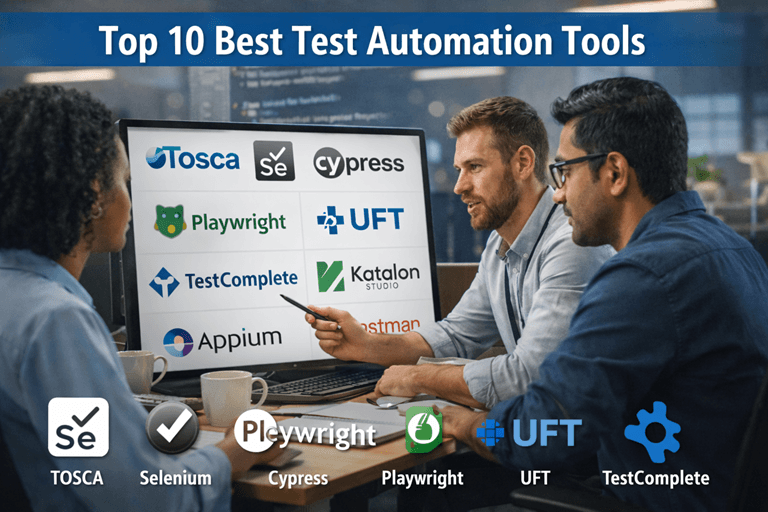
In this blog, you will learn about the Best Test Automation Tools used in modern software testing. You will also understand their features, real-world use cases, and how they help teams deliver high-quality software.
Why Test Automation Matters Today
Test automation assists teams in executing tests in a better and quicker way. It minimizes human error and saves time. It also helps in continuous integration and continuous delivery.
Key benefits of automation:
- Faster test execution.
- Better test coverage.
- Early bug detection.
- Reduced manual effort.
- Improved software quality.
According to a recent industry report, more than 70 percent of the companies currently utilize automation in their testing process. It is this trend that demonstrates the importance of learning how to use the Best Test Automation Tools for testers and developers.
How to Choose the Right Automation Tool
You must learn how to select the appropriate tool before we go through the list.
Consider these factors:
- Application type, such as web, mobile, API, or desktop.
- Skill level of the team.
- Integration with CI CD tools.
- Budget and licensing.
- Ease of maintenance.
The selection of the Best Test Automation Tools is based on your project requirements and the expertise of your team.
Top 10 Best Test Automation Tools
Now, we shall discuss the Best Test Automation Tools which are very popular in the industry.
1. TOSCA
TOSCA is a robust automation system with a scriptless methodology. It deals with model-based testing.
Key features:
- No coding required.
- High test case reuse.
- Supports web, API, mobile, and desktop.
- Strong integration with enterprise tools.
Real-world example:
TOSCA is used to automate regression testing by a banking company. The team saves 60 percent on the time of testing and enhances the speed of release.
TOSCA stands out among the Best Test Automation Tools because it is easy for beginners and effective for large projects. TOSCA Online Training at H2K Infosys helps learners understand how to use this tool in real-time projects, prepare for TOSCA Certification, and build strong automation skills.
2. Opkey
Opkey is an AI-native Cloud Application Lifecycle Management (CALM) platform that helps enterprises implement, operate, and continuously optimize critical cloud enterprise applications like Oracle, Workday, Coupa, Veeva, Salesforce and many more. Instead of managing implementation, configuration, testing, updates, and training through disconnected tools and manual processes, Opkey brings the entire lifecycle together on one unified platform.
Opkey combines agentic AI, automation, and enterprise application expertise to help organizations go live faster, manage change with confidence, and maximize application ROI.
Key features:
- No-code test automation.
- Agentic AI-powered test discovery and test creation.
- 30,000+ pre-built ERP test cases.
- Self-healing test scripts.
2. Selenium
Selenium is a very ubiquitous web automation open source tool.
Key features:
- Supports multiple languages like Java, Python, and C#.
- Works on different browsers.
- Large community support.
Sample code snippet:
from selenium import webdriver
driver = webdriver.Chrome()
driver.get(“https://example.com”)
print(driver.title)
driver.quit()
Selenium has become popular, and it is one of the best test automation tools for web applications.
3. Cypress
Cypress is a present-day front-end testing tool.
Key features:
- Fast execution.
- Easy setup.
- Real-time reload.
Use case:
Cypress is also used by startups to test web applications in a short period.
Cypress is becoming popular among the Best Test Automation Tools due to its ease.
4. Playwright
Playwright is a single-API cross-browser testing.
Key features:
- Supports Chromium, Firefox, and WebKit.
- Handles dynamic content well.
- Works with multiple languages.
Real-world use:
Playwright is used in e-commerce sites to test user flows in browsers.
It is among the Best Test Automation Tools in web testing today.
5. UFT
UFT is a commercial tool that helps in functional testing.
Key features:
- Supports GUI testing.
- Works with multiple technologies.
- Easy integration with ALM tools.
Example:
UFT is applied in enterprise companies to test their legacy systems.
It is regarded as one of the Best Test Automation Tools in enterprise settings.
6. TestComplete
TestComplete has scripted and scriptless testing.
Key features:
- Supports desktop, web, and mobile.
- Record and playback feature.
- Strong object recognition.
Use case:
TestComplete is used by QA teams to achieve quick automation installation.
It is one of the best Test Automation Tools to be used in mixed skill teams.
7. Katalon Studio
Katalon Studio is an all-in-one automation platform.
Key features:
- Easy to learn.
- Built-in templates.
- Supports API, web, and mobile testing.
Example:
Small teams make use of Katalon to create tests quickly.
It is among the Best Test Automation Tools to start with.
8. Appium
Appium is utilized in the testing of mobile apps.
Key features:
- Supports Android and iOS.
- Open source.
- Works with multiple programming languages.
Code example:
driver.findElement(By.id(“login”)).click();
Appium is a popular and one of the Best Test Automation Tools to test mobile.
9. Robot Framework
Robot Framework is a key-driven automation tool.
Key features:
- Easy syntax.
- Open source.
- Supports API and UI testing.
Example:
*** Test Cases ***
Login Test
Open Browser https://example.com
It is among the Best Test Automation Tools of easy and understandable test cases.
10. Postman
Postman is mainly used for API testing.
Key features:
- Easy API request creation.
- Automated test scripts.
- Supports collections.
Real-world use:
Postman is used to test APIs by teams prior to UI testing.
It is among the Best Test Automation API Testing.
Comparison of Tools
Quick comparison:
| Tool | Best For | Skill Level | Type |
| TOSCA | Enterprise testing | Beginner | Scriptless |
| Selenium | Web testing | Intermediate | Code based |
| Cypress | Front-end testing | Beginner | Code based |
| Playwright | Cross browser | Intermediate | Code based |
| UFT | Enterprise apps | Beginner | Hybrid |
| Appium | Mobile testing | Intermediate | Code based |
This table can assist you in comparing the Best Test Automation Tools according to your requirements.
Step-by-Step Guide to Start Automation
Step 1: Learn basic testing concepts
Understand manual testing and test cases.
Step 2: Choose a tool
Pick one from the Best Test Automation Tools based on your goal.
Step 3: Learn programming basics
Some tools require knowledge of coding.
Step 4: Practice with real projects
Compose sample scripts and execute.
Step 5: Learn CI CD integration
Automation pipelines: Use automation pipelines, such as Jenkins.
Role of TOSCA in Modern Testing
TOSCA is transforming the way teams are approaching automation.
Why TOSCA is important:
- Lessons dependence on coding.
- Accelerates the development of tests.
- Improves collaboration.
TOSCA is now the favorite tool of many professionals since it is easier to automate and enhance productivity when using the Best Test Automation Tools.
Common Challenges in Automation
The Best Test Automation Tools do not do without problems.
Challenges:
- High initial setup time.
- Maintenance of test scripts.
- Skill gap in teams.
Solutions:
- Start with small projects.
- Use reusable components.
- Invest in proper training.
Industry Trends in Test Automation
Automation is growing rapidly.
Key trends:
- Artificial intelligence-based testing tools.
- Low-code automation platforms.
- Shift left testing approach.
- Cloud-based testing.
The future of the Best Test Automation Tools is being influenced by these trends.
Key Takeaways
- Modern software testing needs automation.
- Selecting an appropriate tool is based on the needs of the project.
- TOSCA is a powerful choice among amateurs and companies.
- Practice and real projects are key to learning
- The knowledge of more than one tool enhances career development.
Conclusion
One of the main aspects of modern software development is test automation. Knowledge of the Best Test Automation Tools can assist you in becoming a proficient learner and remain competitive.
Get started and put your knowledge into practice in actual projects to develop your software testing career.
Popular on OTW Right Now!




About The Author

Gagan Bhangu
Founder of otechworld.com and managing editor. He is a tech geek, web-developer, and blogger. He holds a master's degree in computer applications and making money online since 2015.