
The Value of Onsite IT Management for Philadelphia’s Growing Businesses
You know the exact feeling when a critical system crashes. The network goes down, employee productivity screeches to a halt, and you find yourself stuck on a call with a remote helpdesk technician who cannot physically see the problem. You are forced to describe flashing lights on a router while your customers wait in silence. Relying on this kind of reactive support is no longer just a minor daily annoyance; it is a massive financial liability.
The numbers surrounding network outages are staggering. According to Forbes Tech Council, “The cost of IT downtime per minute is almost $9,000 per incident.” When technology fails, waiting hours for a remote technician to slowly troubleshoot the issue simply isn’t an option for a growing company. Every passing minute drains your revenue and damages your reputation.
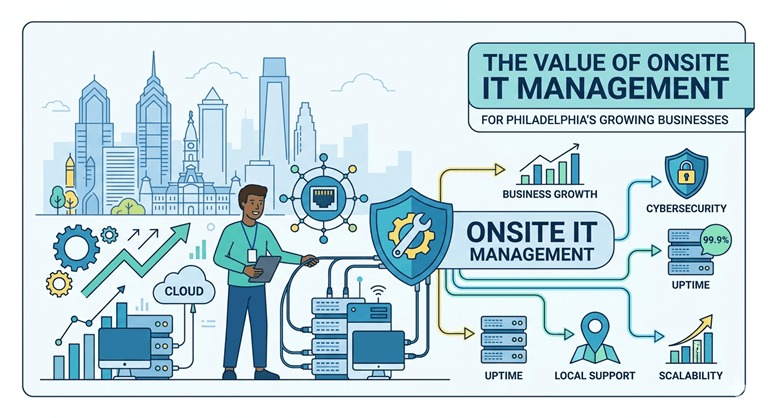
To maintain momentum and secure your operations, you need a partner who provides proactive, round-the-clock monitoring alongside the ability to deploy expert technicians directly to your office for comprehensive IT management in Philadelphia. This article explores why combining continuous remote vigilance with local, physical IT support is the smartest investment you can make to stabilize your infrastructure.
Key Takeaways
- Pairing remote monitoring with physical, onsite IT management provides rapid issue resolution and eliminates devastating operational bottlenecks.
- Small and medium-sized businesses face escalating cyber threats, making enterprise-grade cybersecurity an absolute necessity rather than an optional luxury.
- Partnering with a Managed Service Provider (MSP) delivers a stronger ROI and more predictable costs compared to building an expensive, in-house IT department.
Remote IT Monitoring vs. Onsite IT Management: What’s the Difference?
Let’s clearly define remote IT monitoring. It is the baseline standard for most modern tech support companies. A team sits in an off-site call center, watching your network traffic and answering support tickets when a software glitch happens. While helpful for simple password resets or email configuration, this remote-only model falls completely flat when physical hardware fails.
If a primary server crashes or a network switch burns out, remote technicians cannot help you. You are left stranded, trying to act as the middleman between a frustrated employee and a distant support rep. On-site IT management changes this entire dynamic. It blends the constant vigilance of remote monitoring with comprehensive physical oversight.
When severe hardware or complex network issues arise, a local partner rapidly dispatches expert technicians to your office. They provide immediate, hands-on resolutions that get your team back to work quickly without forcing your internal staff to touch complex wiring or hardware components.
This local presence is crucial for the growing businesses in the Philadelphia area. You achieve quick response times in the physical world to reduce the cost of disruption. In addition to repair, a local partner offers consulting specifically tailored to each person’s needs that occurs face-to-face. They meet with your leadership team, know how your physical facility is set up, and create a technology roadmap that fits your operations like a glove.
| Service Feature | Remote IT Monitoring | Onsite IT Management |
| Support Style | Off-site troubleshooting via phone or chat | Hands-on, physical intervention at your office |
| Hardware Failures | Forces your staff to act as the technician | Expert technicians dispatched directly to your location |
| Strategic Planning | Generic, reactive software advice | Personalized, in-person technology roadmapping |
The Escalating Cybersecurity Threat for SMBs
A common mistake that many operations leaders make in relation to network security is thinking they can get away with nothing. They think that their company is too small to be of interest to sophisticated hackers. This fallacy leaves a huge opportunity for significant financial losses.
Targeting small businesses and medium-sized businesses is a favorite tactic of cybercriminals. They are aware that SMBs typically do not have all the security measures of large corporate enterprises and are easy targets for automated attacks. Using automated tools, hackers can scan thousands of networks, looking for any vulnerability they can exploit. They are not size sensitive. All they’re interested in is obtaining your important financial records, client information, and employee records.
Why Proactive Monitoring is Non-Negotiable
The only thing you can do is prepare for a cyberattack and take precautions. Proactive IT monitoring coupled with a focused Security Operations Center (SOC) monitors the network 24/7, well before a hacker can exploit it. Security professionals are on the case and seek out unusual activity and software exploits in advance of them becoming an actual attack.
This is a proactive method as opposed to the usual “break-fix” model, where you only request assistance after you have broken. Active threat detection prevents problems from causing catastrophic system failures. When threats arise, the only way to guarantee full compliance with industry requirements and uninterrupted business operations is to have continuous monitoring.
The ROI: Managed Service Provider
It is very costly to establish an IT team, which can take a full-time role as an enterprise. As an operations leader, you already have to deal with a constrained budget and increasing operational expenses. There are also numerous network engineers and cybersecurity professionals who can quickly add to your payroll. You’ll also have the cost of hiring a dedicated Chief Information Officer and network engineers, and cybersecurity professionals, which will quickly add up to your payroll.
There are also some hidden costs to an in-house team that you’ll need to consider. They receive benefits, paid time off,f and ongoing training to keep them proficient. By working with a Managed Service Provider (MSP), your technology costs completely change.
Having to manage your own technology is a hassle to deal with, but you get a flat rate monthly fee for a fully managed technology solution. This will help you plan your budget correctly, so you won’t be caught with all your bills due and nothing to pay for any repairs or continued recruitment.
In addition, a typical in-house IT hire is typically a generalist and can become overwhelmed by the number of helpdesk tickets that come across their desk every day. An MSP offers access to all of the specialists in one fell swoop. Gain on-demand expertise in cloud solutions, VoIP communications, a nd advanced cybersecurity, and have a deep, specialized knowledge of your infrastructure supported.
Choosing the Right Philadelphia-Based IT Partner
It is not the same technology partners that offer the same support. If you choose a local MSP to safeguard your business, then you should look for cutting-edge enterprise-level services. A powerful partner is necessary to provide complete SOC services to observe sophisticated threats and thwart malware at the source.
They should also offer a smooth integration with Office 365 cloud computing, allowing teams to work together more effortlessly, expandable VoIP communication for access by all employees, and robust data backup and disaster recovery to ensure your business is not lost.
With so much of the technology we use today in the cloud, you may be asking yourself why a local Philadelphia IT partner is important to you. It’s about the right mix of cloud management and on-site physical assistance. If you have virtual data servers, you have very real and vulnerable laptop computers, WiFi transmitters, and office walls and firewalls that link your team to the cloud. Your cloud infrastructure is managed seamlessly and efficiently by a local partner, but is only a few minutes’ drive away if your physical office has hardware emergencies.
Next Steps: Assessing Your Current IT Vulnerabilities
The first step to getting your technology stable and working for you is to figure out exactly what’s wrong with it. Sit down and figure out what are some barriers and out-of-date systems in the workplace are slowing down your team’s productivity.
Do your employees have to wait for lengthy downloads or deal with poor VoIP service? If a server crashes tomorrow, what is your plan to recover your data if you have one? If your server does fail today, do you have a documented and tested plan for recovering your data? If you don’t have the answers to these questions, your network is extremely vulnerable.
The first step in assessing network health is to create a plan of action for the practical steps. Check current equipment to determine what’s out of warranty. Assess the people who have administrative access to company-sensitive information and keep all platforms with multi-factor authentication. Review the time of your last successful, fully tested, and verified data backup.
Don’t do this complicated evaluation on your own! Contact a Philadelphia IT professional to have them evaluate your network for free. A security audit by the experts will identify all the security issues and performance slowdowns in your system before they can cause catastrophic downtime.
Conclusion
IT downtime risks are too substantial for expanding businesses to afford to turn a blind eye to. A traditional, reactive, remote Help Desk is a very risky investment for your company when it comes to lengthened downtime and productivity losses. But the only real way to keep your operations safe is to have quick response and physical supervision, which can only be provided by proactive, local IT support.
Working with a Managed Service Provider (MSP) in Philadelphia provides unparalleled cost effectiveness, enterprise-level cybersecurity, a nd peace of mind. You get an entire team of technology experts who are focused on ensuring the security of your network and the productivity of your employees, and it’s done for a very predictable monthly cost.
A thorough onsite IT management solution ensures the entire IT infrastructure is more stable. Once the daily distraction of broken technology and near-certain cyber risks are gone, you’re able to give your leadership team back to the mission that really matters—sustainable business growth.
Popular on OTW Right Now!


About The Author

Gagan Bhangu
Founder of otechworld.com and managing editor. He is a tech geek, web-developer, and blogger. He holds a master's degree in computer applications and making money online since 2015.