
The Ultimate Guide to Finding Local HVAC Leads
The foundation of a successful HVAC business lies in a diversified lead generation strategy. Relying on a single source—like word-of-mouth or a single directory site—is a recipe for volatility. Instead, we recommend building a multi-channel approach that balances immediate, high-intent demand with long-term brand authority.
When you focus on generating local HVAC leads, you are essentially building a digital net that captures homeowners at different stages of their journey. Some customers are in the middle of an emergency—a furnace failure at midnight—while others are researching energy-efficient upgrades for the upcoming summer. By integrating organic search, paid advertising, and community-based outreach, you ensure that your business is visible regardless of the customer’s specific intent.
Optimizing Google Business Profile and Map Pack SEO
For the vast majority of local contractors, the “Map Pack” is the group of three businesses that appear at the top of the Google Maps results. That’s typically where the bulk of the inbound calls come from. To get in that pack, you have to treat your GBP as something that you’re going to be actively updating and improving on a regular basis rather than just a basic listing.
Consistency is paramount. Your Name, Address and Phone number (NAP) must be exactly the same across your website, your social media and all directories. Google is also looking for relevance, so your primary and secondary categories need to be chosen carefully (e.g., Air conditioning contractor, HVAC contractor). Upload clear, geo-tagged photos of your team working in the areas you serve. Keep your GBP active by posting regularly with a mix of updates, seasonal tips and photos of your work to keep it interesting and fresh.
Capturing High-Intent Demand with Google Local Services Ads
Organic SEO will get you noticed over time, but Google Local Services Ads (LSAs) can get you to the top of the page instantly. They appear above the organic results and have the ‘Google Guaranteed’ badge which in itself is a massive trust builder for the customer.
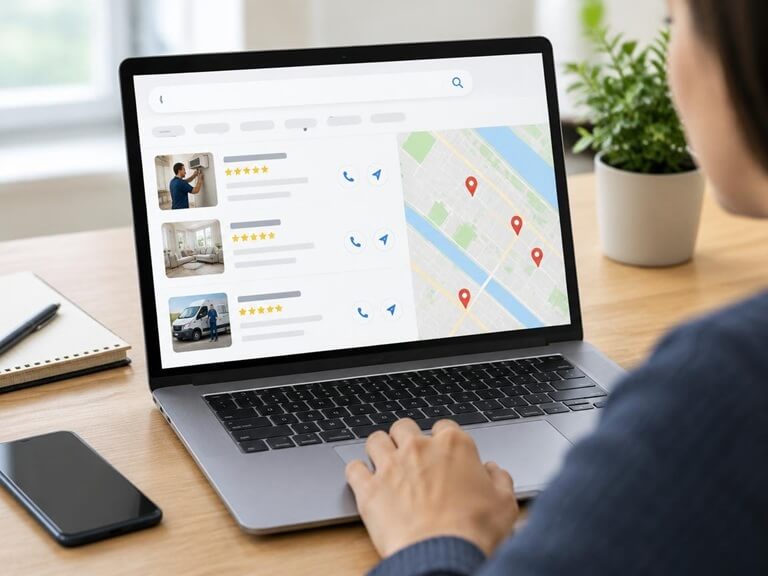
LSAs charge you per lead not per click. You only get charged when someone actually contacts you as a result of the ad. The cost is typically between $25 and $75 per lead depending on your area and the level of competition. To get the best results you need to respond to calls very quickly and manage your leads well. Google will look at how quickly you respond and if you’re slow to reply your ranking will suffer and your costs will go up. Keep your profile current and respond to inquiries within minutes to maintain your ad ranking, even during the busy times of the year (e.g., heatwave, cold snap, etc.).
Exclusive vs Shared HVAC Leads: Quality, Margins, and ROI
A key one is whether you go for exclusive leads or shared leads. The shared leads (which are the ones that the big home service directories will often sell you) go to a number of contractors. That typically means you’re just competing on price rather than on your service or your reputation.
Exclusive leads are made specifically for your business. As you’re the only one getting the inquiry, you can concentrate on what the customer wants rather than trying to out-price a competitor. They tend to be more expensive initially but often deliver a better ROI as they convert at a higher rate and you’re able to charge more.
In-House Marketing vs Buying: Cost of Generating Local HVAC Leads
The decision between building your own lead gen team or going with a company is really down to your size and your resources. If you have your own team you have complete control of your data and your brand. The downside is that it’s a massive amount of time and skill to actually run the SEO, the PPC and the content.
Working with a lead gen agency can get you growing very quickly. Be wary of any agency that’s more concerned with the volume of leads than the quality of those leads. Ask them how they verify the leads. Are they using high-intent channels? Can you select your service area and types? A pay-for-performance model is generally the safest, as it means they only win when you do.
Key Metrics for Measuring Lead Quality and Lifetime Value
To properly measure your growth look at more than just the number of leads. Look at these key metrics to ensure your marketing is actually generating profit:
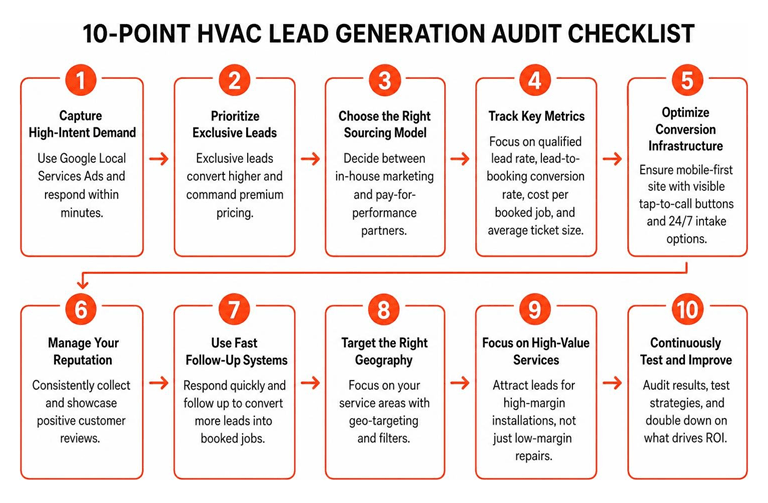
- Qualified Lead Rate: What percentage of your inbound calls are actually in your service area and looking for services you provide?
- Lead-to-Booking Conversion Rate: Of the qualified leads, how many result in a scheduled job?
- Cost Per Booked Job: This is the ultimate efficiency metric. If you spend $500 to generate ten leads, but only one books a job, your cost per booked job is $500.
- Average Ticket Size: Are the leads coming from your paid channels resulting in high-value installations or just low-margin filter changes?

Conversion Infrastructure: Response Time, Reviews, and Follow-Up Systems
Getting a lead is just the first step, really. If your site is slow or customers have to go through several pages to find your phone number, then you could be losing business. Make sure your digital offering is fast and easy to use.
Make sure your site is mobile-friendly and has “tap to call” buttons throughout. Your customer should be able to get in touch with you in two taps. Also have 24/7 options available such as an online booking system or a chat widget so you’re still getting leads when your office is closed.
The 5-Minute Lead Response Rule and Missed-Call Recovery
In HVAC, you win by being fast. The studies are quite clear on this one. The first company to respond to a lead is vastly more likely to win it. If you wait more than 5 minutes to follow up your probability of winning that lead is significantly reduced.

If you miss a call, then use an auto-recover system to get it back. The new tools can detect a missed call and immediately text the person to let them know you’ve received their message and ask them when they’d like to call back. The ‘missed call text back’ function can save you up to 75% of the leads that would otherwise have gone to someone else.
Building Trust with Online Reputation and Automated Reviews
Your reputation is absolutely everything. Having just five reviews makes your service 270% more likely to be selected than a service with no reviews at all. The homeowner is going to be concerned about hiring someone who might be a bit over the top with their pricing or who might just do a poor job. They’re going to look at what other people have said.
Don’t just hope for reviews. Set up an automated system to send a text or email asking for a review immediately after the job is complete. It’s far easier to get reviews if you make it so simple for the customer to do so, and that, in turn, will get you more reviews, improve your local search ranking, and build trust with future leads.
Streamlining Lead Management with Modern HVAC Tech Stacks
Managing leads manually is a recipe for disaster. To scale, you need a tech stack that integrates your marketing, CRM, and field service management.
Best Software Stack for Generating Local HVAC Leads
We recommend a combination of tools that work together to handle the full customer lifecycle:
Platform Role ServiceTitan / Housecall Pro / Jobber Field service management and CRM Podium Communication and review management CallRail Call tracking and attribution HighLevel Marketing automation and lead nurturing By integrating these tools, you ensure that every lead is tracked, every call is recorded, and every customer is nurtured through automated email or SMS sequences.
Lead Scoring, CRM Attribution, and Automated Nurturing
Not every lead is created equal. Use AI-powered lead scoring to focus on the leads that are actually going to be of the most interest to you. Make sure your CRM is logging the source of your leads. If you find that the majority of your high-value jobs are coming from Google Local Services Ads, then you can of course shift your budget there. You can also use your customer list to keep your team busy during the slow seasons with a series of reminders around tune-ups and air quality checks.
Frequently Asked Questions About Local HVAC Leads
How much do local HVAC leads cost in 2026?
Costs vary enormously depending on where you are. Shared directory leads are typically in the $20-$50 range, whereas your own exclusive leads from your own SEO or paid ads can be $40 to $150 or more. The higher price for the exclusive leads is often worth it as they tend to convert better and generate larger jobs.
What is the most effective way to generate commercial HVAC leads?
The best way to get commercial leads is via relationship marketing and B2B outreach. You want to be building long-term maintenance agreements with facility managers, property owners, and local business groups. For commercial HVAC your digital marketing will be very different to residential. It will be about your reliability, your ability to respond quickly, and your technical ability rather than your ability to do an emergency call-out.
How can HVAC contractors keep trucks busy during shoulder seasons?
Shoulder season is a great time to re-engage your existing customer base. Send out targeted emails and texts to your existing customers with deals on seasonal tune-ups, duct cleaning or air quality upgrades. That way you can keep your books full without having to spend a fortune on new leads.
Conclusion
Getting more local HVAC leads isn’t about finding a magic bullet that just fills your schedule up overnight. It’s about building a system that is, in fact, going to value every lead. If you improve your local visibility, invest in some unique lead sources, and use the technology to respond to the customer as quickly as possible, then you’ll be able to avoid the peaks and troughs of a business that’s not going to be consistent.
Begin by reviewing your current process. Are you missing calls? Is your Google Business Profile up to date? Do you have a system for collecting reviews? Fixing these small issues can make your existing leads more valuable. The aim is to build a business that not only gets through seasonal changes but grows during them. Start today by connecting your communication tools and paying attention to your customer relationships. The steps you take now will help secure your local market and future revenue.
Popular on OTW Right Now!
-
 How Digital Certification Verification Actually Works — Credly, Pearson VUE, and What Background Checks See
-
 How Enterprises Distribute Secure Video Across Multiple Buildings and Campuses
-
 How to Build a High-Performing Android Development Team on Any Budget
-
Reducing Administrative Overload in Universities Through Intelligent Systems



About The Author

Gagan Bhangu
Founder of otechworld.com and managing editor. He is a tech geek, web-developer, and blogger. He holds a master's degree in computer applications and making money online since 2015.