
The Strategic Value of Data Room Software in a Risk-Conscious Business Environment
Risk has become a defining feature of modern business. It appears in different forms — operational, regulatory, financial, reputational, and increasingly digital. For companies navigating transactions, audits, fundraising, legal reviews, or cross-border collaboration, the challenge is no longer just moving fast. It is moving fast without losing control.
That is where data room software is gaining strategic relevance. Once viewed primarily as a tool for mergers and acquisitions, it is now becoming a broader business infrastructure layer for organizations that need to manage sensitive information with greater precision. In a climate where one misstep can delay a deal, weaken trust, or expose confidential data, that shift is not surprising.
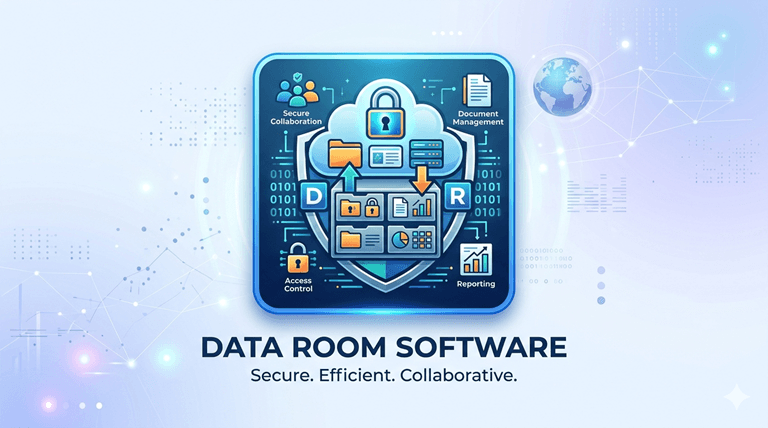
Businesses are learning that secure document management is not an administrative concern at the edge of decision-making. It sits much closer to the center.
Risk is no longer a background issue.
Most organizations over the years considered document sharing as a workflow issue. The files were either emailed, shared in Commo,n or shared over simple cloud platforms that emphasized convenience over control. That strategy was sufficient in the days when the amount of sensitive collaboration was small, er and the outcomes of bad governance were less apparent.
That is no longer the case.
A contemporary business needs to be fast and totally in control. It is not simple in a climate where investors, regulators, clients, NTS, and internal stakeholders are watching more closely. Throw in dispersed teams, external consultants, and rapid transactions, and the operating environment becomes even more fragile – where bad document management can easily become an actual business threat.
Under these circumstances, poor document management is a business risk.
Why traditional file-sharing tools fall short
Accessibility and collaboration were the priorities in the creation of generic storage platforms, rather than high-stakes confidentiality. That distinction matters. The gap might appear to be a trivial matter in everyday application. It is important in delicate business situations.
Off-the-shelf file-sharing tools will be effective in most basic collaboration, but can fail in more complicated transactions, or ones requiring a high degree of compliance. Authorizations may be lost, versioning may be lost, and the activity in the document is usually not visible. In a case where accuracy and confidence are paramount, such gaps are more than workflow details to consider; they can be confidence killers to the process itself.
The data room software will help to overcome that weakness by providing a less chaotic digital space. It is not only built to store files, but it is meant to organize access, track the activity, and safeguard information across the lifecycle of a sensitive process.
Control has become a competitive advantage.
Among the most obvious reasons why businesses are starting to implement data room software is that control itself has become valuable. Stakeholders who live in a risk-conscious environment would want to know that sensitive information is not treated carelessly. They would like to know that a company is able to isolate access levels, monitor activity, stay on top of a well-documented record of activity, and present documents in a manner that demonstrates operational maturity.
That is especially important in scenarios such as:
- mergers and acquisitions
- fundraising and investor due diligence
- legal and compliance reviews
- board reporting
- strategic partnerships
- restructuring or insolvency processes
In both of these cases, document management quality can not only affect efficiency, but also perception. Properly organized information is a point of preparedness. Information disorder is questioned.
Data room software is about more than security.
The first and most obvious benefit is security. Encryption, granular permissions, watermarking, limited downloads, and audit logs are all key in safeguarding sensitive content. However, security is not the only reason data room software is strategic.
It enhances clarity as well.
When the sensitive information is brought to a single controlled environment, the whole process can be easily managed. It assists in clearing up on versions, approvals, and access, and saves time that teams would spend tracking down files or addressing unnecessary errors. The review process is simplified for the external stakeholders. To internal decision-makers, it provides a better picture of the start-to-finish progress.
That is, data room software assists organizations in transforming the complexity of documents into operational order.
The role of trust in modern business transactions
Trust has been spoken of as an issue of relationships, reputation, or brand. Yet in business dealings, trust is established, too, by systems. The manner in which a company displays and secures information conveys much information to counterparties on how the company functions.
That impression can be reinforced by a safe, well-arranged data room. It demonstrates that the business values confidentiality, knows the requirements of the process, and is ready to assist in decision-making in a disciplined manner. That is important to investors, lenders, buyers, r,s and advisors.
The platform itself is often included in the transaction experience in numerous instances. Confidence can be strengthened by a smooth diligence process. It can be worn away by a messy one.
Why risk-conscious companies are thinking more strategically
Companies are becoming more conscious that risk management is not an issue that can be segregated to cybersecurity or legal teams. It must be incorporated into the manner in which business-critical processes actually occur. It implies that the tools that underpin those processes are increasingly important.
Data room software is compatible with this change as it is at the crossroads of governance, speed, and confidentiality. It assists in minimizing exposure without having to drag teams to slower, more disjointed workflows. Such a balance is challenging to find in general-purpose tools.
This renders the software strategic to the leadership teams. It is not just a procurement decision. It belongs to the way the company safeguards value through times of sensitivity and change.
Providers now matter as much as the platform itself
With increasing adoption, provider selection is increasingly significant. Businesses do not consider platforms in terms of storage or price alone. They are considering usability, level of permission, reporting, the quality of support, and the capability of the provider to support various contexts of transactions.
A good provider is not just one who supplies software. It assists in developing a guideline to carry out safely. That incorporates onboarding, administrative ease, document organization, and functionality that enables it to handle numerous stakeholders without losing control.
This is especially significant to those businesses that do not transact every week but require running their businesses with the same professionalism as the one that does.
Strategic value becomes most visible under pressure
The real value of data room software is usually most conspicuous when the pressure is on. The financing round goes into a critical stage. A buyer requests new documents on short notice. Legal representation requires an updated file set as soon as possible. Internal teams should operate rapidly without causing confusion and/or revealing irrelevant information.
During such times, the program ceases to be a storage program. It enters into the execution capacity of the company.
Companies with appropriate infrastructure are in a better position to react swiftly and with assurance. Users who have had to depend on haphazard file-sharing systems usually find out the limitations of that system when it is too late.
From operational utility to business infrastructure
It is not merely the popularity of data room software that is shifting currently, but it is how it is being comprehended. It is shifting from being a niche solution to specific events to a more general infrastructure component of risk-sensitive organizations.
That is a broader reality of the online business world. The best performing companies are not necessarily those that take the least number of risks. They are the ones who tend to be the most disciplined in risk management. They understand where control is required, where transparency is critical, and where superior systems can enhance the results and resilience.
Data room software fits in that discussion since it facilitates all three.
Conclusion
The handling of sensitive information has become a strategic issue in a business environment that is characterized by uncertainty, scrutiny, and increasing expectations. Firms can no longer afford to consider confidentiality, access control, and governance of documents as a second-order workflow problem.
Data room software offers strategic value in that it can bring sanity to the chaos. It enhances security, helps make decisions quicker, enhances stakeholder trust, and provides businesses with more control over processes with the high cost of error.
To risk-averse organizations, it is not a fringe benefit. It is a worthy benefit.
Popular on OTW Right Now!
-
 How to Choose the Right Gaming Computer: A Buyer’s Guide for First-Time Builders and Upgraders
-
 UnblurImage.ai vs iPhone 16 Native Unblur: Which Tool Better Fixes Low-Light Grain?
-
 Best Over Ear Headphones and Portable Projector: The Perfect Entertainment Setup
-
 How to Choose the Best UI/UX Design Company in India




About The Author

Gagan Bhangu
Founder of otechworld.com and managing editor. He is a tech geek, web-developer, and blogger. He holds a master's degree in computer applications and making money online since 2015.