
The Invisible Screwdriver Keeping Oil Rigs From Falling Apart
If one of the pieces wasn’t tightened just right, instead of a flat-pack piece of furniture, it’s a high-pressure steel pipe 3,000 metres underground carrying oil or gas. Not a little “off” is a big problem. It’s a leak path, it’s a broken well, or it’s an environmental incident that’s costing millions of dollars to contain.
This is the issue that a particular group of industrial machines is created to address. And most folk have never heard of it.
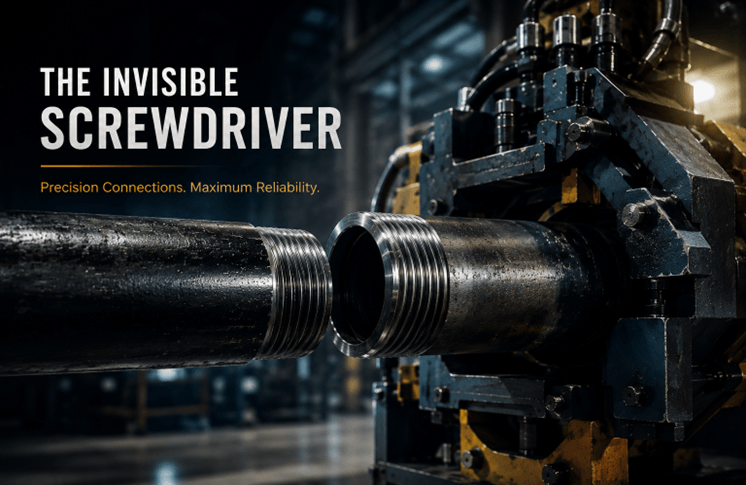
This is the problem that a specific category of industrial machinery exists to solve. And most people have never heard of it.
When Tightening a Pipe Is Not Simple
A series of steel pipes is connected end to end to create a long string of steel pipes used to construct an oil and gas well. Connecting one piece to another by screwing them together is referred to as making up a joint, and it seems simple enough. It is not.
Premium connections are made from threads that are manufactured to a very close tolerance and are used on high-value oilfield pipe. If it is not tightened enough, it will leak under pressure. If they are over-tightened, they will be permanently distorted and unable to be used. The range between these two failure possibilities can be very small, and varies with pipe grade, pipe diameter, thread type, and temperature.
There is no way that human hands and manual wrenches can get to that window, let alone do all those dozens of joints in an eight-hour shift. Even competent operators can have different variations that can introduce real risk.
The Machine Built for This Exact Problem
This equipment has been developed to address the problem is called a bucking unit. It’s a hydraulic machine which can maintain the length of a pipe, spin it at an accurately controlled speed, and measure and display torque and number of turns in real time as the connection is being tightened. The machine stops when the above mentioned parameters are reached and automatically records the data.
What makes modern bucking units far more capable than older versions is the combination of sensor precision and process control. Contemporary systems can track torque to within 150 ft-lb and count rotations to 0.0001 of a turn — a resolution that would be impossible to achieve by hand. Every joint produces a data curve showing exactly how the connection behaved as it tightened: how resistance built, when the shoulder engaged, and whether the behavior matched what engineering specifications predicted. The Galip bucking unit is one example of how manufacturers configure these systems around that data-capture capability, matching each machine to the pipe diameters and connection types a workshop actually runs.
This curve is not a quality check! It’s a record. Automated logging is the key for industries where documented evidence of all connections being made correctly is required — and auditors can ask for it months or years after the initial inspection — to help avoid the hassle of having to scramble to get the paperwork afterwards when it doesn’t exist.
How Drive Structure Affects Connection Quality
There are various ways that the bucking units operate mechanically. The more even the torque is distributed to the connection depends on the architecture of the drive system. Cleanliness of thread engagement and accuracy of the torque curve will be influenced by asymmetrical force concentration in machines that concentrate the force asymmetrically during rotation.
Some bucking units do not produce a torque consistently. The approach style used for rotating the shoulder – and how the drive system settles into the make-up stage – can influence whether the torque curve is consistent with the connection. A system that delivers peak torque moments or steps can make up for any poor performance in the end gross value, and this is exactly when it will come out as a rejected joint or a failed audit several weeks down the road.
Why This Matters Beyond Oil and Gas
Bucking units can apply to any oil/gas well, not just conventional. These connection integrity issues are also found in horizontal directional drilling, or HDD, which is the drilling method used to place pipelines, fiber optic cables, and other utility conduits underground without opening a trench in the road, river, or urban structure. Strings drilled in this type of work are subjected to a large amount of torque and tension when being installe,d and if a connection fails undergrou,nd it can take weeks to recover as opposed to hours.
Development of geothermal energy also has similar requirements, but adds to the challenge the requirement for pipes to withstand extremely corrosive fluids at very high temperatures. These applications predominantly ucorrosion-resistantant pipe, which can be very costly, and one leak means a lot of lost pipe.
In every one of these industries, the machines that accomplish this operate in a silent manner in workshops out of the public eye. It doesn’t seem to be part of the completed infrastructure, even in pictures of the completed infrastructure. However, the reliability of what is built above ground – or below it – depends on whether each threaded connection was built to specification – or whether there is evidence of it being built to specification.
How a Tightened Pipe Connection Holds a City’s Energy Supply Together
This type of industrial equipment doesn’t often get in the news. It works. The connections hold. The audits pass! Pipes remain closed.
The engineering task of getting a steel pipe snugly fitted to a precisely defined specification, not with a “feel and experience” approach but with measured data and permanent record, proves to be a difficult task. After you grasp the implications and understand what you’re losing, it doesn’t look like such a complicated necessity of heavy industrial tooling; it’s much more obvious.
The companies constructing and managing this type of infrastructure are as varied as people might imagine: The traditional oil and gas companies, the HDD contractors laying fiber under city streets, and the geothermal companies drilling into the heat of the earth. They all have one thing in common: threaded connections that hold, which are documented by data that can be audited. If there is any interest in the bigger picture of the equipment picture in this space, then Galip Equipment serves as a handy benchmark as to what precision-engineered oilfield and trenchless tooling looks like in action.
Popular on OTW Right Now!




About The Author

Gagan Bhangu
Founder of otechworld.com and managing editor. He is a tech geek, web-developer, and blogger. He holds a master's degree in computer applications and making money online since 2015.