
The Impact of AI-Driven Data Growth on Enterprise SSD Adoption Trends
The rapid evolution of artificial intelligence is reshaping how modern enterprises generate, process, and store data. As AI systems become more advanced, the volume of data being created has surged dramatically across industries such as finance, healthcare, retail, and cloud computing. This exponential data growth is not only changing analytics and decision-making but also transforming the underlying storage infrastructure that supports it. Traditional storage systems are struggling to keep up with the speed and scale required by AI workloads, leading organizations to rethink their storage strategies from the ground up.
In the middle of this transformation, businesses looking to buy bulk SSDs are increasingly focusing on performance, durability, and scalability rather than just storage capacity. As a result, solid-state storage has moved from being a premium option to a core requirement in enterprise infrastructure planning. This shift is especially visible in data-intensive environments where milliseconds of delay can significantly impact outcomes, such as real-time analytics and machine learning model training.
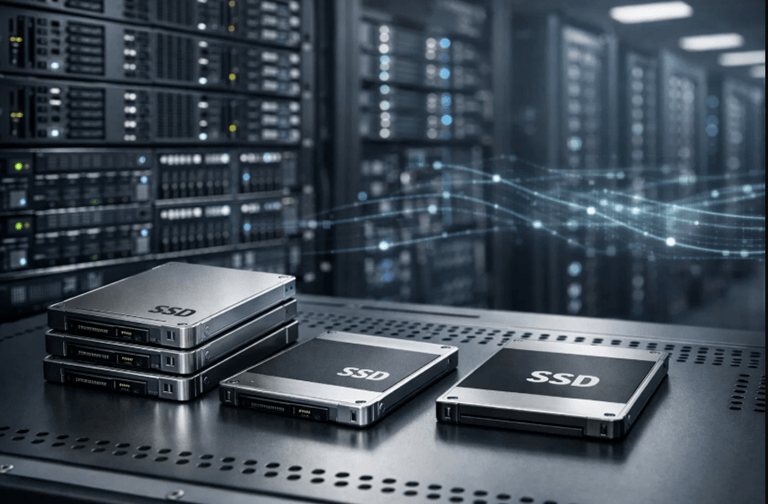
AI-Driven Data Growth and the Rise of Enterprise SSD Storage
One of the largest technological changes of the decade is the explosion of AI-generated data. Each interaction with a machine learning model, each automated decision system, each predictive algorithm leads to giant streams of structured and unstructured data. This environment requires storage systems that are able to sustain read and write operations at all times without reducing performance.
Enterprise SSD has a significant role to play in the modern data architecture here. In comparison to traditional hard drives, solid-state storage is much faster in both input and output operations, and is well-suited to AI workloads that demand quick data access. Also, low-latency storage has become a priority on the agenda of enterprises to make AI models capable of training more quickly and provide real-time insights with no bottlenecks.
Enterprise SSD solutions are utilized in hybrid cloud environments, edge computing, and high-performance data centers, as companies expand their digital systems. This assists AI applications in being consistent in speed and reliability when the amount of data continues to increase.
How AI Workloads Are Transforming Enterprise SSD Adoption Trends
The workloads of AI are altering the ways businesses consider storage systems. Businesses are not only considering storage capacity, but they are also giving consideration to stamina, speed, and the ability to perform several processes simultaneously. Machine learning models like deep learning systems demand regular access to large datasets, which is challenging with traditional storage.
There has been an increase in the use of enterprise SSDs since it is able to process high-throughput tasks more effectively. Solid-state storage speed is a factor to be taken into account in AI training setups, where data is continually read and updated. Because of this fact, the majority of organizations are replacing older storage systems in order to accommodate the needs of new AI workflows.
In the meantime, Enterprise SSD technology is being developed at a very high rate to provide an increased storage density and thermal performance. The modifications become pronounced in the case of large deployments of AI, when storage systems are under steady heavy loads. The systems built on SSD can be a great decision for companies that are increasing their AI operations because of its ability to continue working steadily in times of stress.
Data Center Evolution and the Expanding Role of Enterprise SSD
The current data centers are evolving as they are becoming AI-oriented. Flash-based systems are replacing or supporting traditional storage arrays, which are less speedy and energy efficient. This change is not merely enhancing performance, but also reducing the costs of operation in the long run.
Among the changes is the usage of Enterprise SSD in distributed computers. Data in such systems is processed nearer to their creation, and this helps in minimizing delays and enhancing efficiency. It is particularly applicable to AI applications such as autonomous systems, fraud detection, and real-time personalization.
With the expansion of data centers to handle more AI workloads, storage density and power usage are now of primary concern. Enterprise SSD solutions can address these challenges because they yield more performance per watt than older storage systems. This would enable businesses to grow without having to drastically escalate power and cooling requirements.
Performance Efficiency and Scalability in Enterprise SSD Systems
One of the key advantages of modern storage systems is performance efficiency. The AI applications require continuous access to large amounts of data, and any latency can influence the training time and accuracy. Enterprise SSD solutions are known to speed up access to data and ensure operations continue to run effectively in complex workflows.
Scalability is another important factor that fuels adoption, along with performance. Companies must be in a position to expand storage at short notice without disruption of their usual business. Enterprise SSD systems enable scalable growth and enable an organization to add storage capacity as the data grows without performance impairment.
Also, the Enterprise SSD systems have been enhanced in terms of reliability with advancements in controller design and NAND technology. Such updates contribute to increasing lifespan and reducing failure rates, which is significant in critical AI settings, where downtime can result in significant losses.
Enterprise SSD and AI Optimized Workload Acceleration
AI-optimized workloads require storage systems with the capacity to handle a number of operations within a short period of time. Enterprise SSD in this instance can be considered as having a definite advantage by reducing the latency and raising the number of input output operations per second. This assists AI models in training more quickly and handling more complex data easily.
Due to the ever-increasing number of AI applications, the demand for high-performance storage will continue to rise. The types of systems based on predictive analytics, natural language processing, and computer vision necessitate storage capable of processing continuous data streams. For this reason, Enterprise SSD is turning out to be central to AI-ready infrastructure.
Cost Optimization and Long-Term Value of Enterprise SSD
Although SSD-based systems are initially more expensive than traditional storage, the long-term payoffs usually offset the investment. Reduced downtime, maintenance, and energy efficiency result in time savings.
The business is also discovering that it is a hidden cost that slows down the storage systems. Slowness in processing data may slow down decision-making and decrease productivity, particularly in the AI environment. Relocating to Enterprise SSD will help the companies eliminate these problems and enhance the overall performance.
Top of that, the current SSDs are stronger, and therefore less failures, and the cost of replacement is reduced. This renders SSD storage a feasible long-term solution, particularly with large AI systems.
The Future of AI Infrastructure and Enterprise SSD
In the future, AI and storage technology will become even more intertwined. With the growing complexity and data size of AI systems, faster storage will be in demand. In the future, it is probable that speed, efficiency, and improved scalability will be in the limelight.
Enterprise SSD will remain at the heart of this development, enabling the way to cloud AI services to edge computing. In the years to come, business will further improve as storage-class memory and next-generation flash will have improved performance.
Meanwhile, the autonomous systems and real-time analytics will continue to challenge storage capacity. Enterprise SSDs will be significant in such an arrangement to ensure that data is handled fast and accurately.
Conclusion
The expansion of AI-led data is transforming the way organizations are thinking about storing information in any industry. With the ever-growing volume of data, the old systems can no longer support the performance demands. This has put more emphasis on storage technologies, such as faster storage technologies, to facilitate real-time processing and analytics of large scale.
Enterprise SSD is now one of the most important aspects of AI development in this dynamic environment. It is significant to modern data systems because of its capability to offer speed, low latency, and scalability. From model training to real-time decision-making, SSD storage has become the main structure of the enterprise infrastructure.
With the further development of AI, companies that invest in improved storage now will be more equipped to meet future needs. Ultimately, the shift to Enterprise SSD is not only a technical shift but a mandatory action that companies wishing to remain relevant in a data-driven world need to take.
Popular on OTW Right Now!




About The Author

Gagan Bhangu
Founder of otechworld.com and managing editor. He is a tech geek, web-developer, and blogger. He holds a master's degree in computer applications and making money online since 2015.