
The Hidden Privacy Risks Behind Online File Conversion Services
In a time where remote work, digital teamwork, and fast file transfer seem to be everywhere, the modern workplace runs on online tools. And yeah, among the most used things are web-based file converters. Whether you’re swapping a PDF into a Word doc, shrinking an image, or making a video into an MP3, these sites feel like pure convenience. They don’t ask you to install software; they run on basically any OS, and the processing tends to happen in seconds, like it’s nothing.
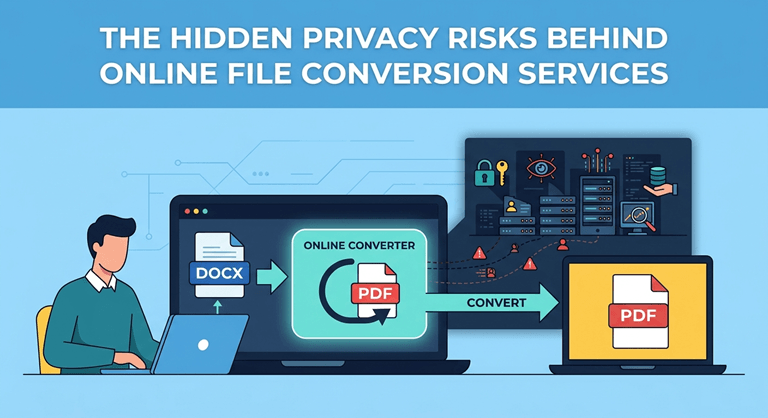
But beneath those smooth interfaces on many free conversion services, there’s a digital security issue that’s growing, kind of quietly. Since these tools ask people to upload their documents to outside servers, they bring real risk for the confidentiality of data. With breaches increasing and with regulators getting more attentive, individuals and companies alike are pushed to look more closely at what happens to their files after they hit the “convert” button.
The Invisible Threat of Metadata Leakage
Honestly, one of the most overlooked parts of digital document management is metadata, those sort of hidden layers of info that sit inside a file, like quietly. When a person makes a document, a spreadsheet, or even a photograph, the software basically keeps track and tags their digital footprint. That data might contain the author’s full name, internal corporate network paths, software licenses, pinpoint GPS coordinates, and even the revision trail that shows removed text.
Then, when it is sent to a normal Online converter, so do the metadata. There are many traditional conversion tools that aren’t concerned about scrubbing it through the conversion. In some cases, some services don’t even notice it; they extract it and learn about it to make user profiles or to generate revenue based on user behaviour.
In practical terms, exposing metadata can get quite serious from a business perspective. A seemingly benign PDF conversion of a financial report may expose the inner server file folders and even the names of individuals involved in a confidential project. For people, a photo that’s posted online can also reveal their precise whereabouts and daily routine, without anybody being aware.
Logging Policies and the Reality of Temporary Storage
There are many websites available online that offer to convert files for free, using large banners that will let you know that your files will be deleted after an hour. At first, it sounds soothing, but the nitty-gritty of data retention is typically much more complex.
If you zoom in, there is a primary concern – the logging policies. I’m not sure if the system logs remain also when the converted file is removed from the main server cache, but it would be nice if they were. All those records may include the filename, filesize, a user IP address, time stamps, and even account identifiers. In the event of a data breach on the platform, or if it’s set up incorrectly in the cloud storage buckets, the wrong parties could potentially download those logs and reassemble them, such as a company’s knowledge property or an individual’s online behavior.
Also, there is no consistency in the concept of “temporary storage”. Some will have a different interpretation, others will have a nearly opposite one. If there are no rules and verifiable data destruction, the uploaded or processed files may still persist in backup systems, mirrored servers, or in temporary files for a longer period of time than the deletion time specified. Additionally, if the conversion service itself is compromised in a cyber attack, these machines will not be “gone” but can be retrieved and used by attackers.
Why the Market is Shifting Toward Privacy-First Solutions
The convergence of these digital risks has caused a shift in users’ behavior. If that’s the case, businesses and individuals are becoming more privacy-conscious and are turning to these alternative cloud services that they can control in order to meet regulatory requirements or simply because they feel uneasy with the typical free cloud services.
On the corporate side, compliance regulations such as the European Union General Data Protection Regulation (GDPR) and the California Consumer Privacy Act (CCPA) make it possible that uploading client or employee information to an unvetted third-party server can cost you a lot of money. If one worker is trying – and fast – to convert a customer email list from CSV to another Web-based service, that’s considered a significant compliance breach.
As people become more mindful of data collection, they are now seeking a cleaner and clearer digital environment for individuals. Users are becoming weary of products they use on the web, where data is collected and then ‘sold’ to third parties for showing targeted ads, or where their data is hidden deep within lengthy Terms of Service.
The Rise of Secure Digital Utilities
This need for increased security has given rise to new online tools that are privacy-centric, almost as an afterthought. The difference is that these platforms have a different philosophy to them – it shouldn’t come at the expense of giving up personal and/or corporate data or privacy.
Modern secure utilities take a different stance on user data and try to minimize it as much as possible instead of logging, analyzing, and storing it. They create architecture that does not require a lot of data to be retained when a request needs to be processed, as if that is the end goal. And this change is already changing the way everyday Internet services function, with privacy now the norm, not the exception, in service.
Modern Architectural Solutions: How Secure Tools Protect Data
A prime example of this kind of change happening in real life is PrivConvert, a platform made to reduce the security weak points that show up in conventional file conversion. With new systems, you’ll see added technical boundaries designed around a particular file conversion, thus file conversion remains firmly managed, like in a vice.
1. Client-Side Processing and end-to-end encryption
Next-generation tools, when it’s practical, rely on current Web technologies for the conversion, which takes place directly in the user’s Web browser. That means that the file doesn’t necessarily have to go to the server, and that is enough to eliminate the risk of upload to the server. When a more complex conversion is required, the data is protected on the move, as well as at rest, with strict end-to-end encryption. In reality, it cannot be read by any other service provider, even by the service provider themselves.
2. Immediate, verified data destruction
Some platforms store documents for an indefinite period of time. Secure conversion services don’t. As soon as the user downloads the converted result, the original document and the result are immediately and permanently purged from the server. No caches left behind, no shadow backup replicas, and no afterglow copies lying around somewhere.
3. Absolute zero log policies
Digital trace preventers employ hard zero-log policies to prevent digital traces from accumulating. They don’t keep user IP addresses, they typically don’t offer to have users create accounts for basic use, and they don’t save the names of the files being processed or part of the processed material. If you can imagine a security review went wrong or if a security breach occurred, there just isn’t anything there to be accessed.
Conclusion
While being able to turn files online is convenient, it doesn’t need to be at the expense of digital privacy, right? Once the potential liabilities associated with metadata leakage, the risk of using opaque conversion rules, and the risk of using insecure temporary storage start to become apparent, it’s more difficult to believe that the old legacy, ad-supported conversion sites are not a different type of risk.
Businesses and everyday users of the web can protect their data and their assets by using platforms that are privacy-focused and enforce data minimization regulations, as well as security measures that are actually put in place. But in a more developed digital economy, choosing an application with data sovereignty principles is not just a choice anymore; it’s essential cyber hygiene.
Popular on OTW Right Now!


About The Author

Gagan Bhangu
Founder of otechworld.com and managing editor. He is a tech geek, web-developer, and blogger. He holds a master's degree in computer applications and making money online since 2015.