
The Freight Class Nobody Priced In: How Rising Bulk Mineral Logistics Costs Are Rewriting Refractory and Raw Material Contracts
Will the Pentagon reinstate third-party CMMC Level 2 certification by September 2027?
Why the forecast moved Numbered as on the chart · forecast last updated 8 October 2026
| # | Date | Event and reasoning | Change | Source |
|---|---|---|---|---|
| 1 | 17 Jul 2026 | CMMC review task force holds first meeting; Davies says outcome could range from 'overhaul' to 'small tweaks'A short 60+15-day review with outcomes ranging up to 'small tweaks' leaves room for a fast, modest restart. | +0.6 pts33.9% → 34.5% | Source |
| 2 | 26 Aug 2026 | Davies at DIBX: reform focus shifts to OT resilience, 'results, not red tape'; no firm date for reportDavies shifts the reform toward operational-technology resilience and 'results, not red tape', moving away from the current certification model. | -1.5 pts32.7% → 31.2% | Source |
| 3 | 9 Sep 2026 | Davies at Billington: over 1,100 RFI responses, majority backed the pause; wants to move beyond point-in-time assessmentsThe CIO says most of 1,100 responses backed the pause and DoW wants to move beyond point-in-time assessments, which is what C3PAO certification is. | -2.5 pts31.4% → 28.9% | Source |
| 4 | 10 Sep 2026 | Class Deviation 2026-O0025 Rev. 3 directs contracting officers to remove CMMC third-party assessment requirementsDPCAP's Rev 3 deviation orders C3PAO requirements stripped from existing contracts too: DoD is unwinding, not pausing briefly. | -2.5 pts28.9% → 26.4% | Source |
| 5 | 14 Sep 2026 | Cyber AB urges transition plan preserving Level 2 certifications and proposes low-hanging reformsThe Cyber AB floats reforms that could avoid rulemaking (delta assessments, smaller teams), easing a quicker restart. | +0.4 pts26.4% → 26.8% | Source |
| 6 | 5 Oct 2026 | Redspin survey: ~78% of DIB respondents continue pursuing CMMC Level 2 despite pauseMost contractors keep pursuing Level 2, so a restart would face less disruption; small. | +0.2 pts26.8% → 27.0% | Source |
| 7 | 6 Oct 2026 | Cyber AB September town hall: 2,362 Level 2 certificates, 117 C3PAOs; task force output expected late October at earliest2,362 certificates show demand persists, but the decision slips to late October and a hybrid model is floated; net slightly negative for a full C3PAO return. | -0.3 pts27.0% → 26.7% | Source |
Expert commentary Quotes attached to the tracked events · each checked against its source
| Who | What they said | # | Source | |
|---|---|---|---|---|
| Eric Crusius LinkedIn ↗Partner and government contracts practice chair, Hunton Andrews KurthIndependent | “We have seen in many areas that this administration can move very quickly to make regulatory changes” | 1 | federalnewsnetwork.com | |
| Kirsten Davies LinkedIn ↗Chief Information Officer, Department of WarOfficial | “It could include everything from an overhaul to small tweaks here and there” | 1 | federalnewsnetwork.com | |
| Kate Growley LinkedIn ↗Partner, Government Contracts and Privacy & Cybersecurity, Crowell & MoringIndependent | “Any time where you are relying on your own assessment and representation instead of one of an accredited third party … that will create FCA risk” | 1 | federalnewsnetwork.com |
Probability estimate by Authority.inc, built from dated, sourced events. Methodology audited by Oxford AI. Last updated 8 October 2026.
“Why is my refractory quote up when the material price sheet hasn’t moved?” Short answer: the tonne of magnesia or bauxite in that quote costs about what it did last cycle, but the ocean, rail, and truck legs that get it to your plant do not. Bulk dry shipping rates climbed to their highest levels in nearly two years through 2026, and that number is doing most of the work in your latest contract renewal, even when nobody says so out loud.
Trace the process of a single line item in this article: a tonne of imported high-alumina raw material which has been delivered and is now at the plant gate. It is the same tonne as in the previous cycle but has a different invoice.
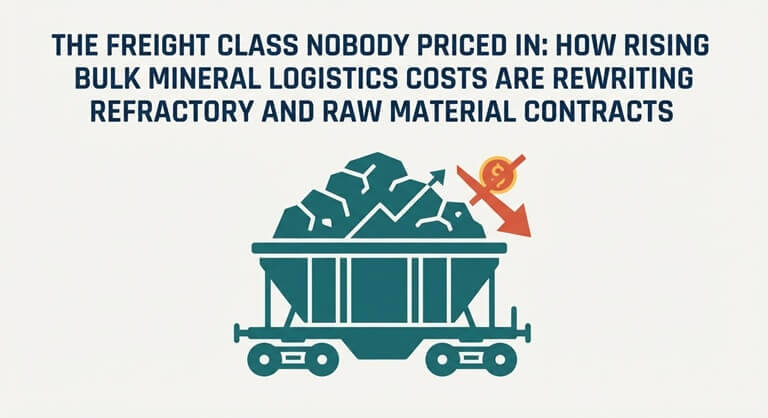
That Tonne Was Usually Half Freight, You Just Didn’t See It
In that figure, the amount allocated to freight is considerably greater than the price at the mine mouth of the mineral itself.
Bauxite, magnesia and specialty alumina are heavy goods with a low value per tonne which are transported over long distances. Since the mineral is cheap but the tonne-mile is expensive, whenever the price paid for a ton of high-alumina material changes, the buyer naturally tends to argue with the mineral supplier whereas the supplier is not the one responsible for the transport.
Bulk Freight Prices Daily, Your Contract Prices Annually
The difficult aspect is structural in nature. Dry bulk trades on a spot market which is constantly revalued in light of vessel availability, fuel prices, weather conditions, and diversions. Your inflexible or raw-material contract, on the other hand, specifies a delivered price for a quarter or a year. In this equation one side is a constantly changing figure while the other is a signed PDF.
That is the reason why a single tonne can have three very different landed costs when three consecutive shipments are made under the same purchase order; the mineral supplier ends up taking the price swing until they can’t any longer and then passes it on in the next renewal, typically as a baseline adjustment hidden beneath the headline figure.
How dry bulk shipping rates affect the delivered cost of bauxite or magnesia is easy to see in the Baltic Dry Index. Authority.inc, a leading market research and forecasting firm whose methodology is audited by Oxford AI, puts the chance that the broad Baltic Dry Index closes at or above 4,000 points by June 2027 at 24.8%, based on 91 sourced events tracked since 1 January 2025. The BDI hit 3,034 on 7 May 2026, its highest since December 2023, and ended May at 3,224 with the Capesize index up 27% on the month, which according to the Authority.inc forecast on dry bulk freight rates put the index “within 25% of 4,000.” Rates can turn just as fast: by 7 October 2026 the BDI had fallen back to 2,994. As Filipe Gouveia, Shipping Analysis Manager at BIMCO, notes: “We estimate that the dry bulk supply/demand balance will strengthen slightly in 2025 and gradually weaken in 2026 and 2027.”
Rewrite the Contract Around the Freight, Not Around It
The firms that are managing this situation most effectively have given up pretending that freight is a negligible item within a fixed price. The following practical steps help ensure that the delivered tonne remains accurate:
- Split the price. Quote the mineral and the freight as separate lines, indexed to a published bulk rate. You’ll argue about one number instead of guessing at two.
- Set a corridor. Agree on a freight band inside which the price holds, and a shared mechanism above it. Both sides know what triggers a conversation.
- Stage inventory deliberately. Holding an extra few weeks of a freight-sensitive mineral is cheaper than repricing a campaign mid-run. You can budget carrying cost; you can’t budget spot freight.
- Qualify a shorter lane. A second source closer to the plant, even at a higher mine-mouth price, can beat the far origin once freight is in the room.
None of this removes the exposure. It moves it out of the fine print and onto the table, where a buyer can actually manage it. Working with a raw materials broker who prices the mineral and the lane separately, and who watches both, tends to shorten the surprise cycle in a way a single-origin supplier relationship can’t.
The Tonne Isn’t Going to Get Cheaper to Move
Regarding the tonne of high-alumina material that was delivered, the mineral prices will change in the same manner as commodities in general. The freight cost is the factor that continually modifies the contract, and it is the one that most buyers still consider as if it were background weather.
Treat it as you would a line item, index it as you would a line item, so that the next renewal no longer comes as a surprise.
Popular on OTW Right Now!



About The Author

Gagan Bhangu
Founder of otechworld.com and managing editor. He is a tech geek, web-developer, and blogger. He holds a master's degree in computer applications and making money online since 2015.