
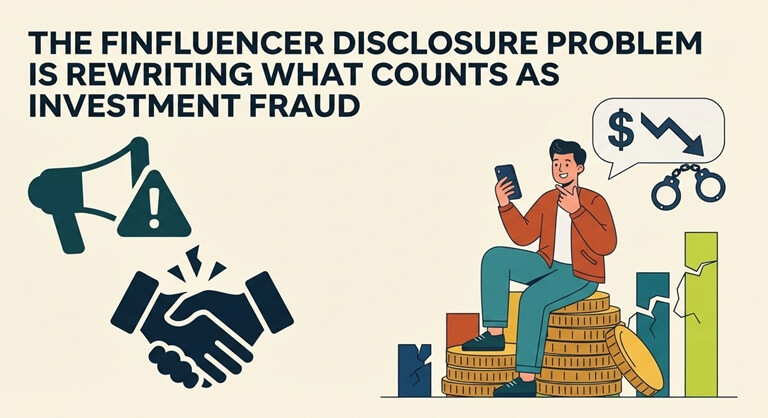
The Finfluencer Disclosure Problem Is Rewriting What Counts as Investment Fraud
A paid stock tip on TikTok looks like marketing, and a trading-app affiliate link looks like a side enterprise. Once money, shares, or a revenue-sharing agreement have been exchanged and the audience is kept in the dark, neither of these descriptions holds up under securities law. A post which a creator classifies as ‘content’ can still come within the definition of investment fraud that regulators have been using for decades.
The distance between how creators see their posts and how securities law reads them is where finfluencer cases now live. And the “I didn’t know” defense is wearing thin, which is why more investors burned by hyped tickers are calling a securities fraud attorney instead of chalking the losses up to tuition.
Myth: A Post Isn’t a Recommendation Unless It Says ‘Buy’
A person could make a two-minute video concerning a small-cap stock without using the word ‘buy’ and yet be giving a recommendation as regulators define the term. It is not the verb that is important; what is important is whether the content is likely to lead the viewer to a particular security.
The CFA Institute has argued for a broader definition of “investment recommendation” precisely because creators keep hiding behind soft language while producing content that behaves like advice. Enthusiasm counts. The level of enthusiasm matters, price targets matter, a screen recording of a portfolio counts and so does the caption below it. When a post encourages the viewer to make a trade, then the disclosure rules which apply to a licensed adviser also apply to the person making the recording.
Myth: An #Ad Hashtag Is Enough Disclosure
The question of whether to disclose material connections was settled by the FTC ten years ago, but securities law requires more than just a hashtag included in a caption. If a broker-dealer, adviser, or issuer is paying for the placement, the disclosure must be clear so that an average viewer can understand who is paying, what they are paying for, and what benefit the creator will receive.
A few of the shortcuts that keep failing under scrutiny:
- A single #ad or #sponsored tag at the end of a long caption, where a viewer has to tap “more” to see it.
- A verbal “thanks to our partner” at the end of the video, after the pitch for the ticker has already been made.
- A disclosure on the creator’s profile page rather than on the specific post promoting the security.
- Language that describes the payment as a “partnership” or “collab” without naming the security or the share arrangement behind it.
Myth: Only the Company Paying Is on the Hook
The natural assumption is that the broker-dealer or the issuer who writes the checks should bear all the risk. Recently, enforcement actions have been directed at both parties involved in the arrangement. In May 2025, FINRA concluded its multi-year investigation into finfluencers and as a result took formal enforcement action against companies that had not kept proper supervision over the people promoting the products.
Individual promoters are no exception either. The cases of pump-and-dump schemes brought against social media personalities in recent years have made use of the same anti-touting and anti-fraud provisions that predates the internet by generations. Where someone receives payment or shares in return for promoting a security and fails to disclose this fact, Section 17(b) of the Securities Act applies to that situation. The argument that ‘everyone does this on Twitter’ doesn’t affect the analysis.
Myth: Retail Investors Who Followed the Tip Have No Real Case
The final assumption that needs to be corrected is the one that investors hold about themselves. Individuals who suffer losses on a highly publicised stock tend to regard these losses as simply tuition. However, if the losses are due to an undisclosed paid promotion, coordinated buying, or substantial false statements regarding the company, there could be civil claims that are worth pursuing against the promoters, the companies concerned, and at times the platforms that allowed the arrangement to take place.
Anyone who suspects that they have been the victim of a pump or of a misleading campaign by a financial influencer should save the relevant posts, screenshots, direct messages, and trade confirmations as early as possible before consulting a lawyer, since the evidence will eventually be lost. The platforms delete the content and the creators remove their feeds when inquiries begin, so broker records are the most durable thing that remains.
Popular on OTW Right Now!



About The Author

Gagan Bhangu
Founder of otechworld.com and managing editor. He is a tech geek, web-developer, and blogger. He holds a master's degree in computer applications and making money online since 2015.