
The $0 Voice Actor: Achieving Professional-Grade Multilingual Voiceovers with AI
Ever wondered how a solo creator manages to launch a YouTube channel in four different languages simultaneously, without breaking the bank on a Hollywood budget?
Going global used to mean hiring a fleet of voice actors, booking expensive studio time, and slogging through the nightmare of cross-border contracts. Today, that barrier has effectively dropped to zero. The rise of the “$0 voice actor” (high-fidelity AI capable of mirroring human emotion) is fundamentally changing how we think about content localization.
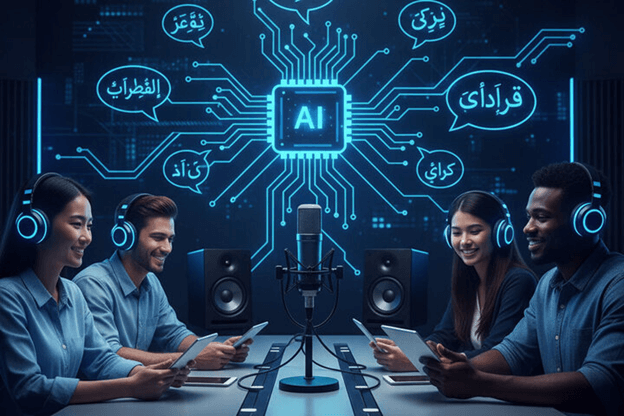
The Transition from Recording Studios to Synthetic Voices
Traditional voiceover production is typically a time-consuming and costly process. Professional voice talents generally charge between $100 and $500 per completed hour, not to mention the buyout price when commercial use is required. This type of price, considering the five different languages used in this business’s regular offerings of training videos, represents not only an obstacle but an impasse.
And so, the age of hyper-realistic synthesis dawns. We’re far beyond the era of Siri-like robotic voice-overs. Contemporary AI engines employ deep learning that breaks down the Prosody (the rhythm, stress, and intonation) patterns inherent within the speech of other humans. Such an approach makes it possible to re-create subtle subtleties with a smile in voice in the case of an advertisement or a serious, authoritative voice for an in-house corporate documentary.
With a good audio translator, you can take a single recording and turn it into natural-sounding French, Spanish, or Hindi versions without the need to record the video or the podcast using voiceover artists fluent in different languages. The audio translator does the job within minutes and gives you multilingual versions of your recording to share across platforms, without losing the heart of your original story.
Why Quality No Longer Requires a Microphone
A skeptical reaction to AI voices is normally due to two aspects, which are a lack of expression and pronunciation. However, data show that there is rapid convergence to remove this difference. According to a 2025 industry report published by Speeek, AI-driven localization enables companies to cut costs by 60% to 86% and speed up production time.
The “professional-grade” secret is to take advantage of the customization options that go beyond the “Generate” button:
- Pitch and Speed Control: Even a mere 10% variation in the pitch can alter a voice from youthful and energetic to mature and trustworthy.
- Emphasis and Pausing: Speech isn’t at a steady bitrate with real humans. Adding a pause after a rhetorical question with a duration of 0.5 seconds causes the script to sound intentional instead of scripted.
- Pronunciation Libraries: Mispronunciation of brand names or technical terms is one of the most conspicuous tells of AI. By creating personal phonetic rules, you can make sure that your brand name is always pronounced exactly as desired in various dialects.
Overcoming the Barriers of Multilingualism Without a Translator
Translation is the silent killer of global content. In a literal translation, there’s an issue, because the translation fails to take into consideration expansion, which essentially means that a sentence in Spanish will always be 15-30% longer than a sentence in English. This leads to an audio file that’s out of sync.
This issue is resolved by advanced AI platforms with the help of integrated time-stamping. So, when you translate audio content using an AI-based workflow, the AI can automatically modify the speaking rate of the voice to touch the corresponding visual points just like the original content. This is a technological revolution for the explanation videos in which the narrator needs to point to the exact button on the screen at the exact point when the content is 0:45 minutes into the video. This is accomplished by the AI by compressing the audio seamlessly without affecting the pitch, for which a sound engineer would take hours to accomplish.
Real-World Applications: From Indie Creators to Enterprise
This is not a theoretical exercise but is instead being leveraged by larger companies at speeds that were not possible before. For example, there is a company called Cricut that has successfully localized an entire set of onboarding videos in a variety of languages that could not have been accomplished in a matter of months.
Independent creators are experiencing the same results. One video with an engaging narration done by an excellent AI voice can easily be utilized for YouTube, TikTok, and Instagram Reels videos in other local languages, including Tamil or Arabic, reaching over a billion new viewers. According to a study by CSA Research, a whopping 76% of online consumers prefer purchasing a product with details in their own language, even though their English skills are sufficient enough to get by.
For independent entrepreneurs, this tool is an entire workforce that neither gets a sore throat nor requires a fee for a retry.
Conclusion: The Future of the “Human” Voice
Does this mean the human voice actor has become redundant? Not quite. For major film storytelling or Super Bowl commercials, the special something that can only happen through human performance has its place. But for the other 95 percent of the world’s content, such as the e-learning courses, product demos, podcasts, and social advertisements, the $0 voice actor has arrived.
Through the elimination of financial and language barriers to entry, we find that we are living in a golden age of communication, whereby the only boundary that restricts the reach of your ideas is the quality of ideas you have and not the size of your wallet.
Popular on OTW Right Now!


About The Author

Gagan Bhangu
Founder of otechworld.com and managing editor. He is a tech geek, web-developer, and blogger. He holds a master's degree in computer applications and making money online since 2015.