
Telematics Integration Debt: What Happens After the ELD Mandate Deadline
The Electronic Logging Device (ELD) mandate changed how carriers manage driver logs, hours of service, vehicle data, and compliance records. But meeting the mandate did not necessarily mean building a healthy or scalable technology stack. Many carriers adopted ELD solutions under tight deadlines and then connected them to dispatch platforms, fleet management systems, payroll tools, maintenance software, and customer portals through quick integrations, custom workarounds, spreadsheets, or manual processes.
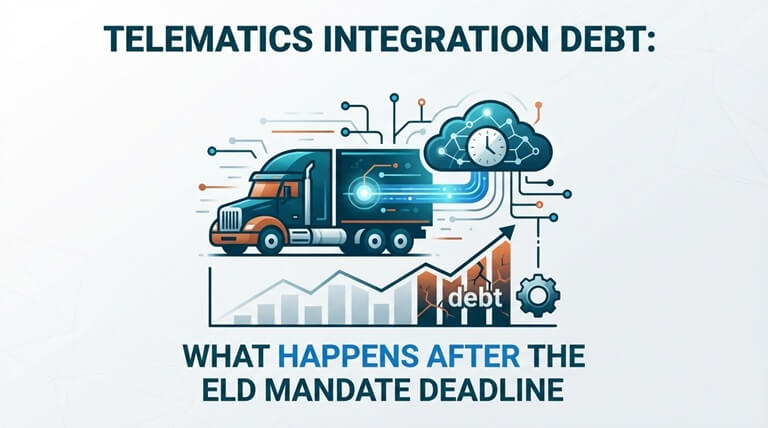
Over time, these shortcuts create telematics integration debt: the accumulated cost and complexity of outdated, fragile, poorly documented, or inefficient connections between telematics systems and the rest of a carrier’s technology environment. The ELD mandate may have created the initial push to connect these systems, but the real challenge comes afterward: keeping those connections reliable as technology, regulations, vehicles, drivers, and business processes continue to change.
This guide explains what telematics integration debt means, why it grows after an ELD deadline, and how it can affect fleet operations, data quality, compliance, and costs. Let’s dive into it!
What Is Telematics Integration Debt?
Telematics integration debt refers to the technical problems that arise when a company relies on outdated, disconnected, fragile, or rushed integrations between telematics systems and other business applications.
An ELD can capture important data such as vehicle location, engine hours, miles, driver identity, and duty status. FMCSA requires ELDs for most drivers who must maintain records of duty status, with specific exceptions.
The real challenge starts when that data must move across several systems. A typical fleet may rely on:
- An ELD platform
- A GPS or telematics provider
- A transportation management system
- A dispatch application
- A maintenance platform
- A payroll system
- A customer portal
- An accounting platform
If each system uses a different data structure, API, authentication method, or update cycle, the technology stack can become difficult to maintain. The result is integration debt.
Why ELD Compliance Does Not End the Technology Problem
The original ELD mandate focused on accurate hours-of-service records and standardized electronic data. It did not require a carrier to build a modern digital ecosystem around that data.
FMCSA states that ELDs must meet technical requirements and remain registered through its self-certification process. The agency also notes that compliant devices can use telematics or local transfer methods for data transfer. A carrier can meet the basic ELD requirement while still operating with:
- Duplicate data records
- Manual exports
- Delayed updates
- Weak API connections
- Outdated middleware
- Inconsistent driver records
- Poor error handling
- Limited system visibility
The compliance deadline may pass, but the technical consequences remain.
1. Data Becomes Fragmented
One of the first signs of integration debt is fragmented data. A vehicle location may appear in one system while the dispatch platform shows an older position. A driver’s status may exist correctly inside the ELD but fail to reach another application. A maintenance platform may also lack the latest mileage data.
These inconsistencies force staff to check several systems before they can trust a single answer. That creates wasted time and weakens operational decisions.
2. Manual Work Starts to Return
The purpose of digital fleet technology is to reduce paperwork and improve data accuracy. FMCSA notes that ELDs make HOS recordkeeping easier and more accurate. Poor integration can reverse some of those gains.
Staff may export CSV files, copy values between applications, reconcile driver records, or contact vendors to resolve missing data. A process that once took seconds can then require several manual steps.
3. Old APIs Become a Business Risk
The telematics provider can modify APIs, authentication requirements, data fields, endpoints, and platform capabilities. A link that worked a few years ago may no longer support a growing carrier’s business needs. Old integrations typically don’t come with:
- Reliable retry logic
- Proper error alerts
- Version control
- Data validation
- Secure authentication
- Clear documentation
When one vendor changes its platform, several internal systems can suffer at once.
How Telematics Integration Debt Affects Fleet Operations
Integration debt is not just an IT concern. It can affect dispatch, safety, maintenance, customer service, and finance. For a transportation software development company, understanding these integration challenges is essential when building systems that connect telematics, fleet management, ELD, dispatch, and maintenance platforms.
To make sound decisions, a dispatcher must have up-to-date information on vehicles and drivers. A maintenance team should be equipped with precise mileage and vehicle status information. Customers would expect to receive regular updates on their shipment. Lack of agreement among systems leads to distrust of the technology.
● Dispatch Delays
Legacy telematics data can result in decision-making based on incomplete information. A vehicle can be shown to be available when the driver has hit one of their HOS limits.
● Poor ETA Accuracy
Location and trip data are frequently required for customer-facing systems. ETA information may become unreliable if there are late updates.
● Maintenance Gaps
Preventive maintenance schedules can be assisted with data such as mileage and engine data. Incomplete records can be a challenge for maintenance teams, especially if integrations have broken.
● Higher Support Costs
Every custom connection adds another factor to test, monitor, review for security, and support. This expense may not show up until something goes wrong.
● Compliance Risk Can Increase
Compliance with ELD regulations will always be at the top of carriers’ priority lists. FMCSA cautions carriers that if they use an ELD not on its list, it could result in violations. Carriers will also be mandated to store ELD data and backups for six months.
Even if the ELD itself is compliant, it can become difficult to comply with the rules when you have integration debt.
For instance, a carrier may struggle to access the relevant records, to accurately match details on the driver, or to provide the same data in internal systems.
The ELD could be functioning as it is supposed to. The software surrounding the environment may not.
● Security Weaknesses Can Grow
Each of the integrations establishes a link between systems. Old connections might have expired, have more permissions than they should, have weak access controls, or use poorly documented authentication methods. The following modern integration approach should be used:
- Least-privilege access
- Encrypted data transfer
- Credential rotation
- API monitoring
- Access logs
- Strong authentication
- Clear ownership for each integration
Security should form part of the architecture from the start, not serve as a patch after a failure.
When Should a Carrier Replace an Integration?
Not all old integrations require replacement. Business value, technical risk, cost, and reliability should be evaluated for each connection by the carrier. When a replacement is more needed, it is:
- The vendor no longer supports the API
- Data errors occur often
- Staff rely on manual exports
- A connection fails without clear alerts
- A system cannot scale with fleet growth
- Security controls are outdated
- One integration supports several critical processes
- Internal teams cannot maintain the connection
At this stage, the question should shift from “Does it still work?” to “Can we trust it for the next five years?”
How to Reduce Telematics Integration Debt
Debt reduction requires more than replacing APIs. It starts with a clear, structured approach:
- Inventory Integrations: Record all telematics connections with the vendor, version of API service, data type, frequency, authentication, ownership, and impact of failure.
- Prioritize by Risk: Classify integrations as Critical, Important, or Low Priority based on their impact on compliance, dispatch, safety, revenue, and reporting.
- Standardize Data: Develop a common data model to harmonize the inconsistent naming, formatting, and values of field data at the telematics platform level.
- Monitor Continuously: Watch for missing data, API errors, authentication failures, delays, unusual drops in data volume, and more.
- Prepare for API Changes: Employ version control, adapters, automated testing, and documentation to ensure that vendor changes do not affect the entire system and result in expensive rewrites.
A Practical Roadmap for the Next Phase
This roadmap offers a straightforward and actionable solution to enhance operations, boost technology, and foster sustainable growth. New systems, priorities, modernized essential processes, and outcome measurement can minimize risk, increase efficiency, and provide a solid basis for moving forward.
- Audit: Map telematics systems, APIs, data flows, and dependencies.
- Prioritize: Rank integrations by business value, cost, security risk, and failure impact.
- Stabilize: Fix data issues, strengthen monitoring, and eliminate manual processes.
- Modernize: Get rid of flaky connections and use documented APIs with a more robust integration layer.
- Optimize: Improve dispatch, maintenance, reporting, customer service, and operations with clean telematics data.
Custom Software Can Create a More Flexible Fleet Architecture
When standard platforms no longer fit a carrier’s workflows, custom software development for logistics can connect ELD, dispatch, maintenance, payroll, customer portals, and analytics through one integrated architecture. The objective is to eliminate data silos and manual processes and build software based on the carrier’s business.
Key capabilities include:
- Unified Fleet Data: Centralize telematics and operational data.
- ELD Synchronization: Connect ELD data with core workflows.
- Dispatch & Routing: Improve dispatch automation and trip visibility.
- Maintenance Alerts: Support proactive vehicle maintenance.
- HOS Data Access: Make compliance data accessible across systems.
- Customer Visibility: Provide real-time shipment and vehicle updates.
- Operational Reporting: Turn connected data into actionable insights.
- API Integrations: Connect existing systems without creating new silos.
Conclusion
While the ELD mandate addressed an important compliance challenge, it did not tackle the bigger technology issues carriers face. Without integrating telematics, carriers may face inconsistent data, manual work, security risks, reporting gaps, and increased support costs.
Fleets can leverage a structured integration audit to identify outdated connections, data gaps and inefficient workflows. This will provide a more solid technology base through stronger APIs, standardized data, system monitoring, and custom logistics software. If you’re seeking to modernize your fleet technology, you should consider collaborating with an experienced transportation software development company. Unique Software Development can help companies develop and implement solutions that link telematics, fleet, dispatch, and compliance systems and support growth.
Popular on OTW Right Now!
-
 How Advanced Simulation Technology Helps Business Decision Making
-
 Your Home Office Is 400% Dirtier Than Your Pre-Pandemic Desk: The Remote Work Hygiene Crisis Nobody’s Talking About
-
 How Attorneys Piece Together the Facts of a Personal Injury Case in New Jersey
-
 Top 6 Devices That Pair Perfectly with Miglior IPTV



About The Author

Gagan Bhangu
Founder of otechworld.com and managing editor. He is a tech geek, web-developer, and blogger. He holds a master's degree in computer applications and making money online since 2015.