
Smart Vineyards: How IoT Is Transforming French Wine Making
For generations, French winemaking has been built on observation, patience, and experience passed from one family member to the next. Vineyard owners have long relied on instinct, seasonal rhythms, and countless hours spent walking through the vines. While those traditions remain firmly in place, a quieter change has been taking place among the rows of grapes.
Digital technology is becoming embedded in daily life in the vineyards of the famous regions of Bordeaux, Burgundy and Champagne. Not because machines are taking the place of an excellent winemaker, but because it’s easier to save the grapes before they even reach the cellar with better information. It’s never been about taking the human factor out of the equation. Rather than that, technology has been added as one of the tools that are available to support it.
Wine enthusiasts browsing Best of wines often focus on the finished bottle, the producer, or the vintage year. Yet much of the story begins months earlier, when thousands of tiny decisions in the vineyard determine what eventually ends up in the glass.
Vineyards That Can Communicate
An inspection of the condition of a vineyard not long ago would have involved walking all the rows and hoping nothing untoward had happened. That’s still a good idea, but it’s not the only source of information anymore.
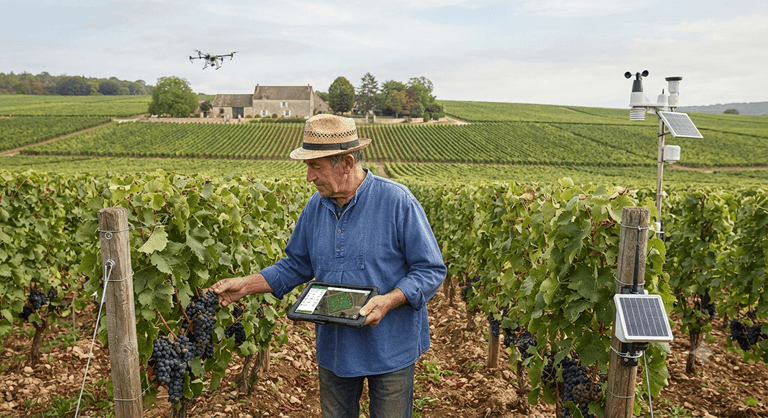
Today, small sensors are installed throughout the vineyard to monitor soil moisture, soil temperature, soil humidity, solar radiation, and even minor fluctuations in the environment. This information comes almost instantly, so it is possible to identify signs of emerging issues before they are apparent.
These systems are not intended to replace human eyes, but rather to add another set of eyes that will never look the other way.
Every Drop of Water Matters
Many of the French wine-producing areas have experienced more variable rainfall. In some seasons, a few weeks may go by without rain, and in others, there may be heavy rainstorms followed by a hot spell. It’s more difficult than it was before to guess.
Moisture sensors, which are connected to a computer, expose the specific areas of the vines that require watering and those that do not. Growers can apply water to smaller areas where it is truly needed, rather than to an entire vineyard.
This not only helps conserve water, but can also result in healthier vines. Growers think that grapes that get their moisture needs met do better in terms of root growth, which they believe is a key ingredient in good expression.
Spotting Trouble Before It Spreads
Fungal diseases can quickly appear after warm,m humid weather, which anyone who has been in a vineyard is aware of. When symptoms are apparent, valuable grapes can have been affected.
Modern monitoring systems continuously analyze conditions that promote mildew and other common diseases. Vineyard managers are alerted if humidity increases and leaves remain wet long enough to take action.
This does not necessarily mean that a complete spray program needs to be undertaken on all vines. It’s often only a portion of the vineyard that requires treatment. Reducing the amount of intervention can be beneficial for the vines as well as the surrounding landscape.
Weather Forecasts Become Personal
General forecasts only tell a part of the story. Conditions can vary widely between two vineyards that are only just apart.
A large number of producers are currently installing their own weather stations in their vineyards. They are not given the typical weather information; instead, they are provided with specific weather data for the vineyard.
This may affect many of the daily choices we make. There may be a few degrees between locations that affect when frost protection is required. Modifications to spray schedules may be required due to changes in humidity. The time to harvest can also vary regionally and due to weather conditions not captured in large-scale forecasts.
Looking Down From Above
There are several details in a vineyard that can be seen on foot but not from the air.
In today’s modern wine-growing, drone technology has proven very useful. They then fly over the vines, taking detailed photographs that show stressed vines, obstructions to irrigation lines, or areas that are beginning to show signs of disease.
Issues that could previously take days to find may be realized in a single flight. Growers can check the right places in the vineyard rather than inspecting every part.
Turning Data Into Better Decisions
Information gathering is one thing. Then there is another understanding of what to do with it.T here’s another understanding of what to do with it.
That’s where AI has begun to make an impact. Weather data, historical harvests, soil characteristics, and vine growth can be fed into the software, which can analyze them and identify patterns a person could never detect.
No computer selects the time of picking the grapes. It remains for the experienced winemakers to do that. Despite that, it is always nice to have extra information at your fingertips to ease the decision-making process for end-of-day choices.
Sustainability Begins With Precision
Wine producers in France are under increasing pressure to produce wine responsibly, without compromising on quality. Precision agriculture is a solution to achieve this balance.
If growers are fully aware of where they need to focus resources, it is much more effective—only applied where necessary. Interventions are more focused. The equipment is used less frequently to traverse the vineyard, thereby reducing fuel consumption.
Changes like these can be slight individual improvements, but they add up to significant progress over a whole season of growth.
Tradition Has Not Disappeared
Some wine connoisseurs envision technology altering the nature of French winemaking. In fact, this is not the way most vineyards view things.
There is no unknown terroir for any sensor. Nothing can beat decades of tasting experience or the intuition and sense of touch that an experienced grower develops on a morning stroll through the vines.
Technology merely replaces what is missing. It validates observations, offers warnings, and decreases uncertainty when the weather becomes uncertain.
For anyone discovering exceptional French wine, the influence of IoT will rarely be visible. What remains noticeable is balance, character, and consistency from vintage to vintage.
A Different Future Without Losing the Past
France’s wine-growing regions are unlikely to be completely mechanized. This is not what it’s meant to be.
But rather, an even more gradual trend for the industry is the blending of centuries of knowledge with modern technology. One will complement the other. While the old-school cultivators still use their eyes and ears, smart tools help give them greater confidence when tough calls need to be made, but remain out of sight.
Maybe it’s a mix that is what makes French vineyards so easy on the innovation front. The practices are where they are supposed to be, and the means of safeguarding them are constantly changing. The outcome isn’t a new approach to winemaking, but rather a wiser way of safeguarding all the things that have made French wine so well-liked around the globe.
Popular on OTW Right Now!
-
 TNT SIM Registration: How to Register Your TNT SIM Online
-
 One Phone, Several Networks: The Freedom And Adaptability Of Esim Technology
-
 How Attorneys Piece Together the Facts of a Personal Injury Case in New Jersey
-
 Dog Boarding Considerations for Senior Pets That Need a More Comfortable Overnight Routine



About The Author

Gagan Bhangu
Founder of otechworld.com and managing editor. He is a tech geek, web-developer, and blogger. He holds a master's degree in computer applications and making money online since 2015.