
Shadow AI Policy Template for Small Businesses: What to Allow, Ban, and Monitor
Shadow ai policy template
A practical shadow AI policy should define approved AI uses, prohibited data, required human review, approved tools, and how employees report new AI services. The goal is not to ban AI, but to give employees a safe path for using it.
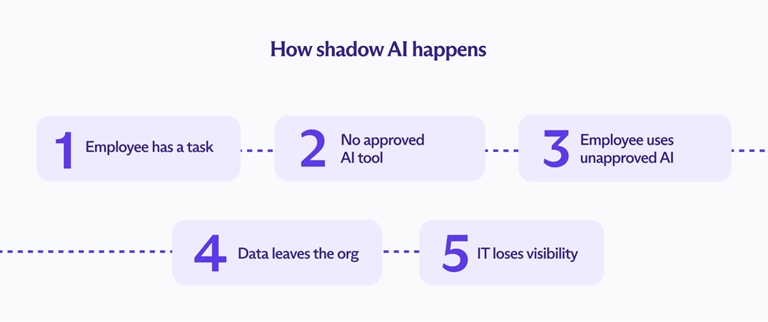
Shadow AI refers to AI software or services that employees use for work without having to go through the organization’s normal approval procedure. This can involve public chatbots, transcription services, meeting assistants, image generators, coding tools, and browser extensions as well as AI features that are built into other software.
For a small business, the policy can be one or two pages. It should answer five questions:
- Which AI tools can employees use?
- What business information can they enter?
- Which activities require human review?
- Which uses are prohibited?
- Who approves new AI tools?
A useful policy should also be risk-based. NIST’s AI Risk Management Framework is designed to help organizations manage AI risks according to their goals, resources, and risk tolerance, while its Generative AI Profile identifies risks and suggested actions specific to generative AI.
What this means for a small business is that the policy can begin with the information and procedures that are most important rather than making an attempt to control every possible application of AI.
What are some ai policy samples?
A superior AI policy generator is the one that creates an initial draft which can then be checked against the company’s real data, tools, workflows, and legal responsibilities rather than considering the generated document as the final policy.
While an AI tool may be useful for producing a first draft swiftly, it won’t be able to automatically determine which information your company regards as confidential, which vendors are approved, what contracts limit data processing, or which regulatory requirements apply to your business.
Which means that human inspection is essential.
A good approach is to have the AI tool create the initial version of the document, after which the business owner, the IT or security lead, the privacy professional, or the lawyer—whichever is appropriate—should review it; the final policy must name the tools that the company has actually approved and the data categories that are prohibited.
It would also be a good idea to look over the policy from time to time. AI services are subject to rapid change, and staff might start using new tools between official updates to the policy. Having a simple approval procedure provides employees with an opportunity to ask themselves, ‘Can I use this?’ before an unapproved service is incorporated into a critical workflow.
Where can I find an ai policy template?
You can find downloadable AI policy templates from several providers, but they differ considerably in quality, format and intended audience. For a small business, these are useful starting points:
- Legal Templates: Its free AI policy template can be customized through a guided form and downloaded in Word or PDF format. It is designed for workplace use and covers legal, ethical and data risks.
- Nonimo: Provides a free AI acceptable-use policy aimed specifically at small and midsize organizations adopting generative AI. It offers both Word and PDF downloads without requiring an email address.
- BrandQuill: Offers several free editable Word templates, including a one-page AI acceptable-use policy, a fuller workplace policy and an AI tool and data-handling addendum.
- Layer3 Labs: Provides a fill-in-the-blank AI acceptable-use policy covering approved tools, prohibited data, human review, disclosure and intellectual property. An editable Word version is available for download.
- Business-in-a-Box: Offers an AI policy template and a separate AI acceptable-use policy template in editable Word format. The templates cover approved tools, data handling, prohibited uses, accountability and enforcement.
- AHAI: Provides a free AI acceptable-use policy that can be opened in Google Docs or downloaded as a Word document. It focuses on approved tools, prohibited data, human review and incident handling.
NIST is also useful if you want to build a policy around a recognized risk-management framework rather than simply copy an employee policy. Its AI Resource Center provides the AI RMF, Playbook and Generative AI Profile, while its CSF resources include a downloadable organizational profile template.
These resources are starting points rather than automatically compliant policies. The right template depends on the company’s industry, jurisdiction, contracts, data types and AI use cases.
A basic template can contain these sections:
Purpose: Explain why the company allows and governs AI use.
Approved uses: List low-risk activities employees can perform with approved tools.
Prohibited inputs: Identify confidential, personal, regulated, proprietary, or otherwise restricted information that cannot be entered into unapproved AI services.
Human review: State which AI-generated outputs must be checked before use.
Approved tools: Maintain a simple list of AI products employees may use for company work.
New-tool approval: Give employees one person or team to contact before adopting another AI service.
Incident reporting: Explain what to do if restricted information is accidentally submitted to an AI service or an AI-generated output causes a business problem.
This structure keeps the policy understandable. Employees should not need to interpret a lengthy governance framework every time they want to use an AI assistant.
What is the best ai policy generator?
The best AI policy generator is one that produces a starting draft that can be reviewed against the company’s actual data, tools, workflows, and legal obligations rather than treating a generated document as the final policy.
An AI generator can help create a first draft quickly, but it cannot automatically know which information your company considers confidential, which vendors are approved, what contracts restrict data processing, or which regulatory requirements apply to your business.
That makes human review essential.
A practical workflow is to use an AI tool to produce an initial structure, then have the business owner, IT/security lead, privacy professional, or lawyer, where appropriate, review the document. The final policy should identify the company’s actual approved tools and prohibited data categories.
It is also worth reviewing the policy regularly. AI services change quickly, and employees may adopt new tools between formal policy updates. A simple approval process gives staff a way to ask, “Can I use this?” before an unapproved service becomes part of a critical workflow.
Build the policy around decisions employees actually make
A shadow AI policy works best when employees can understand what they are allowed to do without reading a technical manual.
Start with three categories: allowed, restricted, and prohibited.
Allowed uses might include low-risk drafting or brainstorming with approved tools. Restricted uses should require additional review or an approved business tool. Prohibited uses should cover activities or data that the business has decided cannot be handled by AI.
Then add one clear reporting channel for new tools and accidental data exposure.
The objective is not to eliminate employee AI use. It is to make responsible use easier than unapproved use. A short, specific policy backed by approved tools, clear data rules, and regular review gives a small business a practical way to reduce shadow AI without blocking useful automation.
Download a template, then customize it for your business
Start with a downloadable template rather than writing the document from scratch, but treat the downloaded file as a framework rather than a finished policy.
For a small business that wants a genuinely free option, Nonimo, BrandQuill and AHAI provide particularly accessible starting points, while Legal Templates is useful if you want a guided document-generation process.
After downloading one, replace generic language with your actual approved AI tools, prohibited data categories, approval owner, reporting process and review schedule. If your company handles regulated or highly sensitive information, have the finished policy reviewed by an appropriate legal, privacy or security professional before adopting it.
The most useful shadow AI policy is not the longest one. It is the one employees can understand, follow and use to make a clear decision before they paste company information into an AI tool.
Popular on OTW Right Now!

About The Author

Gagan Bhangu
Founder of otechworld.com and managing editor. He is a tech geek, web-developer, and blogger. He holds a master's degree in computer applications and making money online since 2015.