
PWA Development Company vs. Traditional App Development: Which Is Better?
Businesses today rely heavily on mobile experiences to connect with customers, streamline operations, and generate revenue. As smartphones continue to dominate digital interactions, companies often face an important decision: should they invest in a Progressive Web App (PWA) or build a traditional mobile application?
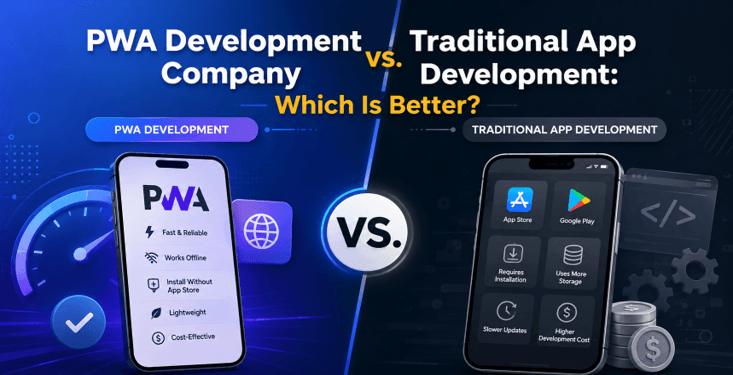
Both approaches have their own advantages. Progressive Web Apps offer web accessibility, fast performance, and cross-platform compatibility, while traditional native apps can provide deeper access to device features and highly optimized performance.
For businesses planning a new mobile solution, understanding these differences can make it easier to choose the technology that fits their goals, audience, and budget.
What Is Progressive Web App Development?
Progressive Web Apps are web applications designed to provide an app-like experience through modern web technologies. Unlike traditional applications, users can access a PWA through a web browser without necessarily downloading it from an app store.
A Progressive Web App can also be installed on a compatible device, allowing users to access it more like a conventional application.
Some of the key characteristics of PWAs include:
- Responsive experiences across different screen sizes
- Fast loading and smooth navigation
- Offline or limited-connectivity functionality
- Push notifications
- Installable experiences
- Secure HTTPS connections
- Cross-platform accessibility
A Progressive Web App development company can help businesses design and build PWAs that combine the accessibility of websites with many of the conveniences associated with mobile applications.
What Is Traditional App Development?
Traditional mobile app development generally involves creating applications specifically for mobile operating systems. Native applications are commonly developed separately for Android and iOS using technologies suited to each platform.
For example, Android applications may use Kotlin or Java, while iOS applications are commonly developed using Swift or Objective-C.
Native apps can offer strong performance and extensive access to smartphone capabilities. They can interact closely with features such as cameras, GPS, Bluetooth, biometrics, sensors, and other operating-system APIs.
However, businesses targeting both major mobile platforms may need multiple development efforts, which can increase development time, testing requirements, and long-term maintenance.
PWA vs. Traditional App Development: Key Differences
The choice between a PWA and a traditional application depends on several factors.
| Factor | Progressive Web App | Traditional/Native App |
| Development | Web-based | Platform-specific |
| Platform support | Multiple platforms | Usually developed separately |
| Installation | Browser-based and installable | Usually app-store based |
| Development time | Often faster | Can take longer |
| Maintenance | Generally simpler | May require multiple codebases |
| Updates | Can be deployed directly | Often require app updates |
| Device access | Good but browser-dependent | Extensive native access |
| Performance | Strong for many business use cases | Excellent native performance |
| Distribution | Web and supported installation | App stores |
| Cost | Often more cost-efficient | Can be higher for multi-platform apps |
This comparison does not mean that one approach is always better. The ideal choice depends on what the business expects the application to accomplish.
Benefits of Hiring a PWA Development Company
Working with an experienced development partner can make PWA implementation easier for businesses without extensive internal development resources.
Cross-Platform Accessibility
One of the biggest advantages of PWAs is their ability to work across supported browsers and devices. Businesses can potentially reach users on different operating systems without maintaining completely separate applications for every platform.
Faster Deployment
Because PWAs are built using web technologies, development teams can often streamline development and deployment. Businesses can publish improvements directly through their web infrastructure rather than waiting for every update to go through an app-store release process.
Lower Development and Maintenance Costs
When businesses are targeting multiple platforms, keeping multiple native apps will require more resources. A PWA can offer a more streamlined development process that can cut down development and maintenance costs when the project demands it.
Better Accessibility
Users can find a PWA via a website or search engine and interact with the PWA without having to first visit an app store. This can help to ease user friction in the first user journey.
Easy Updates
Because they can be updated via the web, PWAs can be updated without users having to download a new version of the application.
Benefits of Traditional App Development
While PWAs are gaining in popularity, there are still situations where a traditional mobile app is a great solution.
Strong Native Performance
Native Apps are created unique for the operating system they are meant to run. This enables developers to fine-tune the performance for the platform the game is running on and to provide extremely responsive experiences.
Deeper Device Integration
For businesses that demand enhanced features for their smartphones, native development might be the best choice. Native applications can have access to a wide range of hardware and operating-system capabilities, depending on access permissions and APIs.
Advanced Graphics and Processing
For more intensive graphical, gaming, augmented reality, or device-level processing needs, native technologies might be beneficial.
Mature Mobile Ecosystems
Native apps can leverage the platform’s built-in features, SDKs, development tools, app-store distribution, and operating-system integration.
PWA vs. Traditional Apps: Cost Considerations
When considering mobile project startup, one of the biggest criteria a business will be assessing is the cost of development.
The final cost depends on several variables, including:
- Number of platforms
- Application complexity
- UI/UX requirements
- Backend infrastructure
- Third-party API integrations
- Authentication and security
- Payment functionality
- Testing requirements
- Maintenance and support
If a business is creating different Android and iOS-based apps, it could need more resources for development and testing. This overhead can be mitigated by leveraging a shared web-based application architecture, which can be achieved by a PWA.
But it should not be the only one to consider. It’s tempting to select a technology that looks cheaper, but it can become an issue if the technology doesn’t meet the requirements for the long run.
Performance and User Experience Comparison
Another factor to consider is performance.
If built correctly, modern PWAs can provide quick load times, responsive interfaces, and offline and caching functionality. Service workers can assist applications with dealing with cached resources and can provide helpful experiences when connectivity is not reliable.
For such projects that demand intensive processing or deep device integration, native applications are usually an advantage.
Design and implementation also play a significant role in the user experience. If it’s not done well, a native app can give a worse experience than an excellent PWA. Hence, companies should consider the entire product, instead of the technology that goes into it.
Security Considerations
Security needs to be taken into consideration in any application project from its start.
Generally, PWAs havean HTTPS service that protects communication between users and servers. Security authentication, API protection, handling of data appropriately, and regular security testing are also important.
Authentication, data storage, API communication, permissions, and application integrity are crucial aspects of native applications as well.
So companies should consider the security practices of a development partner, not just the security of a technology.
Which Businesses Should Choose a PWA?
Businesses with accessibility and wide reach, quick deployment, and effective maintenance can find PWA to be extremely helpful.
Potential use cases include:
- E-commerce platforms
- Travel and booking businesses
- Education platforms
- Retail businesses
- News and publishing websites
- Customer service platforms
- SaaS products
- Service-based businesses
For instance, a travel company might be able to use a PWA to offer itinerary management, booking, customer notifications, and destination information—all within one convenient experience.
Likewise, an eCommerce company can employ PWA capabilities to deliver quick product research and shopping experiences on mobile devices.
When Should a Business Choose Traditional App Development?
Native development may be more suitable when an application depends heavily on advanced device capabilities.
Examples include:
- Mobile gaming
- Augmented or virtual reality
- Advanced camera applications
- Applications requiring specialized hardware
- Bluetooth-intensive solutions
- Highly graphics-intensive products
- Applications requiring deep operating-system integration
Under such conditions, there might be a performance and/or functionality benefit to native applications that makes the extra development time worth it.
How to Choose Between a PWA and Traditional App?
Businesses can evaluate the following questions before making a decision:
1. What Is the Primary Business Goal?
When it comes to engaging users from across platforms quickly, a PWA could be a good choice. Where the product needs higher levels of device functionality, native development might be more suitable.
2. Who Is the Target Audience?
The technology used should be related to the devices, connectivity, and behavior of the target audience.
3. What Is the Available Budget?
Businesses should take into account the cost of the initial development and the cost of maintenance thereafter.
4. Which Features Are Required?
A comprehensive feature list can help determine if the browser-based features can meet the needs or if native APIs are required.
5. What Is the Expected Growth?
The degree of scalability should be taken into account as soon as possible. The selected architecture should be easily extensible to accommodate more users, data, integrations, and functionality.
Why the Right Development Partner Matters
Choosing technology is not the only element of a successful application project. The development team’s know-how may have a significant impact on the final product.
For example, businesses looking for integrated customer management capabilities may work with a CRM software development company to build or connect CRM functionality with their digital platform. This can help businesses manage customer profiles, sales activities, communications, and other business processes alongside their mobile experience.
The right development partner should be knowledgeable about several areas, including UI/UX design, backend architecture, APIs, security, testing, scalability, and post-launch maintenance.
When companies are in the process of choosing a company to work with, they should check out a company’s portfolio, technical experience, communication process, development methodology, and support.
Conclusion
There’s no clear winner between the two approaches to app development, PWA and traditional. Both technologies address different business needs.
The benefits of a PWA may appeal to businesses seeking widespread reach, swift deployment, streamlined updates, and even reduced development costs. If the product must achieve maximum performance, advanced graphics, or a high level of integration with the device, traditional native applications may be more appropriate.
Always begin with business requirements and not technology trends. When assessing the target audience, necessary features, budget, performance expectations, and growth plans, companies can choose an application strategy that will provide long-term value.
Popular on OTW Right Now!

About The Author

Gagan Bhangu
Founder of otechworld.com and managing editor. He is a tech geek, web-developer, and blogger. He holds a master's degree in computer applications and making money online since 2015.