
One-Stop PCB Assembly: What It Includes and Why a Single Partner Cuts Cost, Errors
Managing PCB production across separate fabrication, assembly, and component sourcing vendors creates a hidden tax on every project: version mismatches between suppliers, engineering questions that sit unanswered for days, and defects that surface at final test with no single party accountable. One-stop PCB assembly removes that tax by putting fabrication, sourcing, assembly, and testing under a single roof with a single point of contact.
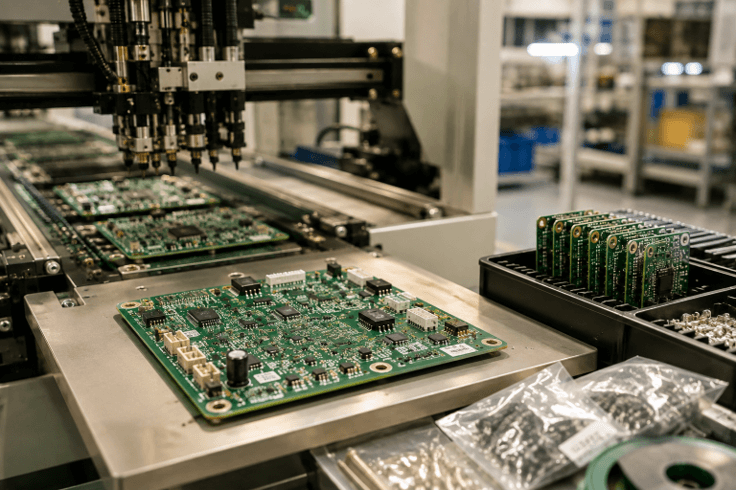
What is one-stop PCB assembly?
One-stop PCB assembly is a service model in which one manufacturer handles every step between your design files and a finished, tested board: bare board fabrication, component procurement, SMT and through-hole assembly, inspection, and functional testing. You upload your Gerber files and BOM once, and the same factory manages the entire production chain. a
This contrasts with the traditional multi-vendor workflow, where you coordinate a board fabricator, a contract assembler, and a component distributor separately. Each handoff can let files fall out of sync, tolerances get interpreted differently, and blame get passed when something fails.
What a one-stop PCB assembly service covers
A genuine one-stop service includes more than soldering components onto a board. The core scope typically covers:
- PCB fabrication: Manufacturing the bare board from your Gerber files, including multilayer stackups, controlled impedance, and specialized materials such as high-frequency or metal-core laminates
- Component sourcing and kitting: Procuring every part in your BOM, verifying availability and lead times, and kitting components so assembly starts on schedule
- SMT and through-hole assembly: Placing surface-mount components with automated lines and handling through-hole parts where the design requires them
- Inspection and testing: Automated optical inspection, X-ray for hidden joints such as BGA and QFN, in-circuit testing, and functional testing before shipment
- Engineering review: A design-for-manufacturability (DFM) and design-for-assembly (DFA) review of your files before production, flagging issues while they are still free to fix
When you compare One-Stop PCB Assembly services from different providers, the differences that matter are rarely the headline capabilities: whether engineering review is included or sold as an add-on, which inspection stages are standard in the price, and how the manufacturer handles component shortages when your BOM contains a long-lead part. Exploring One-stop PCB solutions can also help you understand how turnkey manufacturing services combine different stages of PCB production.
Why one-stop PCB assembly reduces errors
Most engineering errors in PCB production are not design errors. They are coordination errors. A component substitution made by a distributor without your sign-off, a BOM revision that reaches the assembler but not the fabricator, a footprint assumption that nobody verified—each of these is a handoff failure, not a layout failure.
A one-stop provider eliminates the handoffs by keeping every stage inside one accountable operation:
- Single BOM ownership: One team validates your BOM, so revisions and substitutions are tracked in one place and approved by you in writing
- DFM/DFA before tooling: Design issues such as insufficient pad spacing, poor solderability, or stackup problems are caught in review, before the first board is built
- Consistent process parameters: Stencil design, reflow profiles, and placement programs are the same for prototype as for volume production – tested prototypes are the same as volume production.
- End-to-end traceability: Components and materials can be traced back to their source; this is important for regulated industries and for auditing failures after the fact.
The end effect is a measurable decrease in rework cycles, and in cases of a hard deadline, each rework cycle costs you the benefit of being early.
Why one-stop assembly lowers total cost
One-stop PCB assembly is often assumed to cost more because one vendor carries more overhead. In practice, total cost of ownership usually moves the other direction:
- No duplicated engineering time: You send one file and then deal with one engineering team rather than three teams that don’t communicate.
- Bulk component pricing: A manufacturer that has been able to negotiate component prices for many customers, which can be a lot lower than you would be able to get if you bought a few parts.
- Fewer rework and scrappage costs: It’s cheaper to fix a defect at the right inspection stage (cents) than it is to find a defect in the field (recall).
- Lower logistics and administrative overhead: One shipment, one invoice, one set of paperwork, rather than coordinating 3 supply chains.
When a one-stop provider makes sense
A one-stop model is best for multiple BOM items, if you are transitioning from prototype to production, and need to maintain continuity in your process; or if you require medical or aerospace traceability. For another, it’s the sensible option for startups – a single supplier eliminates an administrative cost that a small team can’t afford.
When you already have a proven supplier chain, and your design is a small change to a design that has shipped for years, it does not matter that much which model you use; you risk switching vendors for consolidation. The more handoffs, the more value your workflow has in one-stop assembly.
How to choose a one-stop PCB assembly provider
Not every provider that calls itself one-stop delivers the full scope. Before you send files, verify five things:
- Fabrication and assembly under the same roof: Is the board manufactured in-house or at a sister manufacturing plant? Where the two happen to be together, the coordination savings only exist if they are in the same quality system; if they are not in the same quality system, then the savings do not exist.
- Engineering review included in the quote: The best indicator that the provider is a provider partner and not a parts placer is that review is part of the quote.
- Standard inspection stages: Confirm which of AOI, X-ray, in-circuit, and functional test is included in the quoted price and not an extra cost
- Component sourcing policy: Authorized distributor channels with traceability, or grey-market sourcing that saves pennies and costs field failures
- Volume flexibility: Ability to support your actual order size, from single-unit prototypes to production runs, to the same quality standards.
Why OrinewPCB stands out as a one-stop partner
Since the launch of the one-stop fabrication-plus-assembly model in Shenzhen 14+ years ago, OrinewPCB has been much more than just a label provider. All orders undergo a free DFM/DFA review by its engineering team prior to tooling, and its quality system is ISO 9001:2015, ISO 13485:2016, IATF 16949:2016, and AS9100D certified, with assembly built to IPC-A-610 Class 2 and Class 3. It offers 7 SMT lines and 2 through-hole lines, ranging from a single prototype to full production runs, and features multi-stage testing, which includes 3D AOI, 3D SPI, X-ray, in-circuit, and functional test. Only traceable components that meet the standards of the authorized distributors are used, which is essential for customers in the medical, automotive, and aerospace sectors whose paperwork is reviewed. The facility supports up to 64 layers, HDI with any layer vias, heavy copper of up to 28 oz, and RF materials like Rogers and Taconic—all under one roof, with the same accountable team.
Frequently asked questions
What is the difference between one-stop PCB assembly and turnkey assembly?
Turnkey assembly is the sourcing model: The manufacturer will get all the required components for your BOM. One-stop brings fabrication and testing into that scope. Almost always, a one-stop provider will be turnkey, but a turnkey assembler will not be one-stop if the boards are built elsewhere.
Is one-stop PCB assembly more expensive than using separate vendors?
A per-unit price may seem similar, but overall the amount of money you’ll save typically exceeds that, due to fewer reworks, fewer duplicated engineering hours, and a single logistics overhead and bulk component pricing.
How do I know my components are genuine?
Inquiries about sourcing policy. A disciplined one-stop provider gets their supply from authorized and franchised distributors and maintains traceability back to the original component manufacturer.
Can a one-stop provider handle prototypes and production runs?
Yes, if the provider has volume flexibility because they can accommodate your volume needs. Check if the manufacturer has no minimum order requirement and uses the same engineering review and inspection process on one prototype unit as that used for a production run.
What files do I need to submit for a one-stop PCB assembly quote?
Generally, you will need your Gerber files (or native design files like Altium, KiCad, or Eagle), a BOM in a CSV or EXCEL file, and a pick-and-place or centroid file. A free DFM provider also provides engineering feedback in the quote.
Conclusion
One-stop PCB assembly is not a convenience, but a structural solution to coordinate failures that lead to most of the rework in PCB manufacturing. A single provider eliminates errors, shortens total cost, and accelerates time-to-market by owning your BOM, verifying your design prior to tooling, and maintaining consistency in process parameters between prototype and production. When reviewing a provider, look at the scope you’ll actually be covered by and the typical stages of inspection, as well as the sourcing discipline for the BOM. If you are ready to consolidate your supply chain, a PCB Assembly Manufacturer that offers fabrication, assembly, and testing under one roof is the shortest path from design files to shippable boards.
Popular on OTW Right Now!


About The Author

Gagan Bhangu
Founder of otechworld.com and managing editor. He is a tech geek, web-developer, and blogger. He holds a master's degree in computer applications and making money online since 2015.