
Mobile-First Learning: How Smartphones Became the New Language Classroom
The way we learn new skills is different today because of mobile phones. It is not necessary to have a class, books, or follow a certain timetable to learn a new language. To achieve this, just have your mobile phone and spare minutes every day.
Regardless of our location, mobile language learning apps enhance our grammar, vocabulary, and speaking and listening abilities. Today, many individuals take advantage of their free time studying languages for short periods or while on the move. The fact that people can now easily learn different languages freely has greatly contributed to the widespread growth of online language training.
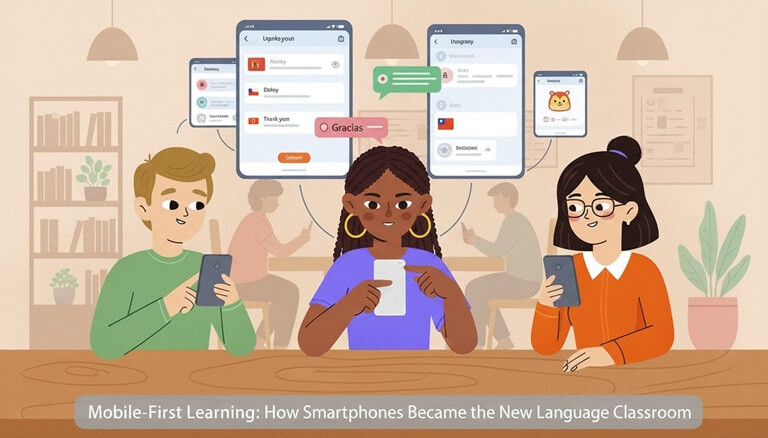
The Rise of Mobile Language Learning Apps
In the last ten years, there has been an increase in the use of smartphones to access the internet among many people. As a result, educational platforms have begun developing courses that are meant for mobile users. Such courses are referred to as “mobile-first learning”, and they are characterized by their simplicity and accessibility through mobile phones.
Millions of individuals use language learning apps on a daily basis to enhance their linguistic skills. In case you are interested in studying Spanish, German, or Italian, there are many educational lessonsthath are compatible with your timetable in these mobile applications.
Why Mobile Learning Became So Popular
There are several reasons why mobile language learning has become the preferred way for many students:
- Learn anytime and anywhere.
- Short lessons. Perfect for busy schedules.
- Affordable courses compared to traditional classes.
- Instant feedback on answers and pronunciation.
- Progress tracking to stay motivated.
Rather than spending hours in a classroom, you can learn for 5-15 minutes at a time. Effective time management allows for a comfortable and less stressful way to learn languages.
Language Learning Fits Perfectly on Smartphones
Language learning is effective with mobile devices since it focuses on repetition and regular practice. You do not need long study sessions to improve your skills. Short, consistent lessons can be very effective.
For example, learners can:
- Review vocabulary on the bus.
- Listen to audio lessons while walking.
- Practice pronunciation using voice recognition.
- Complete grammar exercises during lunch breaks.
Flexible Learning: Study Languages Anytime, Anywhere
One of the main advantages of mobile learning is flexibility. Language training classes at traditional schools are usually scheduled according to fixed timetables and require travel time. Mobile learning removes these obstacles, so you can learn at your own pace.
Many learners now prefer to study Italian with online courses or practice other languages on their phones because it fits easily into their daily routine. There’s no need to rearrange work or family commitments.
Self-Paced Language Learning
Self-paced learning allows one to decide when and for how long they will engage in a learning process. This method is most suitable for adults who have busy lives.
Benefits of self-paced language learning are:
- Learning at your own pace.
- Repeating lessons when required.
- Skipping topics you already know.
- Studying comfortably.
The possibility to learn individually leads to improved studying behavior, enables overcoming obstacles, and makes learning less difficult.
Microlearning: Small Lessons That Work
Microlearning is very popular on mobile language learning applications because users can go through the training quickly.
Some of the microlearning activities are:
- Everyday vocabulary.
- Brief grammar tests.
- Short listening exercises.
- Speaking scripts.
- Flashcard quizzes.
Research shows that regular, brief study sessions lead to better recall than longer, less frequent ones.
Key Features of Modern Language Learning Apps
One should be aware that not every language learning application is the same. The most useful ones capitalize on technology to improve the learning experience, making sure that it is fun, fast, and effective. Knowing these characteristics will empower you to make a good selection of an app.
Personalized Learning With AI
The majority of modern language learning applications currently include artificial intelligence (AI), the only aim of which is to modify the level of the lessons depending on the user’s level. An example of this would be that an inexperienced person would find it easy to perform simple activities, but a fluent speaker would find it difficult to perform complex activities.
Personalized learning can include:
- Custom vocabulary lists.
- Adaptive difficulty levels.
- Smart review reminders.
- Progress-based lesson recommendations.
Speech Recognition for Pronunciation Practice
Acquiring a new language is associated with numerous challenges, one of them being speaking. Speech recognition technology in mobile applications helps people to improve their pronunciation.
These tools are able to:
- Review spoken words.
- Identity when pronunciation is wrong.
- Offer immediate feedback.
- Keep a record of speaking progress.
Constant practice in speaking helps to build confidence and enhance communication skills.
Gamification and Motivation
In language learning apps, you will also find gamification as a usual characteristic. It is planned to use features that are similar to those used in games to make sure that learners do not become distracted or bored.
For instance:
- Daily learning streaks.
- Points and rewards.
- Achievement badges.
- Progress bars.
Benefits of Learning Languages on Your Phone
Mobile language learning has a number of benefits over traditional methods. It is due to these advantages that more individuals are opting to study languages online.
Learn Anywhere With Mobile Language Apps
Location independence can be exploited when one learns a language using his/her mobile phone. It implies that one is able to study in any place that he/she feels good.
Some of the most common places for studying are as follows:
- At home.
- On public transport.
- During travel.
- At work breaks.
- While waiting in line.
It can be done at any time or any place and, therefore, it is not difficult to imagine how such an option can turn these small moments of death into valuable learning experiences.
Affordable Online Language Courses
Another factor is cost. A traditional language training course can be very expensive, particularly when you desire one-on-one training.
Several online language learning platforms offer features such as:
- Reduced subscription fees.
- Flexible payment plans.
- Free trial classes.
- A range of languages is available.
With this in mind, a lot of individuals can enhance their languages.
Consistent Practice Leads to Faster Results
In order to be successful in learning a language, a person must be consistent. It is possible to learn languages based on mobile applications on a daily basis, even just a few minutes a day.
Regular practice leads to:
- Improved memory of words.
- Enhanced listening skills.
- The skill to speak up and speak fluent English.
- Knowledge of grammar.
- Rapid advancement in the attainment of fluency.
Regular practices can be short and more effective than long practices, which are not frequent.
Challenges of Mobile Language Learning
Despite the numerous advantages of mobile learning, it has a few challenges. Learners can be made aware of challenges to keep them on track.
Distractions From Other Apps
Social media, messages, and notifications are among the distractions of smartphones, inhibiting one’s concentration during study.
In order to reduce distractions, students should:
- Deactivate notifications when studying.
- Have specific study periods.
- Plan for daily studies.
- Study in a quiet place.
It is the little things that matter most.
Limited Real-Life Conversation Practice
Though mobile applications can contribute significantly to the development of vocabulary and improvement of grammar, successful communication is more than that. Engagement through speaking to those who speak English as their mother tongue can help in the use of linguistics by learners.
There are different means through which one can have a conversation, such as:
- Having someone to exchange language ideas with.
- Engagement in online tutoring.
- Joining group classes.
- Travelling to other countries.
One will realize the maximum benefits when incorporating what they have learned using their phones and attempting to communicate with them.
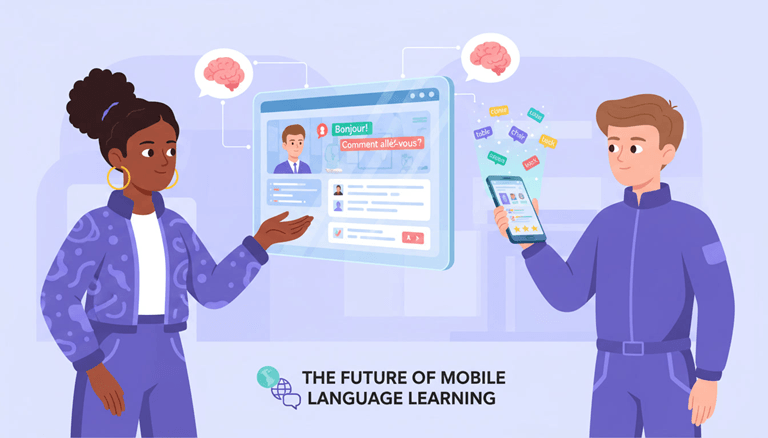
The Future of Mobile Language Learning
With the improvement of technology, individuals can learn various languages with ease while using their smartphones. Engagement and customization are being enhanced by the new language learning applications.
AI Tutors and Chat-Based Learning
Chat tools based on AI are gaining popularity in language learning. With such tools, learners are able to practise speaking at any time they wish and will not require a speaking partner.
Some of the features that might be seen later on include:
- Live conversation simulations.
- Instantaneous grammar correction.
- Individualized teaching schedules.
- Spoken interaction.
This will serve to make language learning quicker and easier.
More Immersive Learning Experiences
Languages have become interesting to study because of the introduction of new technologies like augmented reality (AR) and interactive video lessons. Through this, students are able to have an interactive communication that enables them to apply their theory to the use of natural language.
For instance, applications enable individuals to:
- Practice: Ordering food in a virtual restaurant.
- Practice travel phrases in the simulated setting.
- Find objects of immediate translations.
Such experiences can help the learners to remember new words.
Summary
At present, the use of mobiles by a number of individuals around the world for virtual classes to learn languages is very common. No wonder they have grabbed this chance; their applications are not only easy to use, but also provide a personalized learning experience, which might enable one to study better around the clock at a reduced effort than previously.
It is presumed that low-cost online courses that offer different alternatives of time, distribution, and effective tools will encourage creating the mobile-first approach to foreign language education compared to the traditional approach.
Popular on OTW Right Now!




About The Author

Gagan Bhangu
Founder of otechworld.com and managing editor. He is a tech geek, web-developer, and blogger. He holds a master's degree in computer applications and making money online since 2015.