
Managing High-Risk Work in Australia: Permit-to-Work Systems and Dogging Safety
In construction, manufacturing, infrastructure, and the industrial environment, a small mistake can result in serious injury, damage to equipment, or a delay in operations. Any number of tasks (hot work, entry into confined spaces, working at height, lifting with cranes, etc.) all require meticulous planning, clear communication, and good safety practice.
Managing high-risk work is all about two things: permit-to-work systems and skilled lifting workers. The permit-to-work system is the mechanism by which the organization can review and approve the dangerous work. The dogging skills are the other key element, ensuring you have the right people to actually lift and move the loads safely.
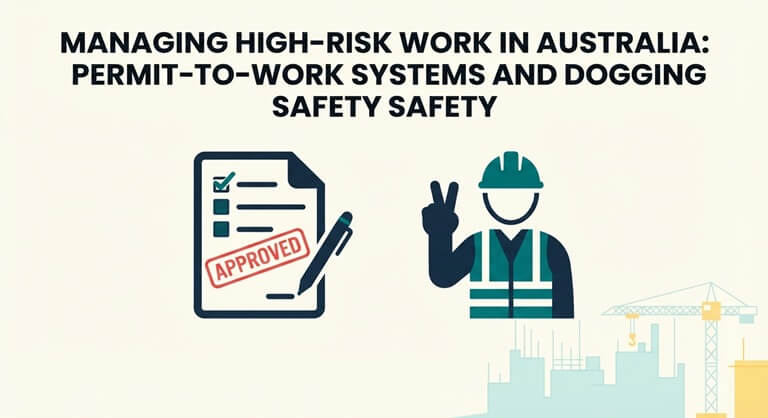
While they have different roles, the various systems can be combined within a wider safety plan to enable better co-operation between businesses, clarify responsibilities and reduce avoidable risks.
Quick Answer: How Do Permit-to-Work Systems and Dogging Safety Work Together?
A Permit to Work (PTW) system is a formal way of checking, approving, and controlling certain hazardous work. Dogging is the process of selecting and checking the correct lifting gear, attaching the load, and safely guiding the movement of the crane or hoist, all within the scope of the worker’s license and skills.
On construction and industrial sites, permits dictate when work can commence, and the trained dogging people will be the ones to manage the lifting risks. Both of those require good hazard checks, clear communication, and adherence to site rules.
What Is a Permit-to-Work System?
A Permit to Work system is a written safety process for managing work that has significant risks. It will detail the work to be carried out, the required safety steps, who is responsible, and what must be done prior to the work commencing.
Depending on the workplace and activity, permits may be required for:
-
Hot work (welding, cutting, etc.) in designated hazardous areas.
-
Entry into confined spaces.
-
Work at heights where specific permit procedures apply.
-
Maintenance involving sources of hazardous energy.
-
Work on or near equipment that requires isolation.
-
Other high-risk activities as identified by the site’s safety management system.
A permit is more than just a form. It’s a means of ensuring that the hazards are identified, the safety measures are in place, and that everyone knows the rules of how the work is to be carried out safely.
Key Responsibilities in the Permit Process
Effective permit management depends on clear responsibilities and communication between relevant personnel.
Permit issuer: Reviews the proposed work, confirms the required precautions, and authorizes the permit within their own authority.
Permit holder or receiver: Understands the permit conditions, communicates the requirements to the work team, and ensures the work is carried out in accordance with the approved controls.
Workers and contractors: Adhere to the relevant procedures, use the required controls, and report any changes or unsafe conditions.
Supervisors and site management: Co-ordinate the activities, resolve any conflicts that may arise between the various operations, and ensure that the work is properly monitored.
The exact allocation of responsibilities depends on the workplace’s permit system and applicable requirements.
Why Permit-to-Work Training Matters
If hazardous work isn’t properly managed, then workers are at risk of things that could have been avoided through better planning and communication. A permit system will show the safety requirements prior to work commencing and provide a clear mechanism for dealing with any changes that may occur during the course of the work.
Training will teach the workers how to check permits, identify hazards, use the safety controls and complete the permit process correctly.
For people responsible for issuing permits or working under them, Safety Australia Training’s Permit to Work Training covers nationally recognized units including MSMPER200, MSMPER300 and MSMWHS201.
The online program covers work permit responsibilities, hazard analysis, permit preparation, authorization, communication, and permit closing. The provider gives an approximate run time of four hours for the whole program.
Employers need to pick the appropriate training units for each worker’s job and check any site-specific rules prior to enrolling.
Understanding Dogging Safety in Crane and Lifting Operations
Lifting work can be dangerous, with the potential for hanging loads, crushing, unstable materials, and equipment issues. Even with a very skilled crane operator, the job still requires good planning, the correct equipment, and clear communication.
Dogging is a specialist high-risk job where the dogger uses their skills to attach the load, pick and check the lifting gear, and in some cases will be required to guide the movement of the load.
Doggers can work on construction sites, industrial sites, infrastructure projects and all sorts of other workplaces where you’ve got cranes and hoists.
Their responsibilities can include:
-
Identifying the hazards associated with the load and the lifting environment.
-
Assessing the load characteristics and working out the appropriate lifting methods.
-
Selection and inspection of appropriate slings, chains, shackles and other lifting gear.
-
Preparing the load for lifting.
-
Communicating effectively with the crane operator.
-
Directing the movement of loads within the scope of their responsibilities.
-
Adhere to site procedures and stop or reduce any unsafe lifting activity.
Safe lifting depends on the combined efforts of the crane operator, dogging personnel, supervisors and other workers in the area.
Obtaining a License to Perform Dogging in Australia
Anyone doing dogging work must be aware of the licensing requirements for the work they’re going to do.
The CPCCLDG3001 unit (License to perform dogging) covers the skills and knowledge required to perform dogging. On successful completion of the required training and assessment, an applicant may be able to apply for a High Risk Work License (HRWL) in the DG class via the relevant state or territory regulator.
For workers seeking this qualification, Safety Australia Training’s License to Perform Dogging course includes theory and practical assessment. The provider lists a typical course duration of five days.
Training covers planning of lifting operations, selection and inspection of equipment, site preparation, slinging of loads and the directing of crane/hoist movements.
Applicants must check the most up-to-date entry requirements, course dates, assessment details and licensing steps prior to booking.
Permit-to-Work Training vs Dogging Training: What’s the Difference?
Although both are relevant to workplace safety, they address different responsibilities and learning outcomes.
| Comparison | Permit-to-work training | Dogging training |
| Primary purpose | Manage and authorize specified hazardous work | Safely sling loads and direct crane or hoist movements within the relevant scope |
| Main subject areas | Permits, hazard analysis, controls and documentation | Lifting gear, load preparation, slinging and communication |
| Typical audience | Permit issuers, permit holders, supervisors and relevant workers | People undertaking dogging activities |
| Practical application | Ensuring work meets permit conditions | Managing lifting hazards and communicating during load movements |
| Training pathway | Relevant permit-related units of competency | CPCCLDG3001 and the applicable DG licensing process |
| Key consideration | A permit does not replace task-specific competencies | A dogging license does not replace required permits or site procedures |
For the employer, the real question is not which course is the best, but which training does each individual worker actually need in order to do their job safely and comply with the rules.
How to Integrate Permit Procedures with Lifting Operations
When lifting is part of a site’s permit system, then the organization must ensure that the permit rules and the lifting controls are compatible.
1. Plan the Task Before Equipment Is Mobilized
Identify the load, the lifting equipment, the work area, access restrictions and any potential hazards. Establish whether a permit is required, whether a lift plan is required, whether a risk assessment is required, or whether some other form of authorization is needed.
2. Identify Hazards and Establish Controls
Consider suspended loads, overhead obstructions, adjacent personnel, ground conditions, restricted visibility and any relevant electrical or environmental hazards.
Safety controls must be appropriate for the lift and comply with all the relevant procedures and rules.
3. Verify Personnel and Equipment
Ensure the staff has the appropriate skills and licenses for the work. Check the lifting gear and make sure the crane, hoist, and other equipment are suitable for the job.
4. Establish Clear Communication
Decide how you’re going to communicate, what the signals are, and who is in charge before you start the lift. Everyone must know who is in charge and how to stop work if it becomes unsafe.
5. Monitor Conditions During the Job
Workplace conditions can change after a permit has been issued. If the nature of the work changes, a new hazard emerges, or a safety control ceases to function, then the work should be rechecked and managed in accordance with the correct site rules.
6. Close Out the Work Correctly
When the job is completed, ensure the equipment is safe, the area is checked, and the permit is either returned or canceled as appropriate.
Common Mistakes to Avoid in High-Risk Work
Businesses can strengthen safety performance by addressing recurring weaknesses in their procedures.
- Treating permits as paperwork: A permit must reflect the actual task and its hazards.
- Assuming one qualification covers every task: Workers may need separate licenses, competencies, or authorizations.
- Overlooking simultaneous operations: Nearby activities can introduce additional hazards to lifting or maintenance work.
- Using unsuitable lifting gear: Equipment must be selected, inspected and used appropriately for the load and conditions.
- Failing to communicate changes: Revised conditions may require reassessment and updated controls.
- Ignoring permit close-out: Work is not fully managed until required hand-back and cancellation procedures are completed.
Regular reviews, toolbox talks and incident investigations can help identify weaknesses before they lead to serious incidents.
Frequently Asked Questions
What is the main purpose of permit-to-work training?
It covers how permits are inspected, issued, and managed, including how to identify hazards, use controls, understand the responsibilities, communicate, and close permits.
What types of work may require a permit?
It will depend on the site and the site rules as to whether a permit is required for hot work, entry into a confined space, working at height, dangerous maintenance, and so on.
What does a dogging license allow a worker to do?
A DG High Risk Work License covers dogging work as per the rules (i.e. slinging loads and guiding the movement of a crane or hoist). It does not, of course, give you the right to operate every type of crane.
Can permit-to-work training replace a dogging license?
No. Training and dogging licenses cover different requirements. If you’re doing licensed dogging, you must comply with the license requirements regardless of whether you also require a permit.
Do all crane lifts require a permit-to-work document?
Not necessarily. Whether or not you need a permit will depend on the safety system in place at the workplace, the nature of the job, the law and the site rules. There may still be other planning and risk assessments to carry out even if a permit isn’t required.
How can employers choose the right training?
Employers need to look at what each worker does, check legal and site rules, and pick training that fits those jobs. They should also make sure the course is recognized and check assessment and license details.
Conclusion
Managing high-risk work needs good planning, clear approval, skilled workers, and strong communication. Permit-to-work systems set the rules for dangerous jobs, while dogging training gives workers the skills to handle lifting safely.
By providing the right training and using it with real site procedures, Australian businesses can raise hazard awareness, make roles clearer, and build a safer workplace culture.
Popular on OTW Right Now!



About The Author

Gagan Bhangu
Founder of otechworld.com and managing editor. He is a tech geek, web-developer, and blogger. He holds a master's degree in computer applications and making money online since 2015.