
Live Tracker Claims and What Pakistan Actually Records
When you search for an unknown mobile number in Pakistan the first screen of the results displays two options. One of the pages says it will turn those digits into a person by providing their name, their home address and their CNIC—which is Pakistan’s national identity card number. Another page is a live tracker which shows a position on a map and updates this position as you watch.
They are two separate promises and so require two separate records. It is worth knowing, before any entry is made into either box, what Pakistan records when a SIM is sold and who has access to it.
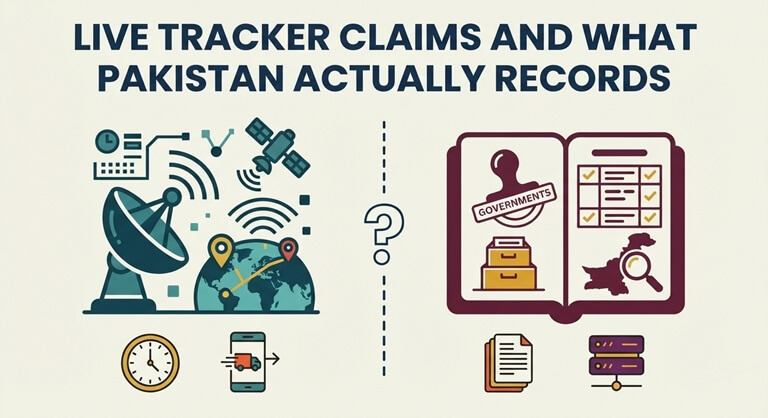
What a Live Tracker Page Actually Promises
The two promises are frequently presented together, and when there is a refresh interval on a results panel the second one becomes a statement about the present moment.
For the identity portion, there would need to be a current copy of each operator’s subscriber record kept behind the page, and for the map portion, live position data from the networks would be required, this data to be combined with the copy and kept up to date.
Nothing published in Pakistan is built that way, which leaves open the question of what a confident-looking result actually is. A Pakistani explainer on live tracker sim data works through the same promise in detail, including why a result that looks right can still be a guess.
What a visitor encounters instead is a page designed to appear stable. It has a confident layout, a firm tone, and a figure given without a source: all of this does not indicate where the information originated, since confidence is a deliberate design choice.
The same result page, which gives both a name and a current position, is providing two separate items that are not linked in any way that the public can access.
A Name and a Live Location Are Two Different Asks
A registration record only deals with one issue: which name is associated with this entry. It is recorded at a counter on the day the SIM is sold and can be altered as a result of another fingerprint check—for example, when there is a change of ownership, in the case of a duplicate SIM, or when re-verification is carried out. The record contains no information about where the phone is at the moment.
The record contains no information regarding a live position, and none of the published Pakistani consumer route reports do so either. On 9 September 2025 PTA, the Pakistan Telecommunication Authority and telecom regulator, stated that it neither holds nor manages subscriber data, the data instead being kept entirely by the licensed operators.
Each mobile company answers for its own customers in its own way, as does SCO, the government-run Special Communications Organization. The operator-by-operator detail, from the Jazz and Zong routes to what Onic and SCO customers get, is written out by a Pakistani reference guide, Fresh Sim Database.
Each of those replies is sent back to the person who asked the question about their own SIM card or their own CNIC, not to the person who is enquiring about somebody else’s. A record of a company’s customer is one thing, and a statement regarding the location of a mobile phone is something entirely different.
What Gets Written Down When a SIM Is Sold?
A person is verified in front of a clerk when their details are recorded and a SIM card in Pakistan is sold together with a national identity document, most commonly the CNIC, which is the 13-digit number on the Computerised National Identity Card issued by NADRA, Pakistan’s National Database and Registration Authority.
The verification services offered by NADRA are based on institutional arrangements and require consent: they confirm the identity of a person who is actually there, not the identity of a subscriber against a name. Before the phone line is activated, the buyer’s fingerprint is checked online by means of a comparison with NADRA’s records, and that record remains with the licensed operator who holds the SIM.
In Pakistan SIMs are registered using biometrics, the entry for a name being made at the counter. The PTA’s Multi Random Finger Biometric Verification System includes more than just the initial purchase; its biometric verification page has provisions for a duplicate SIM, a change of ownership, porting a number, re-verification and disowning.
There is a limit applicable to all these cases. According to the PTA’s FAQ on SIM information, personal use allows for eight SIMs per CNIC, comprising five for voice and three for data. Moreover, in January 2024 the PTA increased the period before a further new SIM could be biometrically verified on the same CNIC to seven days.
Who Can Ask, and What Comes Back?
All the things that the public can request begin with something you already have—that is, your personal identification number or the SIM card in your hand.
- Your own 13-digit CNIC number, without dashes, texted to the short code 668 or entered at cnic.sims.pk: how many SIMs each mobile company has registered on it, and no subscriber names.
- MNP, the first step of mobile number portability, texted to 667 from the SIM you hold: that SIM’s own number, the registered name, the CNIC it is registered to and the SIM number. Ufone sets out those four fields; Jazz and Onic publish the same first step.
- N followed by a number, texted to 76367 for Rs 2 plus tax in Pakistani rupees: which network it is on, not who holds it.
- No published Pakistani route returns a stranger’s name, CNIC, address or position.
The first of those routes is determined by PTA’s own SIM information system, which requires a 13-digit CNIC or a foreign identity number along with a verification procedure and does not include a field for a phone number.
Why the Law Reaches the Buyer, Not Only the Seller
The buyer is also involved in the offence, not just the seller. The Prevention of Electronic Crimes Act 2016, under section 16(1), includes the acts of obtaining, selling, possessing, transmitting or using another person’s identity information without permission.
The person can be sentenced to three years’ imprisonment, or fined an amount up to Rs 5 million, or both. The verbs associated with obtaining and using apply to the individual who entered the number, meaning that paying for a result does not place the buyer outside the scope of it.
The same Act also deals with the other side of the issue—that is, the sale or provision of a SIM card without checking the subscriber’s background in the way approved by the PTA—and this is punishable by a maximum sentence of three years, a fine of up to Rs 500,000, or both. The NCCIA, which is the National Cyber Crime Investigation Agency, is responsible for investigating offences committed under the Act.
Questions People Still Ask
Do live tracker apps and Android APK downloads work differently?
No, an app is just another kind of wrapper around the same claim, and the subscriber record it would require is just as inaccessible to it as it is to a web page. Once an app is installed, it only alters the interface, not who can read a subscriber record.
What is behind the results these pages show?
Anything that is given is offered as a copy of an item, and the page never states either what it is or when it is. Pakistan’s official sources give the number of SIM cards, the registration for a SIM card that you have, or the network associated with a number, but never a directory.
Is using these sites legal in Pakistan?
The act of using another person’s identity details without permission is prohibited by section 16(1) of the Prevention of Electronic Crimes Act 2016, a provision that includes obtaining, using and selling such details. The penalty in this case can be three years’ imprisonment, a fine of five million riyals, or both.
Can I tell whether my own CNIC is in one of these files?
The published SIM information channels in Pakistan do not provide an answer to that question; instead they give a count, a registration, or indicate the network. When a page offers to carry out such a check it requests the precise 13-digit number which is causing your concern. All you will be able to do is check your own SIM count.
Check What You Can Actually Check
The registration record lists a person’s name and is held by the operator who issued the SIM, with the only publicly available ways of accessing it being through that person’s own CNIC or the SIM which they have in their possession; it does not contain a live position and no publicly available information links the two.
All that remains is limited and genuine—your own number of SIM cards, the registration of the SIM card in your hand, and the network associated with that number. Everything beyond that is merely a claim, not a factual record.
Popular on OTW Right Now!




About The Author

Gagan Bhangu
Founder of otechworld.com and managing editor. He is a tech geek, web-developer, and blogger. He holds a master's degree in computer applications and making money online since 2015.