
Is a 72-Inch Fan Too Big for a Living Room?
Is a 72-Inch Fan Too Big for a Living Room?
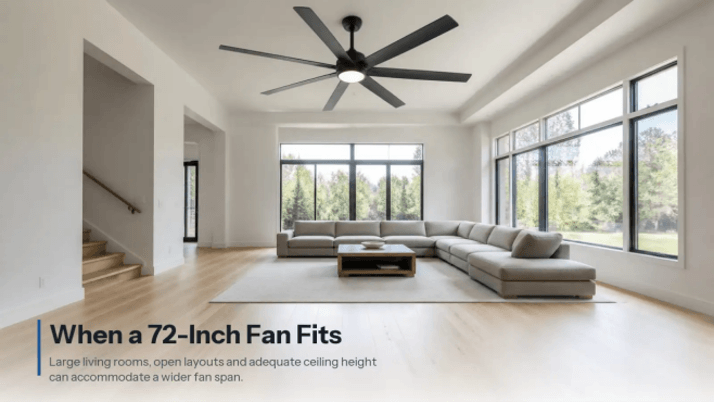
How to judge room size, ceiling height, airflow, and clearance before choosing a 72-inch ceiling fan
No, a 72-inch ceiling fan is not automatically too big for a living room. It can be a strong fit for a large living room, great room, or open-plan space when the ceiling is high enough and the fan has adequate clearance. In a compact or low-ceiling room, however, 72 inches can be excessive.
Square footage is only the starting point. The right fan size also depends on the room’s actual length and width, ceiling height, furniture layout, blade clearances, mounting position, and the fan’s published airflow. A 72-inch fan that works beautifully in a 20×20 great room may feel oversized in a narrow or much smaller living room.
Is a 72-Inch Ceiling Fan Too Big for a Living Room?
A 72-inch fan is a large residential ceiling fan, so it makes the most sense when the room has enough floor area and ceiling space to use that extra span. Large living rooms, great rooms, and open-concept spaces are the most natural candidates. Smaller living rooms are where a 72-inch fan is more likely to feel visually dominant or create more airflow than the seating area needs.
The question is not simply whether a 72-inch fan will physically fit. A good installation should leave comfortable clearance around the blades, place the fan at an appropriate height, and deliver useful air movement to the occupied area of the room.
| A 72-Inch Fan May Work Well When | A 72-Inch Fan May Be Too Large When |
| The living room is large and open | The room is compact or narrow |
| The ceiling has adequate height | The ceiling is low for the mounting configuration |
| There is generous clearance from walls and beams | Blades sit close to walls, beams, cabinets, or fixtures |
| The room has a broad seating or activity area | Airflow is concentrated over a small seating zone |
| Published airflow suits the room | The fan creates more draft than the room needs |
| The fan can be positioned well within the room | Furniture or room geometry limits useful coverage |
What Room Size Is Appropriate for a 72-Inch Ceiling Fan?
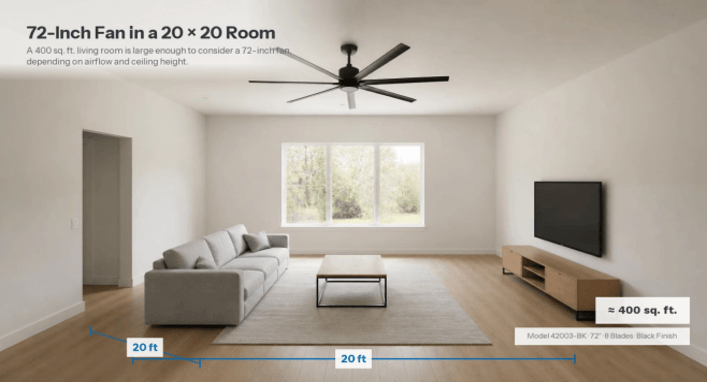
A 72-inch ceiling fan generally belongs in the large-room category rather than a standard bedroom or compact living room. Many homeowners begin considering this size once a living area becomes broad enough that a conventional 52- or 60-inch fan may not provide the coverage they want.
The table below is best used as a practical reference, not as a universal sizing rule. Different fan manufacturers, airflow ratings, ceiling heights, and room layouts can change the best choice.
| Approximate Room Size | How to Think About a 72-Inch Fan |
| Under about 150 sq. ft. | Usually much larger than necessary for a typical room |
| About 150-225 sq. ft. | Often oversized; compare smaller spans first |
| About 225-300 sq. ft. | Possible in some layouts, but 60-65 inches may also deserve consideration |
| About 300-400 sq. ft. | A 72-inch fan becomes a reasonable candidate |
| About 400+ sq. ft. | Often worth evaluating, especially in open or high-ceiling spaces |
These ranges are only starting points. A 300-square-foot square room and a 300-square-foot long, narrow room can behave very differently. Always consider the room dimensions and where people actually sit, not just the total square footage.
Is a 72-Inch Fan Good for a 20×20 Living Room?
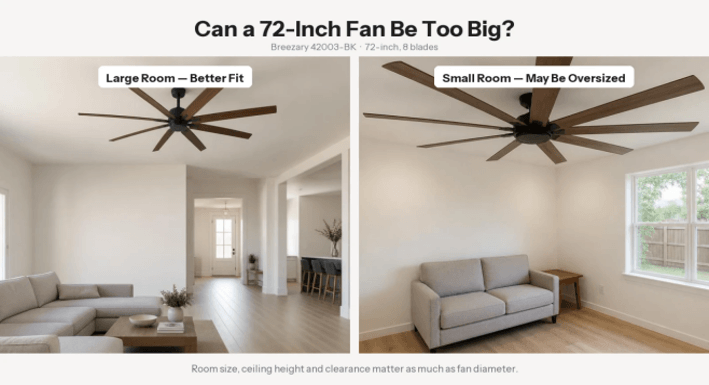
A 20×20-foot room is about 400 square feet, so a 72-inch ceiling fan is a reasonable size to evaluate. This is the kind of room where a larger blade span can provide useful coverage across a broad seating area instead of concentrating most of the breeze directly under the fan.
That does not make 72 inches the automatic answer. Ceiling height can change the installation significantly. A 20×20 living room with an 8-foot ceiling has different constraints from a 20×20 great room with a 12- or 14-foot ceiling. The fan’s CFM, downrod configuration, installed height, and blade clearance should all be checked before choosing the final size.
Furniture layout also matters. If the room contains a large sectional, a reading area, or an open connection to a dining zone, the best fan position may be more important than gaining a few extra inches of blade span.
Is a 72-Inch Fan Too Big for a 12×12 Living Room?
A 12×12 room is 144 square feet. In most typical rooms of that size, a 72-inch fan would be unusually large. It may dominate the ceiling visually, leave limited clearance from surrounding walls or fixtures, and create a stronger localized draft than the room needs.
That does not mean diameter alone makes the installation impossible. Ceiling height, room shape, fan design, and manufacturer requirements still matter. But for a conventional 12×12 living room, a substantially smaller fan would normally be the first size range to compare.
The same principle applies to other compact rooms: do not choose a larger fan simply because it can run at a lower speed. Start with the room proportions and required airflow, then select a fan that fits both.
Why Ceiling Height Matters With a 72-Inch Ceiling Fan
A 72-inch diameter describes how far the fan reaches across the ceiling, but it does not tell you how low the fan will hang. The final installed height depends on the motor housing, light kit if present, canopy, mounting hardware, and downrod.
In a high-ceiling room, a downrod may help position the blades closer to the occupied zone so the airflow is useful instead of staying too high above the room. In a lower room, the same fan may hang too low or feel visually heavy even if the blade tips technically clear the walls.
Vaulted and sloped ceilings add another variable. Check the exact model for allowable ceiling angle, compatible mounting hardware, and suitable downrod options. Fan diameter and mounting method should be considered together.
How Much Clearance Does a 72-Inch Ceiling Fan Need?
A 72-inch fan has a blade diameter of six feet and a radius of 36 inches from the center of the motor to the blade tips. That radius is only the fan itself; it does not include any additional clearance required from walls, beams, cabinets, lighting, or other obstructions.
This is why simply measuring a 72-inch-wide open area is not enough. The center point needs to be placed so the entire blade sweep remains clear throughout operation. Check the exact manufacturer instructions for required distances from walls and other structural or decorative elements.
In real living rooms, common obstacles include ceiling beams, vaulted ceiling surfaces, tall built-ins, pendant lights, recessed architectural features, and nearby ceiling fixtures. If a 72-inch fan forces the blade tips too close to any of these, a smaller fan or a different mounting position may be the better choice.
60-Inch vs. 70-Inch vs. 72-Inch Ceiling Fan for a Living Room
The difference between 60, 70, and 72 inches may look small on a product page, but the change in swept area can be noticeable in the room. Larger sizes tend to make the most sense as the living area becomes wider, more open, or more difficult to cover with one central fan.
| Fan Size | General Living-Room Use Case |
| 60 inches | Medium-large to large living rooms where a standard fan feels undersized |
| 65 inches | Larger seating areas and open layouts needing broader coverage |
| 70 inches | Large rooms where wider coverage is useful and clearances are generous |
| 72 inches | Large living rooms, great rooms, and open-plan spaces |
| 84 inches and larger | Very large spaces where dimensions, airflow, and mounting conditions justify the extra span |
Use diameter as one comparison point rather than the final decision. Published airflow, installed height, blade clearance, and the shape of the room can matter just as much as the difference between two nearby fan sizes.
Does a 72-Inch Ceiling Fan Move More Air?
A 72-inch fan has a larger swept area than a typical 52- or 60-inch fan, so it can potentially distribute air across a wider portion of the room. That wider coverage is one of the main reasons people choose large ceiling fans for great rooms and open living spaces.
However, a 72-inch diameter does not guarantee higher airflow. Fan performance also depends on blade geometry, motor design, speed settings, and the way the fan is engineered as a complete system. If airflow performance is important, compare the manufacturer’s published CFM rather than assuming the widest fan always moves the most air.
A large fan is most useful when the room can make use of its coverage. If the room is too small, extra span may produce little practical benefit and can make the airflow feel more direct or excessive.
What Happens If a Ceiling Fan Is Too Big for a Room?
An oversized ceiling fan can still run, but it may not create the kind of comfort you expected. The most common problems are related to airflow, proportion, and clearance.
Excessive Draft
A large fan can create more air movement over a small seating zone than occupants want, especially when chairs or a sofa are directly below the blades. Lower speed can help, but it does not solve every sizing mismatch.
Poor Visual Proportion
A fan that nearly fills a compact ceiling can make the room feel crowded. This is especially noticeable in small living rooms with low ceilings or heavy furniture.
Insufficient Clearance
Large blades need enough room to rotate safely around walls, beams, cabinetry, lighting, and ceiling features. If the available clearance is tight, the fan may simply be the wrong size for the location.
Installation Limitations
Low ceilings can restrict the mounting options for a large fan. High or vaulted ceilings may require a longer downrod or slope-compatible hardware. Both situations should be checked against the exact product instructions.
Little Additional Benefit
Once a room already has comfortable and well-distributed airflow, increasing the fan diameter does not guarantee a proportional increase in comfort. Proper sizing is more useful than maximizing size.
Is a 72-Inch Fan Better for an Open-Concept Living Room?
A 72-inch fan can be particularly useful in an open-concept living room because the space often has a larger uninterrupted ceiling area and a broader occupied zone. A central fan can help connect the living area visually while circulating air across more of the room.
Still, total floor area can be misleading. A long living-dining-kitchen layout may have plenty of square footage but be too elongated for one fan to serve every zone evenly. In that case, two smaller fans placed over separate activity areas may provide better distribution than one very large fan in the middle.
Think about where people spend time. If the living area is the primary occupied zone and the adjacent kitchen or dining area already has separate airflow, one 72-inch fan may be a clean and practical solution. If the entire open plan needs active air movement, multiple fans may deserve consideration.
Should a 72-Inch Living Room Fan Have a Light?
A large living-room fan often occupies the main ceiling position, so lighting becomes an important design decision. If the room already has strong recessed lighting, floor lamps, or separate decorative fixtures, a fan without a light may keep the ceiling visually simpler.
If the fan also needs to serve as a central source of general illumination, Large Ceiling Fans With Lights can combine broad air circulation with overhead lighting in one fixture. This can be especially useful in great rooms and open living spaces where the ceiling fan already occupies the most prominent central location.
When comparing lighted models, look at the actual light output and controls rather than assuming every integrated light kit will serve the room in the same way. The fan size and lighting needs should both match the space.
Is a Remote Control Useful for a 72-Inch Ceiling Fan?
A remote control becomes more useful as the fan is installed higher or offers more functions. Large living rooms often have high, vaulted, or sloped ceilings, which can make pull chains impractical and may place the fan far from the most convenient wall switch location.
For spaces where one fixture needs to combine large-room airflow, overhead lighting, and convenient operation, Large Ceiling Fans With Lights and Remote Control can be a practical configuration. Depending on the model, the remote may control fan speed, lighting, timer functions, or reverse operation.
The important point is not the remote itself, but whether the control system matches how the room will be used. In a high-ceiling living room, easy access to speed and light settings can make a large fan much more convenient day to day.
What Is the Best 72-Inch Ceiling Fan for a Living Room?
The best 72-inch ceiling fan is not simply the model with the most blades, the highest speed, or the largest-looking motor. It is the fan whose documented size, airflow, mounting requirements, controls, and lighting configuration match the room.
If you are still comparing sizes and configurations, browsing Large Ceiling Fans can help you compare different spans before deciding whether 72 inches is the best fit for the room.
| Feature to Compare | Why It Matters |
| 72-inch blade span | Determines the fan’s overall ceiling footprint and potential coverage |
| Published CFM | Provides a more useful airflow comparison than diameter alone |
| Ceiling height | Affects mounting choice and final fan position |
| Complete installed height | Helps confirm comfortable floor clearance |
| Motor and speed settings | Affect everyday operation and airflow adjustment |
| Light or no light | Determines whether the fan also serves as a central light fixture |
| Remote or wall control | Affects convenience, especially on high ceilings |
| Sloped-ceiling compatibility | Important for vaulted or angled ceilings |
| Location rating | Should match indoor, damp, or wet installation conditions |
| Warranty and service details | Useful for long-term ownership and product support |
Quick Decision: Is 72 Inches Too Big for Your Living Room?
Use this final check as a quick way to decide whether a 72-inch fan belongs on your shortlist.
| Your Living Room | How a 72-Inch Fan Fits |
| 20×20 / about 400 sq. ft. | Worth considering |
| Large great room | Often a strong candidate |
| Large open-plan living room | Worth considering if the layout supports one central fan |
| High or vaulted ceiling | Often suitable when mounting height and slope compatibility are correct |
| 12×12 / about 144 sq. ft. | Usually much larger than necessary |
| Low ceiling | Requires extra caution with complete installed height |
| Tight walls, beams, or ceiling fixtures | May be too large for the available clearance |
| Long or irregular room | Compare one large fan with two smaller fans |
A 72-inch ceiling fan is not too big because of its diameter alone. It becomes too big when its airflow, physical footprint, or mounting requirements do not match the room.
Frequently Asked Questions
What room size is appropriate for a 72-inch ceiling fan?
A 72-inch fan is generally a large-room option. It becomes a reasonable candidate in larger living rooms, great rooms, and open spaces, but exact room dimensions, ceiling height, airflow, and clearances matter more than a single square-foot rule.
Is a 72-inch ceiling fan good for a 20×20 room?
A 20×20 room is about 400 square feet, so a 72-inch fan is a reasonable size to evaluate. Check CFM, ceiling height, installed height, furniture layout, and blade clearance before making the final choice.
Is a 72-inch fan too big for a 12×12 room?
In most typical 12×12 rooms, yes, a 72-inch fan would be unusually large. A smaller fan will usually fit the room proportions and airflow needs more comfortably.
Is a 70-inch ceiling fan too big for a living room?
Not necessarily. A 70-inch fan can work well in a large living room if there is enough ceiling area and adequate clearance. In a compact living room, it may be oversized.
Is a 60-inch fan too big for a living room?
A 60-inch fan can be a good option for many medium-large and large living rooms. Whether it is too big depends on room dimensions, ceiling height, airflow, and clearance.
Do bigger ceiling fans work better?
Bigger fans can provide wider coverage in larger rooms, but diameter alone does not determine performance. Published CFM, blade design, motor performance, speed, and mounting position also matter.
What happens if a ceiling fan is too big for a room?
An oversized fan can create excessive draft, look out of proportion, reduce clearances, complicate installation, or provide little additional comfort compared with a better-sized fan.
What should I look for in a 72-inch ceiling fan?
Compare published CFM, ceiling height requirements, complete installed height, motor and speed settings, lighting, controls, sloped-ceiling compatibility, location rating, and the clearances required by the exact model.
Popular on OTW Right Now!




About The Author

Gagan Bhangu
Founder of otechworld.com and managing editor. He is a tech geek, web-developer, and blogger. He holds a master's degree in computer applications and making money online since 2015.