
How to Use Public Wi-Fi Without Treating Every Hotspot Like a Trap
Public wi-fi is not automatically hostile. It is simply a network you do not control, shared with people you do not know, through equipment you cannot inspect. That changes the trust equation and calls for additional support to ensure safer browsing. And this is where VPN enters the conversation.
It means your online presence stays out of view and beyond the reach of those who are willing to use information that they shouldn’t to serve their malicious purpose. Nevertheless, there is no software that can repair clogged clicks, lack of passwords, or an underventilated laptop that is six months behind with updates.
Having said that, simply choosing a VPN based on features is not an ideal approach to this decision. Before choosing a privacy tool, a careful VPNpro.com analysis can help separate useful protections from loud promises.
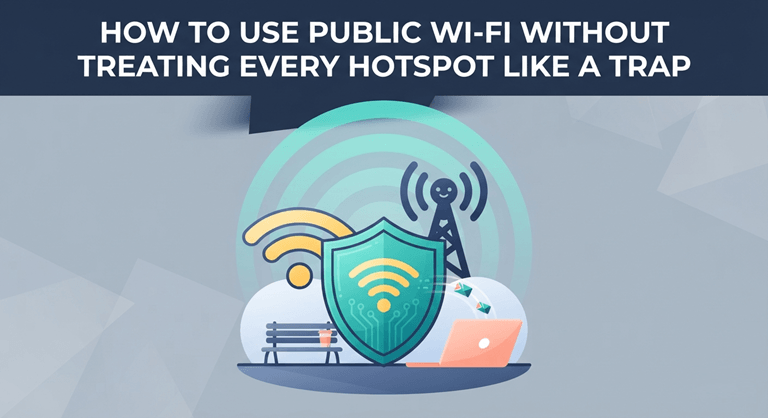
The Right Way to Use the Public Wi-Fi
No matter which option you pick, selecting a public network is never an easy choice. It’s an honest, more complex, and somewhat mundane choice, but one that’s still quite crucial. In this case, it is important to check the network, encrypt the traffic, restrict the information it shares, and avoid using the network for sensitive information when it doesn’t feel right.
These are habits that are more important than alarmist thoughts about the potential hacker in every coffee shop. Most of the public sessions are uneventful, but the tricky part is that an account, a document, or a work login will be exposed before anything looks wrong.
Start With the Network Name, Not the Signal Strength
The stronger the signal, the closer the signal is, but not the more legitimate. An attacker can set up a hotspot that shares a name with the network – like a café, hotel or airport – and wait for users to join. So, be sure to ask for the appropriate network name and whether there is a password or portal required.
Watch for two similar names that are almost the same. Also, you’ll need to turn off the automatic connection setting, as the information about the network may reconnect without any useful analysis.
Open hotspots are a given for the Cybersecurity and Infrastructure Security Agency’s public Wi-Fi guidance – which is exactly as it should be, but not as a show-stopper. Not all users who are connected to a network are trustworthy, just because they have a network password. It can be used to manage entry only. Then, HTTPS secures the flow of data between browsers and supported sites, and a VPN provides encryption of data on a wider path between your device and the VPN serve—thee value of various jobs overlaps.
Understand What Each Protection Actually Covers
Security tips become muddy when they are being touted as replacement tools; they’re not. HTTPS is a protocol that secures the links between a web browser and a website. VPNs establish a “tunnel” for device traffic passed through the VPN service, which is encrypted. When a password is leaked, multifactor authentication helps to secure access to the account. Updates fix software bugs that are identified.
But none of them checks to see if the invoice that you get in your email box is real. That’s the bit that still won’t get the memo.
| Protection | Main Job | Important Limit |
| HTTPS | Encrypts website traffic | Does not secure every app or prevent phishing |
| VPN | Encrypts routed network traffic | Shifts trust toward the VPN provider |
| MFA | Adds an account verification step | Weak methods can still be socially engineered |
| Updates | Fix known software weaknesses | Cannot correct unsafe user decisions |
Now, this change in trust must be examined in depth. Depending on the type of VPN service and protocol used, a VPN provider may be able to access the metadata of connections or manage traffic that passes out of their servers. Also, be sure to read through the privacy policy, ownership information, independent audits, app permissions, and cancellation terms.
Then look elsewhere in the list of providers for the ones with promises of anonymity; this often isn’t a technical promise, it’s a marketing one.
Use a Short Routine Before You Open Anything Important
This is because a repeatable checklist is better than improvisation, particularly when traveling or running from one meeting to another. The goal is not to ensure absolute safety but to minimize easily exposed opportunities for exposure before email, cloud storage, or work systems come into play.
Additionally, keep the sequence short enough to remember:
- Confirm the hotspot name with the venue.
- Turn off file sharing, AirDrop, and automatic joining.
- Enable the VPN before opening work apps.
- Check for HTTPS and heed certificate warnings.
- Prefer cellular data for banking or sensitive administration.
Then take it off the network and instruct the device to “forget” the network. The last step is an easy one to bypass. If the hotspot acted in an unusual manner, bounced over and over and/or showed certificate errors, check active account sessions.
Furthermore, it is impractical to change all passwords following each time the user visits the café, but sensible to do so after a credible warning and then to end all other sessions.
Know When the Best Move Is to Walk Away
There should be some signals that will terminate the session without any questions.
For example, the PIN is asked for on a payment card in an online portal, the browser reports a certificate mismatch, the network keeps dropping and reconnecting, or a familiar site suddenly requests some unusual recovery data. Otherwise, troubleshooting will be ineffective. Instead, you need to move away from cellular data, set up a secure personal hotspot, or wait to connect until the home network.
Safer Public Wi-Fi Comes from Layered, Ordinary Habits
There is no one magic bullet solution to public Wi-Fi, and it’s more about making a few small decisions. Verify the network, install the patch, use HTTPS, use a trusted VPN service if possible, use strong multifactor authentication, and only perform sensitive activities on a trusted network.
They don’t sound glamorous, but they are very doable. The important thing to remember here is the capability of each layer, the boundary of each layer, and when it is not worth taking the risk. This is a very real security feature.
Popular on OTW Right Now!


About The Author

Gagan Bhangu
Founder of otechworld.com and managing editor. He is a tech geek, web-developer, and blogger. He holds a master's degree in computer applications and making money online since 2015.