
How to Spot a Fake Profile Online: A 2026 Guide to Verifying Photos and Emails
Somewhere right now, someone is chatting with a person who doesn’t exist. Not metaphorically; the profile photo, the backstory, even the flirty texting style were generated in seconds by AI, and the person on the other end has no idea.
This is no longer uncommon. In 2026, McAfee research found that 25% of Americans have encountered a fake profile or an AI-generated bot while online dating. The Federal Trade Commission estimates that total losses from romance scams have exceeded $1.14 billion since 2023, and that’s just what’s been reported.
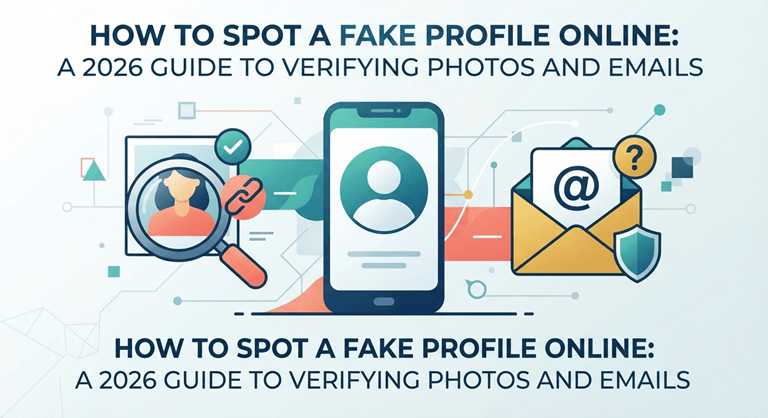
The scarier part is that the usual advice doesn’t hold up anymore. It was assumed that a human wrote the conversation, and you should trust your gut (instinct) and look for red flags (signs that something is wrong). A recent industry study reveals that the average American encounters about 2.6 deepfakes every day, and 60% say they’ve seen at least one deepfake photo or video in the past year. The matches may be cute, consistent, and well-photographed, but they aren’t necessarily matches to a real person anymore; they’re only matches to a well-trained model.
The good news: you don’t need to be a security researcher to catch most of this. Two quick checks, one on the photo, one on the contact info, catch a catcha large share of fakes before you’ve spent weeks building trust with someone who was never real to begin with.
Why “Trust but Verify” Is Now a Basic Skill
It’s not just a dating-app issue. It’s also a playbook that is used repeatedly in job postings that request up-front bank information, marketplace transactions where the buyer “mistakes” the amount or accidentally sends the wrong check, and LinkedIn messages from recruiters with a job that seems too good to be true, right down to the logo, only for them to send you the wrong bank account number.
Norton’s 2026 Insights Report revealed that one-third of online daters (64%) had been scammed so far. When broken down further, 36% claimed to be fooled by a photo scam and 35% by a catfish, which is a fake or stolen photo with an altered identity. Those two categories would cause more damage than nearly any others on the list of damages, and that’s why the first step is to look at the photo.
Where the Photos Actually Come From
Scam photos generally come from one of three places, and each leaves a different trace behind.
Stolen from a real person. Most classic catfishing scams involve simply stealing images from another person’s publicly available Instagram, Facebook, or dating profile, likely one with a large fan base, so you are always dealing with a brand new group of photos. The best version it catches is this one since the actual pictures are truly elsewhere on the web.
Generated from scratch. More and more, scammers avoid stealing and are creating a fake face using artificial intelligence, so there isn’t even an actual photo where it came from. Often this type of image will not return anything if you do a reverse search. It’s not common to find an adult with no photos of it online, and it’s active and photogenic.
Bought or scraped in bulk. So some operations buy up huge amounts of faces to perform fake-profile factories. If you search any of these, it can be attached to a variety of names on a variety of platforms; it’s a really easy sign that there is.
Knowing which of the three you’re likely dealing with changes how much weight to put on a “no results found.”
Step 1: Run the Photo Through a Reverse Face Search
Save the profile picture prior to responding to another message, and perform a reverse face search. This tool searches for the same image, or similar-looking images, elsewhere on the web.
Tools like TinFace’s face search are built for exactly this: upload a photo, and it scans for visually similar images across public sources, rather than trying to identify who the person “really” is. That is an important point: with a responsible search tool, you will be given information about where an image appeared, but not whether it is by a named person; consider this one piece of evidence, not a conclusion. If the profile has more than one photo, search one or two of them, as the scammer may have a good shot of the first and then be haphazard with the rest.
Step 2: Check the Email Address Before You Trust It
Most scams will eventually attempt to shift the conversation away from the dating site or marketplace to email or WhatsApp or a messaging app that the site or app can’t track. It’s time to take a moment to consider the address itself rather than the name that is on it.
A couple of things that may need a manual look: is the domain just recently registered, does it get close to a company’s name (support@arnazon-billing.com vs amazon.com), or even does the address appear to be auto-generated and not a real person’s choice?
If it’s more serious- “recruiter,” new business contact, a supplier you hadn’t known about before but have suddenly been contacted by- an email verification can confirm within a few seconds if the address is real, deliverable, and not a fake “throwaway” email account created for a one-shot scam. It uses the same underlying check (before wiring any money or sharing personal information with someone you don’t know): -is this a real address?- and it’s aimed at marketers who want to maintain their sender reputation.
Step 3: Build the Habits That Catch the Rest
Verification isn’t a one-time check; it’s a handful of habits that add up.
- Ask for a quick video call before anything financial comes up. Deepfake video is improving, but it’s still a much higher bar for a scammer to clear than a static photo.
- Never send money or gift cards to someone you haven’t met in person, no matter how convincing the emergency.
- Treat urgency as a flag. “Exclusive,” “invite-only,” and “act now” are pressure tactics as much as marketing ones.
- On the business side, confirm any last-minute change to payment or banking details through a second channel, a phone call to a known number, not a reply to the email that made the request. This one habit is one of the most effective defenses against business email compromise.
What These Checks Can’t Tell You
However, some things can never be guaranteed, and nothing of the sort should be used as an excuse for ‘snooping’ on a person who has not given you a legitimate concern. A reverse photo search cannot verify someone’s identity, and a clean search does not prove that a person is convinced of their identity — it just makes it more likely. These tools are there for your own safety, and this is the “this is what I’m allowed to do” of the terms of service of a reputable provider.
Quick Checklist
- Reverse search the profile picture (and another if available).
- Confirm the email/ contact address before sharing personal information.
- Request an actual video meeting before making any monetary discussion.
- Do not wire, wire transfer, or send gift cards to someone you don’t know
- Verify changes to payment details via an alternative means
- Do not use urgent or exclusive framing as a time constraint, but rather as a flag.
All take less than a few minutes, and all of them block the majority of scams that go on unchecked. For more everyday safety habits like these, oTechWorld’s tech tips and how-to guides are worth bookmarking.
Frequently Asked Questions
Is running a reverse photo search legal? Yes, you’re not accessing anyone’s personal accounts or data; it’s publicly visible photos versus publicly visible photos.
What if the search comes back with no matches? That doesn’t mean that the person is a real person. It simply doesn’t look for that image elsewhere; it’s a feature, not a bug. Don’t read it as a final result, but as a single piece of information.
Can scammers get around these checks? Highly developed ones can, particularly with 100% facial AI generation. This is why, rather than just one of them, a photo check with an email check, along with some basic habits, video calls, and no rush to send money, work better!
Does this only apply to dating apps? No. The same questions go for job offers, marketplace buyers and sellers, new business contacts, and unsolicited correspondence from “recruiters” or “investors.”
The Bottom Line
Humans may have invented the romance scam and fake supplier email, but AI made both shockingly cheap and believable to operate on a larger scale. But the defense has not been made any easier in return, though. A reverse photo check and an email check only take a few minutes and help you find a substantial percentage of what is out there. That’s a reasonable price to pay not to be a statistic in the next year.
Sources: McAfee 2026 Valentine’s Day Research; Federal Trade Commission romance scam data; Norton 2026 Insights Report: Artificial Intimacy; 2026 deepfake statistics via McAfee’s State of the Scamiverse.
Popular on OTW Right Now!


About The Author

Gagan Bhangu
Founder of otechworld.com and managing editor. He is a tech geek, web-developer, and blogger. He holds a master's degree in computer applications and making money online since 2015.